The Operational History and Final Patrol of USS Shark II SS-315
In the late autumn of 1943, the United States Navy aggressively expanded its undersea campaign across the Pacific Theater. To sever the Japanese Empire’s sea lines of communication, American naval doctrine demanded advanced fleet-type submarines capable of long-range, deep-penetration patrols in heavily contested waters. The transition to the Balao -class submarine design directly addressed earlier operational limitations—such as structural depth constraints and hull vulnerability under sustained depth-charge attack—by replacing mild structural steel with high-tensile steel (HTS). This engineering evolution provided the Silent Service with a deep-diving capital asset engineered to withstand severe anti-submarine countermeasures while penetrating heavily defended maritime corridors to destroy enemy combatants and merchant shipping.
The construction of USS Shark (SS-314) began at the yards of the Electric Boat Company in Groton, Connecticut. As part of the industrial mobilization of the U.S. Submarine Force, her keel was laid down and work progressed rapidly toward her launch on October 17, 1943. Following fitting-out, initial dock tests, and trial runs, Shark was formally commissioned into the United States Navy on February 14, 1944. Command of the new fleet submarine was entrusted to Commander Edward Noe Blakely, a seasoned submarine officer of the United States Naval Academy Class of 1934.
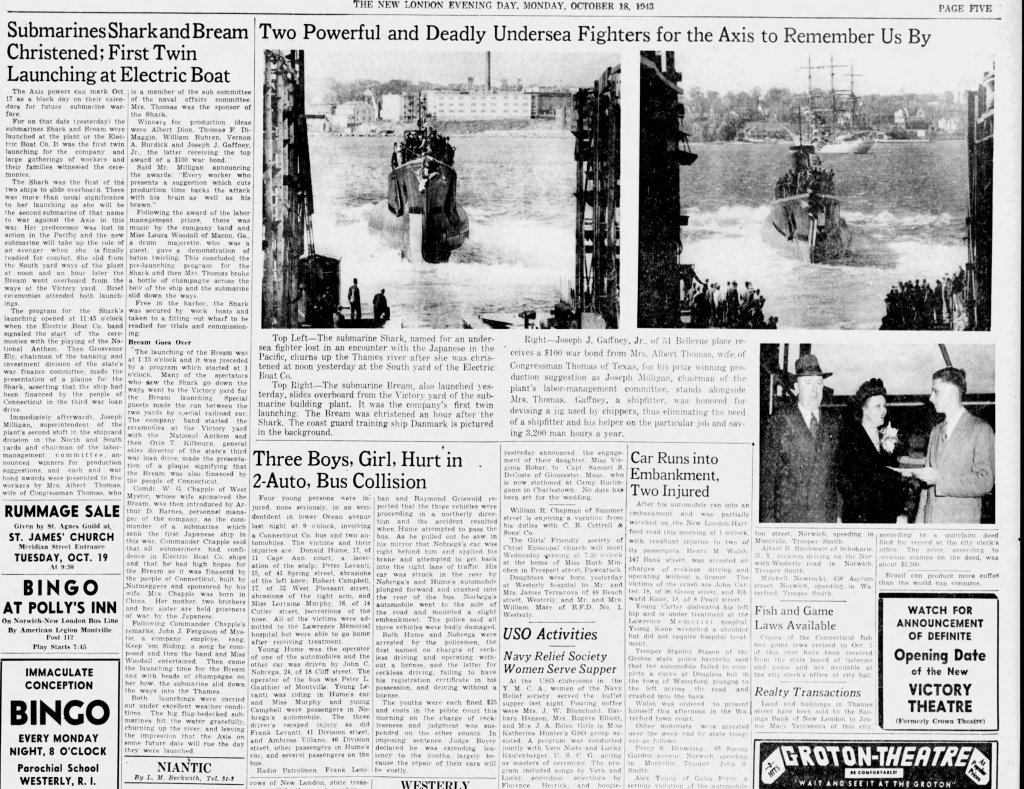
The structural adoption of the High-Tensile Steel pressure hull represented a major advancement in submarine survivability. By elevating the vessel’s operational test depth to 400 feet (with an ultimate structural yield depth exceeding 600 feet), Shark gained a broader vertical tactical envelope when subjected to depth-charge attacks by Imperial Japanese Navy (IJN) surface escorts and anti-submarine aircraft. This increased depth capability allowed the conning officer to maneuver beneath density gradients, bathythermal layers, and standard depth-charge fuse setting arrays, reducing acoustic signature transfer and dispersing explosive shockwaves during anti-submarine warfare (ASW) evasive actions.
Following her formal commissioning and initial equipment integration off the New England coastline, USS Shark prepared to depart the Atlantic coast to begin her operational training and integration phase at Pearl Harbor.
A Crew Prepared for War
By mid-1944, the Pacific submarine campaign had become the primary instrument of strategic sea denial against the Japanese Empire. Allied operational strategy focused on isolating the Japanese home islands by cutting off southern maritime supply corridors originating in Southeast Asia and the South Pacific—specifically shipments of crude oil, natural rubber, bauxite, iron ore, and food supplies. As Allied amphibious and carrier task forces advanced through the Marianas and prepared for the reoccupation of the Philippines, U.S. fleet submarines were deployed in coordinated blockades across essential oceanic choke points to prevent the reinforcement and resupply of isolated enemy garrisons.
Following her initial shakedown cruise off New London, Connecticut, USS Shark transited the Panama Canal, entered the Pacific Theater, and arrived at Pearl Harbor on April 24, 1944. Upon reaching Hawaiian waters, the vessel underwent intensive operational training. The ship’s company practiced dive routines, radar setup calibration, target angle calculations, submerged torpedo fire-control procedures, and simulated multi-vessel surface attacks to bring the ship to maximum combat effectiveness.
The command structure aboard Shark was established by her Commanding Officer, Commander Edward Noe Blakely, and her Executive Officer, Lieutenant Commander John D. Harper, Jr. (USNA Class of 1939). Blakely brought substantial combat experience to Shark, having served as Executive Officer aboard USS Tuna (SS-203) across six war patrols, including operations in the severe weather environment of the Aleutian Islands Campaign. Blakely had been awarded the Silver Star for gallantry aboard Tuna, where his composure, endurance, and fire-control assistance under ASW counterattacks proved critical to ship performance. His tactical approach directly influenced Shark ‘s training regimen and combat routines.
By mid-1944, the U.S. Submarine Force was routinely employing coordinated attack group tactics, commonly referred to as “wolfpacks.” Deploying in tactical units of three submarines helped offset individual radar line-of-sight limits, provided wider area coverage across transit lanes, and permitted multi-directional attacks against escorted merchant convoys, disrupting escort screen formations and maximizing torpedo distribution.
With operational training complete and command integration achieved, USS Shark was cleared to deploy on her initial combat war patrols in the Central Pacific.
The First Two War Patrols
Shark ‘s initial war patrols took place during the Allied Central Pacific offensive of mid-1944. U.S. fleet submarines performed two main operational roles: hunting merchant shipping along enemy supply lines and standing duty on lifeguard stations near targeted island strongholds to rescue downed Allied aviators during carrier strike operations. Shark departed on her First War Patrol on May 16, 1944, operating in waters west of the Mariana Islands as part of a coordinated attack group alongside USS Pintado (SS-387) and USS Pilotfish (SS-386). During this maiden patrol, Commander Blakely executed three torpedo attacks against enemy convoys despite anti-submarine surface escorts and aerial patrols. Shark torpedoed and sank four Japanese cargo vessels— Chiyo Maru , Katsukawa Maru , Tamahime Maru , and Takaoka Maru —totaling over 32,000 tons, while damaging an additional 5,600-ton freighter. Blakely maneuvered Shark to evade depth-charge counterattacks without sustaining damage, returning to Midway Island on June 17, 1944, for refit. For his leadership and tactical execution during this patrol, Commander Blakely was awarded the Navy Cross.
On July 10, 1944, Shark put to sea for her Second War Patrol, patrolling through the Volcano and Bonin Islands before taking up a designated lifeguard station off Iwo Jima to support carrier strike groups. On the afternoon of August 4, 1944, Shark conducted a surface rescue, retrieving two downed crewmen from USS Lexington (CV-16): aviator Lieutenant (j.g.) William S. Emerson and his gunner, Harvey.
LTJG Emerson’s personal journal provides a detailed primary record of daily life and routines aboard Shark :”So help me, these sub boys are the tops. Nothing is too good for you when you come aboard under our circumstances. We got a hot shower, clean dry clothes, cigarettes, coffee, hot soup, etc. All we had to do was name it, and we could have it… By the way, their food is the tops.”Emerson documented life aboard the submarine, describing shipboard mess culture featuring meals of roast chicken, mashed potatoes, and pineapple ice cream. He noted watchstanding under “darken ship” conditions illuminated by red lighting, rapid emergency dives prompted by Japanese aircraft (“fly-fly boys”), and the informal uniform code of shorts and T-shirts adopted by officers and crew alike. On August 6, Emerson recorded an air attack when Japanese “Hamps” or “Zeros” caught the submarine on the surface, forcing a rapid dive before three depth charges detonated close aboard (“WHAM! WHAM! WHAM!”) without causing structural damage. Emerson spent a month aboard Shark, which was followed by a two-week leave arranged by Commander Blakely for the submarine’s crew at the Royal Hawaiian Hotel in Pearl Harbor.
Having completed her lifeguard duties and returned her crew from shore leave, USS Shark was ordered to refit and prepare for deployment into the choke points of the Western Pacific.
Into Luzon Strait
By October 1944, the Luzon Strait had become one of the most critical choke points in the Pacific Theater. Positioned between Formosa and northern Luzon, this narrow body of water served as the main transit route for Imperial Japanese shipping moving between the home islands and occupied territories in Southeast Asia. Following the Allied invasion of the Philippines, the South China Sea became an active operational zone where U.S. Navy submarine wolfpacks maintained continuous surveillance to interdict troop transports and merchant shipping.USS Shark departed Pearl Harbor for her Third War Patrol on September 23, 1944. After refueling and staging at Saipan on October 3, she formed a coordinated attack group alongside USS Seadragon (SS-194) and USS Blackfish (SS-221) to patrol the Luzon Strait. On October 20, 1944, at 2340, Japanese Convoy MATA-30 departed Manila bound for Takao, Formosa. The convoy was composed of twelve merchantmen and auxiliary vessels: ● Arisan Maru (Freighter / POW Transport, 6,886 tons) ● Kimikawa Maru (Auxiliary Seaplane Tender, 6,863 tons) ● Kurasaki (Auxiliary Supply Ship / Kyuryokan , 2,371 tons) ● Kokuryu Maru (Passenger-Cargo Ship, 7,369 tons) ● Kikusui Maru (Freighter, ex-Dutch Iris , 936 tons) ● Tenshin Maru (Merchant Freighter, 6,250 tons bauxite payload) ● Shikisan Maru (Cargo Ship, 4,725 tons) ● Daiten Maru (Cargo Ship, 4,555 tons) ● Eiko Maru (Cargo Ship, 1,503 tons) ● Shinsei Maru No. 1 (Cargo Ship, 3,436 tons) ● Fuyukawa Maru (Cargo Ship, 8,781 tons) ● Ryofu Maru (Cargo Ship, 5,695 tons)The convoy was escorted by IJN destroyers Harukaze , Take , and Kuretake , alongside submarine chaser CH-20 .
On October 22, Shark sent a contact report stating she had visually located four large enemy vessels in position 20°28’N, 117°50’E while carrying a full load of torpedoes. Over the next 48 hours, multiple American submarines—including Sawfish (CDR Alan B. Banister), Snook (LCDR George H. Browne), Icefish (LCDR Richard W. Peterson), Drum (LCDR Maurice H. Rindskopf), Seadragon (CDR James H. Ashley), and Shark —converged on Convoy MATA-30.
The multi-submarine operational environment between October 22 and October 24 was fast-moving and complex. Operating under low-visibility nighttime conditions and evasive convoy maneuvers, multiple submarines conducted simultaneous periscope and radar tracking setups. Torpedo spreads fired from different positions led to overlapping detonations on target vessels, creating conflicting target claims in post-patrol reports. For instance, the sinking of Tenshin Maru at 0605 on October 24 involved simultaneous attack setups by both USS Snook and USS Shark, leading to shared historical attribution. Amidst this running battle, the auxiliary supply ship Kurasaki survived the wolfpack attacks intact; she was not sunk during the MATA-30 engagement, but was later torpedoed and sunk on November 15, 1944, by USS Raton (SS-270) off Western Luzon.
During these running engagements, USS Shark sent her final radio message on October 24 to USS Seadragon, reporting radar contact with a single freighter and stating she was moving in to attack. This communication set the stage for the tragic climax of the attack on Arisan Maru and the subsequent ASW engagement.
Arisan Maru and the Loss of Shark
Throughout World War II, the Imperial Japanese military routinely employed merchant vessels to transport Allied prisoners of war and forced laborers across occupied sea routes. These vessels, known as “Hellships,” operated without exterior markings, flags, or international symbols to indicate the presence of POWs. The decision to omit POW markings was standard Japanese military practice, presenting American submarine commanders with a difficult tactical situation: operating under Fleet directives to sink all Empire-bound shipping, they had no way to identify prisoner transports. At approximately 1730 (JST) on October 24, 1944, in the Bashi Strait / South China Sea, a submarine—determined by post-war historical analysis to be USS Shark —torpedoed the 6,886-ton freighter Arisan Maru. Unbeknownst to the submarine crew, Arisan Maru held 1,782 American prisoners of war alongside Japanese military personnel and crew. The torpedo struck aft of midships, causing the vessel to split in two and sink. The sinking resulted in a heavy loss of life, killing 1,773 American POWs. Only nine POWs survived the ordeal, five of whom managed to reach the Chinese coast in a lifeboat to report the conditions aboard the transport.
Historian’s Note on Navigational Coordinates: Wartime action logs and post-war records display minor variances in geographic reporting. United States Navy casualty records and Find a Grave registries document the sinking of Arisan Maru at 20°46’N, 118°18’E. The Japanese tabular movement record for IJN Kurasaki lists the loss at 20°00’N, 118°44’E, while IJN operational reports place Harukaze ‘s depth-charge counterattack nearby at 20°41’N, 118°27’E. These differences reflect wartime plot variations between dead-reckoning navigational calculations and post-war joint evaluations.
Following the strike on Arisan Maru , IJN escorts initiated an aggressive anti-submarine counterattack. Japanese postwar records show that the destroyer Harukaze (supported by Take ) detected a submerged contact on sonar in the Bashi Strait at 20°41’N, 118°27’E. Harukaze executed multiple depth-charge runs. After losing and re-establishing sonar contact, the destroyer dropped a final barrage of 17 depth charges. Physical evidence rose to the surface—including heavy oil slicks, air bubbles, items of clothing, and cork insulation material—confirming the submarine’s destruction.
When subsequent efforts by Seadragon and shore bases to establish radio contact failed, Shark was officially designated as “presumed lost” on November 27, 1944. On November 8, 1945, the Navy Department issued official death declarations for all 87 crew members. Standing Fleet instructions directed U.S. submarines to search for Allied survivors in the water following sinkings of Empire-bound vessels. Naval historians hypothesize that Shark may have sustained damage or been delayed on the surface while attempting to search for and rescue survivors from the water, leaving her vulnerable to Harukaze ‘s counterattack.
This tragic engagement ended the operational history of Shark and brings attention to the biographical tributes of the men who served aboard her.
The Men of Shark
The tactical capability and internal cohesion of a fleet submarine depended on the technical skill, leadership, and personal trust among its officers and crew. Operating a combat submarine required precise coordination and shared commitment across all engineering and operational departments.
Commander Edward Noe Blakely, USN — Commanding Officer
Born on May 17, 1912, in Philadelphia, Pennsylvania, Edward Noe Blakely was the son of Dillwyn Parrish Blakely and Florence Noe Blakely. Raised in Norristown, Pennsylvania, his father passed away in 1927. Edward attended Norristown High School and Severn Preparatory School before receiving his appointment to the United States Naval Academy in 1930. Graduating with the Class of 1934, “Eddie” participated in plebe football, plebe track, and varsity track. His early officer service included duty on USS Marblehead (1934–1936), communications staff duty on USS Pennsylvania (1936–1937), and instruction at Submarine Base New London. He served aboard USS S-28 (SS-133) from 1938 to 1941, before joining USS Tuna (SS-203) as Executive Officer, where he was awarded the Silver Star over six war patrols in the Aleutians and South Pacific.
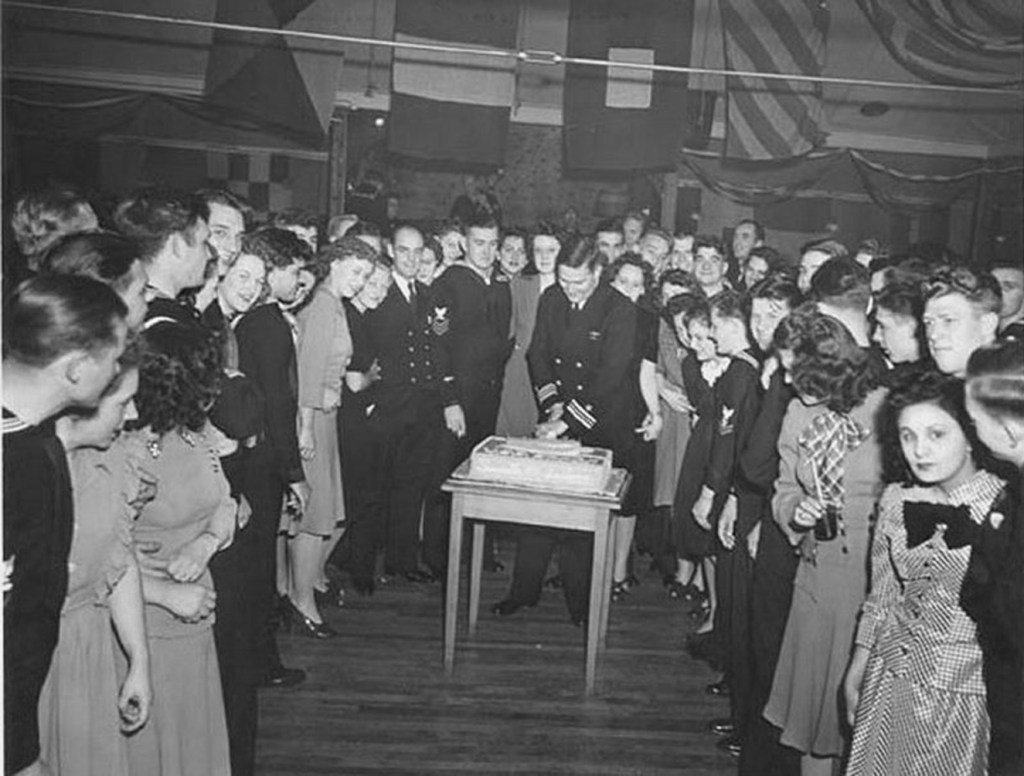
Polly’s Inn burned down (total loss) during the night of 5 March, 1947. See the attached newspaper article (Front page, bottom right under FLASHES!). (NAVSOURCE)
Blakely assumed command of USS Shark upon her commissioning in February 1944, earning the Navy Cross for her First War Patrol. Following her loss, he was posthumously awarded the Purple Heart and a Gold Star in lieu of a second Navy Cross award. (In United States Navy decoration terminology, a “Gold Star” signifies a second award of a previously conferred decoration—in Blakely’s case, a second Navy Cross.) He was survived by his wife, Virginia Sampson Blakely, and his two-year-old son, Edward Jr.
Lieutenant Commander John D. Harper, Jr., USN — Executive Officer
Serving as second-in-command, LCDR Harper (USNA Class of 1939) managed shipboard routine, navigation, and torpedo fire-control calculations. Working alongside Commander Blakely in the conning tower during combat engagements, Harper was responsible for integrating periscope tracking data into attack solutions. He died alongside his commanding officer and crew in the Bashi Strait on October 24, 1944.
Chief Motor Machinist’s Mate Lloyd Bernhard Schuermann, USNR
Born on January 13, 1915, in Missouri to Walter Henry and Rose Mueller Schuermann of St. Louis, Chief Schuermann (Service No. 3370523) was responsible for the submarine’s propulsion plant. Overseeing the operational reliability of the four General Motors 16-278A main diesel engines and auxiliary machinery, Schuermann’s technical work ensured the boat maintained surface pursuit speeds and smooth power transitions during crash dives. He was killed in action on October 24, 1944.
The sacrifice of the 87 officers and enlisted men lost aboard USS Shark leads directly into the quantitative assessment of her combat record and historical memory.
Combat Record and Remembrance
Post-war analysis of submarine warfare metrics often reveals differences between wartime operational claims and confirmed vessel sinkings. During hostilities, periscope observations, explosive detonations, and visual sinkings were logged under difficult tactical conditions. Post-war historical synthesis—conducted by bodies such as the Joint Army-Navy Assessment Committee (JANAC)—reconciled wartime claims against captured Imperial Japanese official records, transport logs, and decrypted message traffic.
For her service across three war patrols, USS Shark (SS-314) was awarded three battle stars for World War II service. Her officers and crew received individual decorations, including Commander Blakely’s Navy Cross, Gold Star (second Navy Cross), Silver Star, and Purple Heart. The physical memory of USS Shark and her 87 crew members is preserved at the Manila American Cemetery and Memorial in Taguig, National Capital Region, Philippines, where their names are carved upon the Tablets of the Missing. Digital and institutional tributes include the U.S. Naval Academy Virtual Memorial Hall (supported by the Class of 1954), Fold3 historical archives, Find a Grave memorial registries, and the nationwide Stories Behind the Stars initiative.
At a Glance: USS Shark (SS-314)
| Class | Balao-class fleet submarine |
| Builder | Electric Boat Company, Groton, Connecticut |
| Launched | October 17, 1943 |
| Commissioned | February 14, 1944 |
| Commanding officer | Commander Edward N. Blakely |
| Propulsion | Four General Motors 16-278A diesels; electric motors |
| Torpedo tubes | Ten (six forward, four aft); 24 torpedoes |
| War patrols | Three |
| Lost | October 24, 1944, Luzon Strait |
| Crew lost | 87 |
Chronology
October 17, 1943 Launched at Groton, Connecticut
February 14, 1944 Commissioned under Commander Edward N. Blakely
April 24, 1944 Arrived at Pearl Harbor
May 16–June 17, 1944 First war patrol, west of the Marianas; returned to Midway
July 10–August 29, 1944 Second war patrol, Volcano and Bonin Islands; lifeguard duty
August 4, 1944 Rescued two USS Lexington airmen off Iwo Jima
September 23, 1944 Departed on third war patrol
October 3, 1944 Staged at Saipan
October 22, 1944 Reported contact with four enemy vessels
October 24, 1944 Final reported engagement and loss of Shark
November 27, 1944 Declared presumed lost
November 8, 1945 Official death declarations for the 87 crew members


Leave a Reply