Introduction: From Sail to Steel
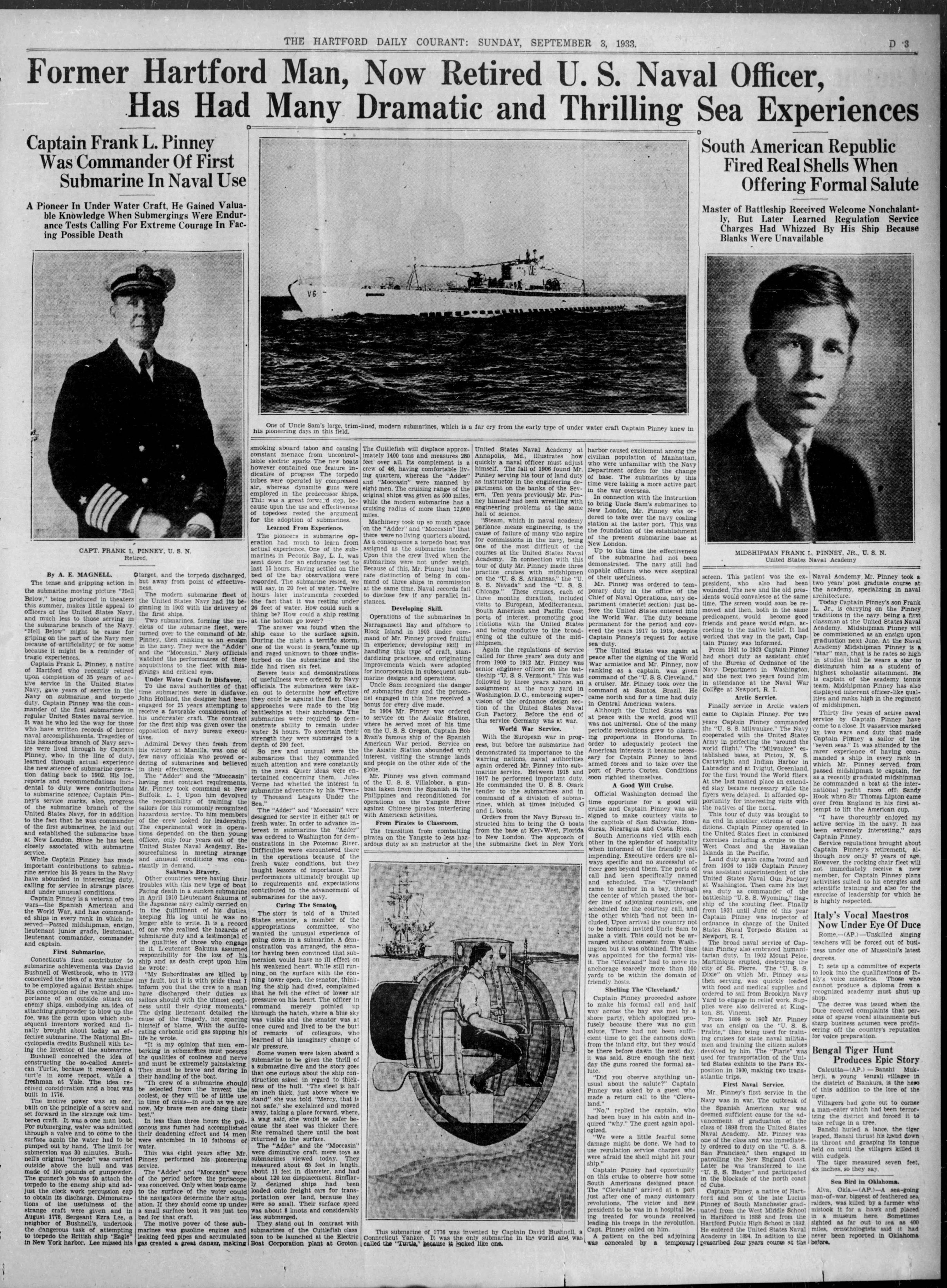
Frank Lucius Pinney, Sr. began his distinguished naval career during a period of massive transition, witnessing the United States Navy systematically replace its wooden sail-powered vessels with armored steel steamships. He first entered the national spotlight for his extraordinary bravery during the Apia cyclone in Samoa on March 15–16, 1889, where the wooden steam-frigate USS Trenton was destroyed. For his conspicuous gallantry in saving lives and assisting in the preservation of his shipmates during the wreck of the Trenton, a special Act of Congress appointed him to the rank of Ensign.
This early recognition established Pinney as a cool-headed and courageous officer under extreme duress. He subsequently served on active duty during the Spanish-American War in 1898, where his actions earned him advancements in rank for eminent and conspicuous conduct in battle, as well as the Specially Meritorious Medal. His operational horizon expanded further during the Philippine-American War and the subsequent Peking Relief Expedition (the Boxer Rebellion) in 1900, where he was repeatedly cited for bravery and advanced in grade for distinguished battlefield leadership. These intense, high-stakes operational experiences prepared him for the complex technical and administrative challenges of implementing a completely new form of naval warfare: the submarine torpedo boat.
Establishing the Foundation: New Suffolk Acceptance Trials
At the dawn of the twentieth century, the United States Navy formally authorized the construction of its first class of standardized submersibles, known as the Plunger-class (or A-class). These vessels, designed by pioneer John P. Holland, were built under contract by Lewis Nixon’s Crescent Shipyard in Elizabethport, New Jersey. To ensure these highly experimental craft could be successfully tested and integrated into the fleet, the Navy assigned highly competent technical officers to supervise their final fitting out and operational trials.
Then-Ensign Pinney, Sr. was ordered to New Suffolk, Long Island, to oversee the competitive and critical final acceptance trials of the submarine torpedo boats Adder (Submarine Torpedo Boat No. 3) and Moccasin (Submarine Torpedo Boat No. 5). To support these trials, Pinney was placed in command of the torpedo boat USS Dahlgren (Torpedo Boat No. 9) on November 19, 1902. Under his command, the Dahlgren served as the station ship at New Suffolk, acting as a crucial operational platform and tender for the experimental submarines during their final competitive trials. Pinney operated the Dahlgren in this critical support role until late October 1903, establishing the logistical baseline for early submarine trials.
Commissioning the Pioneers
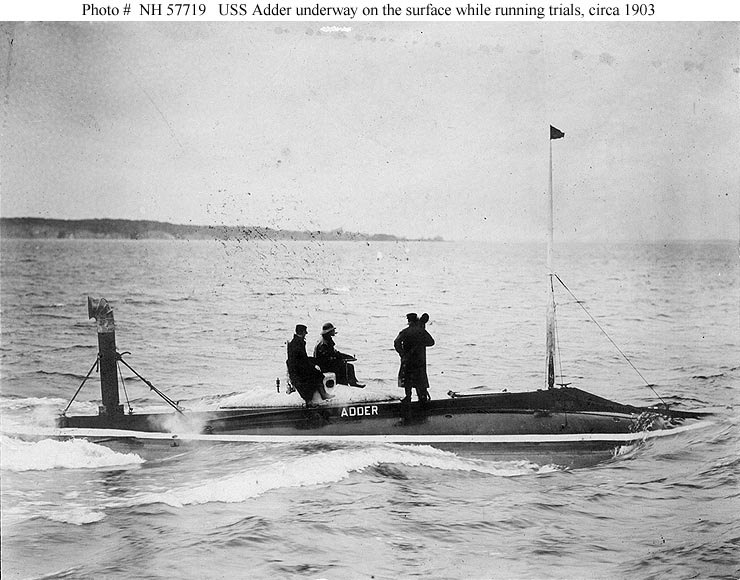
In January 1903, Pinney, Sr. formally commissioned both the USS Adder and the USS Moccasin, making naval history by assuming command as the first official commanding officer of these pioneer submersibles. He formally commissioned the USS Adder on January 12, 1903, followed by the USS Moccasin on January 17, 1903.
Operating these early submersibles required immense technical skill and physical courage [905]. The Plunger-class vessels were remarkably diminutive and technologically primitive compared to later designs, as illustrated by their core technical specifications:
| Technical Parameter | Specification Details for Plunger-Class (Adder / Moccasin) |
|---|---|
| Displacement | 105 tons (surfaced) / 123 tons (submerged) [906] |
| Length | 63 feet 10 inches [11, 906] |
| Beam | 11 feet 11 inches [11, 906] |
| Draft | 10 feet 7 inches [11, 906] |
| Surfaced Speed | 8 knots (powered by a single 180 horsepower gasoline engine) [11, 906] |
| Submerged Speed | 7 knots (powered by a single 150 horsepower electric motor) [11, 906] |
| Crew Complement | 7 officers and enlisted men [11, 906] |
| Maximum Operating Depth | 19 meters (approximately 62 feet) [906] |
| Primary Armament | 1 x 18-inch (45 cm) bow torpedo tube; capacity for 3 to 5 torpedoes [11, 906] |
The physical realities of these vessels were fraught with danger. Propelled by primitive gasoline engines on the surface and early lead-acid battery designs submerged, the vessels were highly volatile. Pinney and his crew constantly battled life-threatening conditions, including internal gasoline leaks, electrical fires, and sudden, volatile losses of depth control. Furthermore, reloading the single 18-inch bow torpedo tube required manual breech-loading in highly confined spaces, utilizing heavy wooden skids that slid across the cramped deck.
The Birth of the “Craft Command” Philosophy
It was in this hazardous, high-stakes operational environment that Pinney, Sr. became a strong advocate for what he termed “craft command.“ He asserted that the highly unique, technical, and unpredictable nature of submersibles required a fundamental departure from the rigid, centralized command structures of traditional surface warships.
Instead, the “craft command” philosophy advocated for:
- Decentralized Decision-Making: Giving junior officers on the spot the authority to make critical tactical and mechanical decisions based on their immediate operational environment.
- Technical Self-Reliance: Requiring every member of the small crew to have an intimate, hands-on knowledge of their vessel’s technical and physical boundaries.
- Junior Officer Autonomy: Fostering a professional culture that valued technical expertise over mere administrative hierarchy.
This operational philosophy proved essential to the professionalization of the early submarine service [905]. By advocating for decentralized command, Pinney, Sr. helped foster a distinct naval subculture of technical self-reliance that defined the identity and command structure of the United States Navy’s submarine force for the next century.
Strategic Deployment to the Asiatic Station
Initially, the Navy kept the Plunger-class submarines concentrated at the Naval Torpedo Station in Newport, Rhode Island, where Pinney utilized them for localized training, tactical experimentation, and experimental torpedo testing. Following these initial runs, the vessels were assigned to the Reserve Torpedo Flotilla at Norfolk in 1904.
As geopolitical tensions rose in the Pacific, the Navy decided to deploy these submersibles to the Philippines to bolster the defense of vital deep-water harbors like Manila Bay and Subic Bay. Because the tiny Adder and Moccasin lacked the fuel capacity, range, and sea-keeping abilities to cross the Pacific Ocean under their own power, they had to be transported as deck cargo.
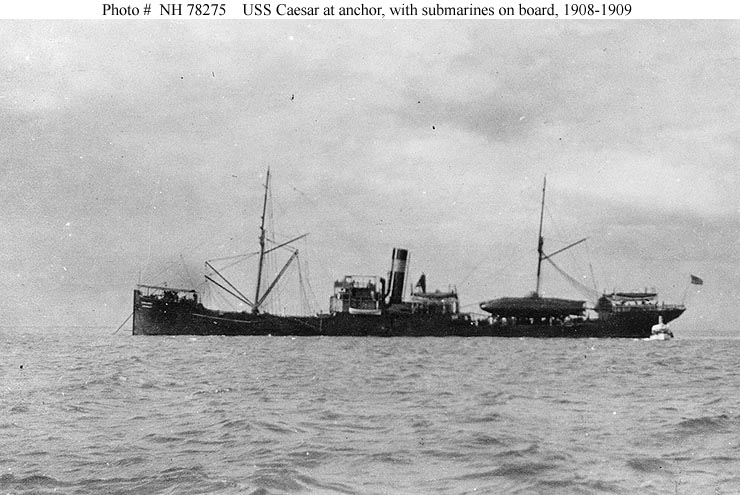
In July 1909, both submarines were decommissioned, secured on wooden blocks, and loaded onto the forward well deck of the collier USS Caesar. The Caesar arrived at Olongapo in October 1909, where the submersibles were hoisted back into the water . Recommissioned on February 10, 1910, they were assigned to the First Submarine Division of the Asiatic Torpedo Fleet based in the Manila area.
Under a standardized Navy renaming initiative on November 17, 1911, Adder was redesignated A-2 and Moccasin became A-4. Under Pinney’s conceptual framework, these early submersibles established a persistent defensive presence in the Philippines. During World War I, A-2 and A-4 conducted active defensive patrols, guarding the strategic entrance to Manila Bay and navigating the waters around the island fortress of Corregidor to deter potential hostile naval raids.
Strategic Anti-Submarine Warfare and World War I Command
The onset of World War I required Captain Pinney, Sr.’s technical expertise on a broader administrative and strategic scale. During the war, he commanded an active division of submarines within the Atlantic Fleet, managing the logistics, training, and tactical deployment of larger, diesel-powered vessels designed for open-ocean operations.
His responsibilities expanded to include temporary duty in the Office of the Chief of Naval Operations in Washington, D.C., followed by a strategic posting to London. In London, he served directly with the Commander of United States Naval Forces in European Waters. In this capacity, he coordinated Allied anti-submarine warfare doctrines and collaborated closely with the British Royal Navy to combat the German U-boat threat, applying his deep understanding of underwater operations to counter hostile submarine tactics.
Interwar Technical Leadership at the Newport Torpedo Station
Following the armistice of 1918, Pinney, Sr. transitioned from operational sea commands, which included a highly successful tour commanding the battleship USS Wyoming, back to his core specialty of underwater ordnance. Succeeding Captain Joseph R. Defrees, Pinney assumed command of the Naval Torpedo Station at Newport, Rhode Island, serving as the Inspector of Ordnance in charge .
The Newport Torpedo Station was the sole research, development, and manufacturing hub for the Navy’s underwater weapons. During his tenure, which lasted until 1933, Pinney navigated complex interwar budget constraints and bureaucratic obstacles to push for vital advancements in underwater weapons systems. He prioritized and oversaw technical modernizations in:
- Torpedo Guidance Systems: Advancing the precision and reliability of torpedo trajectories.
- Hydrostatic Depth Controls: Improving the depth-keeping abilities of underwater weapons.
- Warhead Chemistry: Developing high-explosive chemistry for increased military effectiveness.
- Precision Manufacturing: Ensuring that the station’s civilian and military labor forces maintained highly rigorous tolerances in manufacturing.
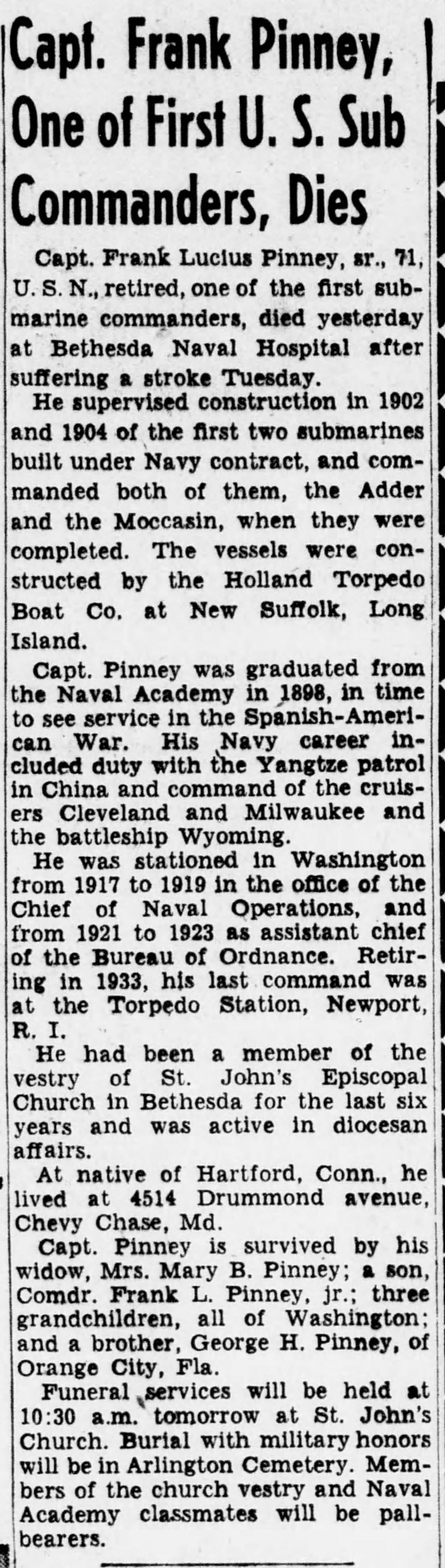
Pinney’s fair administrative policies and technical foresight made him highly respected by his workforce. Upon his retirement in 1933, where he was succeeded by Captain Harvey L. Delano, the civilian labor force and the Metal Trades Council presented Pinney with an engrossed copy of a resolution praising his administrative fairness, technical vision, and dedication to the welfare of the workforce.
Legacy
Captain Frank Lucius Pinney, Sr. passed away in December 1945. He lived to see the underwater weapons systems, administrative structures, and operational doctrines he had pioneered guide the United States Navy through the unprecedented challenges of World War II.
The early operational lessons learned by Pinney aboard the Adder and Moccasin, such as managing high-pressure air systems, sealing hulls against extreme water pressure, and stabilizing submerged vessels, formed the engineering foundation of the modern submarine force. His multi-generational legacy was further carried on by his son, Rear Admiral Frank L. Pinney, Jr., who later served as the Deputy Director of the Fleet Ballistic Missile (Polaris) Program. From gasoline-powered coastal submersibles to global strategic nuclear deterrence, Pinney, Sr.’s courage, technical foresight, and formulation of “craft command” permanently shaped the identity and capabilities of the United States Navy’s submarine force.
Bibliography
Naval History and Heritage Command (NHHC) Records
- Naval History and Heritage Command. “A-4 (Submarine Torpedo Boat No. 5).” Dictionary of American Naval Fighting Ships. Last modified August 31, 2016. https://www.history.navy.mil/research/histories/ship-histories/danfs/a/a-4.html.
- Naval History and Heritage Command. “Dahlgren I (Torpedo Boat No. 9).” Dictionary of American Naval Fighting Ships. Accessed August 12, 2026. https://www.history.navy.mil/research/histories/ship-histories/danfs/d/dahlgren-i.html.
- Naval History and Heritage Command. “Topeka II (CL-67).” Dictionary of American Naval Fighting Ships. Last modified July 6, 2022. https://www.history.navy.mil/research/histories/ship-histories/danfs/t/topeka-cl-67.html.
- Naval History and Heritage Command. “UA 01.08 RADM Frank L. Pinney, Jr. Collection.” photographic Archives. Accessed August 12, 2026. https://www.history.navy.mil/our-collections/photography/alphabetical—donations0/p/ua-01-08-radm-frank-l–pinney–jr–collection.html.
Official U.S. Navy Registers
- United States Navy Department. Register of the Commissioned and Warrant Officers of the United States Navy and Marine Corps. Washington, DC: Government Printing Office, 1925. HyperWar Foundation / Ibiblio. https://www.ibiblio.org/hyperwar/AMH/USN/Naval_Registers/1925.pdf.
- United States Navy Department. Register of the Commissioned and Warrant Officers of the United States Navy and Marine Corps. Washington, DC: Government Printing Office, January 1, 1928. Marine Corps Historical Library. https://www.usmcu.edu/Portals/218/HD/Lineal%20Lists/1928.pdf.
Historical Monographs and Compilations
- “The Pinney Dynasty and the Century of Undersea Warfare: From Plunger-Class Submersibles to the Fleet Ballistic Missile (Polaris) Program.” Historical Monograph. Accessed August 12, 2026.
Military and Ship History Databases
- Military Times. “Frank Pinney.” Hall of Valor: Medal of Honor, Silver Star, U.S. Military Awards. Accessed August 12, 2026. https://valor.militarytimes.com/recipient/recipient-305826/.
- NavSource Naval History. “Destroyer Photo Index DD-709 USS HUGH PURVIS.” Last modified September 26, 2022. http://www.navsource.net/archives/05/709.htm.
- USS Topeka CLG 8 Association. “Captain Frank L. Pinney.” Accessed August 12, 2026. https://usstopekaclg8.org/History/Recom/Pinney.htm.
- USS Topeka CLG 8 Association. “Captain Frank Pinney.” Accessed August 12, 2026. https://www.usstopekaclg8.org/Shipmates/Departments/CO’s/05_CaptPinney.htm.
- USS Topeka CLG 8 Association. The Plainsman, Vol. 1, No. 1. “Navy Missile Expert Assumes Command of New Topeka.” Accessed August 12, 2026. http://www.usstopekaclg8.org/History/Plainsman/Vol1_No1/ThePlainsman01.html.
Collaborative Reference Wikis
- Military Wiki. “USS Adder (SS-3).” Fandom. Accessed August 12, 2026. https://military-history.fandom.com/wiki/USS_Adder_(SS-3).
- Military Wiki. “USS Moccasin (SS-5).” Fandom. Accessed August 12, 2026. https://military-history.fandom.com/wiki/USS_Moccasin_(SS-5).
- Wikipedia contributors. “A-2 (U-Boot).” Wikipedia, Die freie Enzyklopädie. Last modified April 24, 2025. https://de.wikipedia.org/wiki/A-2_(U-Boot).
Transcription of the article from the Hartford Courant, August 12, 1933


Leave a comment