The USS Dace (SS-247) represents one of the most storied combat records in the history of the United States Navy’s “Silent Service.” A Gato-class fleet submarine, the Dace distinguished herself as a premier instrument of undersea denial during World War II, earning seven battle stars and the prestigious Navy Unit Commendation. Her operational history is characterized by a high degree of tactical versatility, ranging from aggressive surface gun actions and the destruction of heavy cruisers to specialized commando insertions in enemy territory.
The vessel’s career serves as a historical microcosm for the evolution of American submarine warfare. Her journey reflects the broader transition of the U.S. Submarine Force: originating as a raw, mass-produced WWII fleet combatant and evolving into a specialized Cold War training and anti-submarine warfare (ASW) platform. Through technical modernization and international cooperation, the Dace helped bridge the gap between the era of unrestricted undersea commerce raiding and the sophisticated sonar-driven environment of the NATO alliance.
In the annals of naval history, the most celebrated vessels are often those with the longest lists of enemy ships sunk. However, the true strength of a naval force frequently rests upon the less decorated workhorses that provide the essential foundation for victory. The USS R-13 (SS-90) was exactly such a vessel. An R-1-class coastal defense submarine, she served as the critical “bridge” between the experimental, often unreliable underwater designs of the earlier O-class and the sophisticated fleet boats that dominated the Pacific in World War II.
Over a career spanning 26 years, the R-13 functioned not as a primary combatant, but as a vital laboratory for tactical development and a premier classroom for the men who would eventually lead the “Silent Service.” Her service can be defined by three primary phases:
Pacific Tactical Testing: A decade-long deployment in the Hawaiian Territory developing submarine doctrine and fleet integration.
Atlantic Training: A tenure at the Submarine School in New London, Connecticut, forging the skills of future wartime commanders.
World War II Coastal Defense: Active wartime service protecting vital shipping lanes and perfecting American Anti-Submarine Warfare (ASW) tactics.
Technical DNA: Specifications of the R-1 Class
The R-class represented a major evolutionary step in American submarine technology, prioritizing improved habitability and mechanical reliability over its predecessors. The R-13 was a robust platform designed to operate in littoral waters and withstand the pressures of a 200-foot test depth.
Physical and Displacement Specifications
Characteristic
Measurement
Displacement (Surfaced)
569 – 574 long tons
Displacement (Submerged)
680 – 685 long tons
Length Overall
186 feet 2 inches
Beam
18 feet
Mean Draft
14 feet 6 inches to 15 feet 6 inches
Test Depth
200 feet
Propulsion and Engineering
The R-13 utilized a “Dual-System” propulsion arrangement, which was the standard for diesel-electric boats of her era. However, the specific machinery selected for this class often drew scrutiny from contemporary naval engineers.
NELSECO Diesel Engines: Two New London Ship and Engine Company 6-EB-14 engines provided 440 brake horsepower each for surface operations and battery charging. These engines were often viewed with skepticism due to their mechanical complexity and significant vibration issues.
Electro-Dynamic Company Motors: Two electric motors, each rated at 467 horsepower, provided propulsion while submerged, drawing power from two 60-cell storage batteries.
A unique design feature of the R-class allowed for the loading of fuel into the main ballast tanks. This specialized configuration could extend the vessel’s standard range of 4,700 nautical miles to an impressive 7,000 nautical miles, significantly increasing her strategic reach for long-range transits.
Offensive Capabilities
The ship’s armament was designed for both underwater and surface engagements:
Bow Torpedo Tubes: Four 21-inch (533 mm) tubes with a total capacity of eight torpedoes (four in the tubes and four reloads).
Deck Gun: One 3-inch/50-caliber gun mounted on the deck for surface combat against small craft or disabled targets.
Origins and Early Service (1918–1920)
The R-13 was born out of the Navy’s buildup during the First World War. She was constructed by the Fore River Shipbuilding Company in Quincy, Massachusetts. Her keel was laid down on March 27, 1918, with the total cost for the hull and machinery reaching $614,641.53.
She was launched on August 27, 1919, sponsored by Miss Fanny Bemis Chandler. On October 17, 1919, the vessel was officially commissioned with Lieutenant Commander Walter E. Boyle in command. Following commissioning, the R-13 conducted an intensive shakedown period and training patrols in the waters off New England and Bermuda to calibrate her systems and train her initial complement of 2 officers and 27 enlisted men.
The Pacific Laboratory: Tactical Development (1920–1930)
In 1920, the R-13 transited the Panama Canal, where she was often observed with a distinctive large white star recognition symbol on her fairwater. On July 17, 1920, she received the official hull designation “SS-90.” She arrived at Pearl Harbor on September 6, 1920, beginning a nine-year tenure in the Hawaiian Territory.
During this decade, the R-13 served as an indispensable platform for tactical development. She was a frequent participant in “Fleet Problems”—large-scale naval exercises that tested submarine stealth and coordinated attacks. These simulations included specific scenarios such as attacks on the Panama Canal, the defense of the Hawaiian Islands, and fleet engagements in the open ocean.
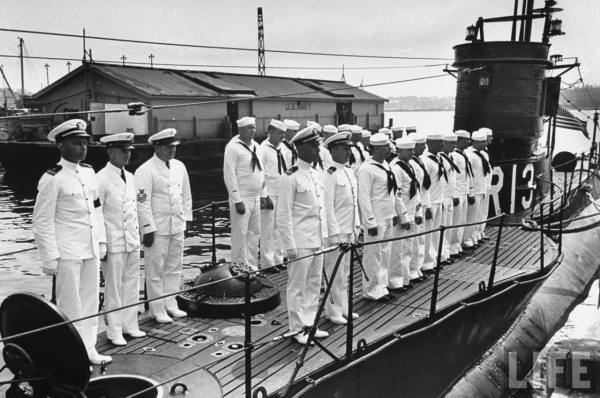
R-13 (SS-90), returning to port. Circa 1930’s. Courtesy of John Hummel & ussubvetsofwwii.org. (NAVSOURCE.NET)
However, this service came with a significant mechanical and human toll. Operating in tropical environments without modern air conditioning or habitability features meant the crew endured extreme heat and humidity. These challenges provided the Navy with critical data, eventually leading to the prioritization of better living conditions and more robust engineering in future fleet boat designs.
The School Ship: Forging WWII Legends (1931–1941)
Returning to New London on February 9, 1931, the R-13 began what was arguably her most impactful mission: serving as a primary training vessel for the Submarine School. For a decade, the boat served as a stable platform where thousands of sailors and officers mastered the fundamental “manual” of submarine operations.
Future WWII Heroes
The R-13 served as the “junior varsity” for several legendary commanders who would later earn multiple Navy Crosses in the Pacific:
Glynn R. Donaho: Served as Navigator from August 1934 to June 1935; he later became one of the most decorated submarine commanders in U.S. history.
Mannert L. Abele: Took command of R-13 in February 1937; he later commanded the USS Grunion (SS-216) and was killed in action after sinking three Japanese destroyers in a single day.
July 5, 1943 The Herald News (MA)
This training mission provided the practical environment for mastering periscope techniques, diving procedures, and torpedo maintenance—skills that would prove foundational for the submarine force during the coming war.
Wartime Vigilance: Key West and the Battle of the Atlantic (1941–1945)
In May 1941, the R-13 relocated to Key West, Florida. While newer fleet boats were deployed to the Pacific, the R-13 was tasked with protecting the strategic waterways of the Gulf of Mexico, the Florida Straits, and the Yucatan Channel. These lanes were vital for the transport of oil and bauxite required for the American war effort.
During this high-stakes period, the R-13 was commanded by Antone R. Gallaher (February 1942 to April 1943), who would later command the USS Bang (SS-385) and earn four Navy Crosses.
Beyond patrols, her most grueling wartime task was serving as a sonar target for the Fleet Sound School at Key West and Port Everglades.
The submarine spent countless hours submerged to allow surface crews to practice detection.
This “live” target practice helped American destroyer crews perfect the Anti-Submarine Warfare (ASW) tactics used to defeat the German U-boat threat.
The boat maintained a high operational tempo despite her advancing age, ensuring that surface forces were combat-ready.
Final Voyage and Operational Legacy
The R-13 was decommissioned on September 14, 1945, shortly after the cessation of hostilities. She was struck from the Navy list on October 11, 1945, and sold for scrap to Macy O. Scott on March 13, 1946.
Though the USS R-13 never fired a torpedo in an engagement, her operational legacy is undeniable. The institutional knowledge gained through her technical trials and the thousands of personnel trained within her hull were the silent pillars upon which the Navy built its eventual victory. She remains a testament to the essential role of the training and coastal fleets in the architecture of national defense.