
On the morning of September 7, 1944, USS Sealion slipped away from Saipan and headed west.
She had come into Tanapag Harbor only two days earlier. The pause had been brief. Fuel tanks were topped off, minor repairs completed, and fresh torpedoes brought aboard. Fifteen Mark 14-3A torpedoes came from the submarine tender Holland, while Billfish supplied another eight Mark 18-1 electric torpedoes. By the morning of the seventh, Sealion was ready to return to the war.
At 0650 she got underway.
Her orders were to rejoin the coordinated attack group known as “Ben’s Busters.” The group consisted of Sealion, USS Growler, and USS Pampanito. American submarines had increasingly begun operating in these small coordinated groups, spreading themselves across the likely routes of Japanese shipping and sharing contact information once somebody found something worth attacking.
At 1155, Sealion entered the safety lane west of Saipan. Her escort was released.
From there, she was on her own.
The next several days were mostly spent covering water. On September 9 she made 16½ knots toward Area 11 Destroy. On the morning of the 10th she entered Area 11 Delete and increased her speed to 17½ knots. That evening she passed through Balintang Channel, between Luzon and Formosa, moving toward the waters where Japanese shipping still had to pass if it hoped to move men, oil, supplies, and equipment through the shrinking empire.
There were other submarines somewhere out there.
At 2145 on September 10, Sealion exchanged radar recognition signals with a friendly submarine. The following evening she finally found Growler. The two boats closed to within a hundred yards and communicated by megaphone. At 2130, Pampanito joined them.
The wolfpack was together.
At 2230 on September 11, the three submarines spread into a scouting line. Pampanito took the eastern position, Growler the center, and Sealion the west. Eight miles separated each boat. Together they swept forward at thirteen knots.
They did not have long to wait.
At 0125 on September 12, Sealion’s radar operator picked up something twenty-three thousand yards away.
Then more contacts appeared.
By 0200 it was clear that this was no stray freighter. Radar showed at least nine large ships accompanied by an uncertain number of smaller escorts. A smaller radar contact well ahead of the formation was rapidly closing. Commander Eli Reich believed it was probably Growler, already moving into position.
Then the darkness ahead began to flash.
At 0201 Sealion saw an explosion in the direction of the convoy and heard at least two detonations. Two minutes later came gunfire and tracers. At 0208 a red flare climbed above the Japanese ships.
The convoy was awake.
Sealion closed.
At 0233 the range had fallen to seven thousand yards. Moonrise was just beginning, giving Reich enough light to see that the convoy was moving in a confused formation. Ships crowded together and escorts maneuvered among them. Reich selected a large vessel in the near column and began working Sealion toward firing position.
The Japanese saw her first.
At 0238, with the range down to fifty-six hundred yards, the convoy suddenly zigzagged toward Sealion. Reich turned to run alongside it. An escort lay between him and his intended target, and for several minutes Sealion raced along the surface only a few thousand yards from the Japanese formation.
At 0248 Reich swung the submarine right.
For a moment, Sealion crossed directly across the escort’s bow.
Two minutes later, at a range of approximately three thousand yards, Reich began firing his forward torpedoes. But after the first weapon left the tube, the gyro setting mechanism malfunctioned. The attack had to be stopped. A second torpedo was fired with the gyro set manually, this one aimed at the escort now only about twenty-five hundred yards away.
Then the Japanese spotted them.
A red light appeared aboard the escort.
At 0253 two Japanese escorts opened fire.
Their deck guns and machine guns began throwing shells across the water as Sealion turned away and accelerated. The range when the chase began was only about twenty-one hundred yards. Shells splashed around the submarine while Reich worked her slowly eastward, the diesels driving her up to 19.2 knots.
For nearly twenty minutes the Japanese pursued. Finally, at 0326, the escort broke off and returned to the convoy.
But Reich was not finished. He continued tracking.
For nearly two more hours Sealion maneuvered ahead of the Japanese formation, trying to determine its base course and work into another firing position. Shortly after five in the morning, Reich submerged for a night radar-periscope attack.
At 0514 he raised the periscope.
The convoy was fifty-six hundred yards away. A column of four ships was visible, guarded by an escort. Reich selected a large oiler, the second ship in the column.
At 0522, Sealion fired three torpedoes. Two minutes later came three timed explosions.
The oiler erupted in flame.
Reich immediately shifted targets. At 0525 three more torpedoes went toward a large transport.
Two explosions followed.
Then sonar reported fast screws.
Sealion went deep.
At 0530 an escort dropped six depth charges, but they were well away. Ten minutes later another six exploded much closer. Reich took the submarine down to four hundred feet. Sonar began hearing Japanese echo-ranging pings.
Then the screws came closer.
At 0635 the sound was almost directly overhead. For several minutes the men inside Sealion could do nothing except listen. Then the screws began to fade.
“We breathed easier,” Reich later wrote.
The submarine eventually descended as deep as 525 feet before beginning the long climb back toward periscope depth. When Reich finally looked around at 0804, he could see a burning ship low in the water. Nearby, the masts of an escort were disappearing beneath the surface.
Sealion had survived.
So had much of the convoy.
For the rest of September 12, Reich tried to regain contact. Reports from Pampanito placed the Japanese ships farther west, and Sealion raced after them. By the early hours of September 13, however, the convoy had apparently maintained its westward course.
Reich received new orders that morning. He was now the attack group commander. Pampanito was directed to patrol independently while Sealion moved toward the approaches to Hainan Strait.
That evening, Sealion encountered one of the ships left behind. At 2100 the lookout spotted the glow of a burning vessel. Reich turned toward it. By 2330 they were five thousand yards away.
The ship was dead in the water, listing heavily to starboard, its rudder apparently jammed hard over. Flames still flickered around the stern. Gray-white smoke rose from the wreck. Nobody appeared to be aboard.
Reich concluded that the ship was finished. He did not waste another torpedo.
During September 14, Sealion patrolled off Hainan. Even after darkness fell, the glow from the burning Japanese ship remained visible behind them.
Then the mission changed.
On September 15, Sealion rendezvoused with Pampanito. The two submarines formed another scouting line and began searching.
At 1703 a message arrived from Pampanito: There were men in the water.
Englishmen.
Australians.
Prisoners of war.
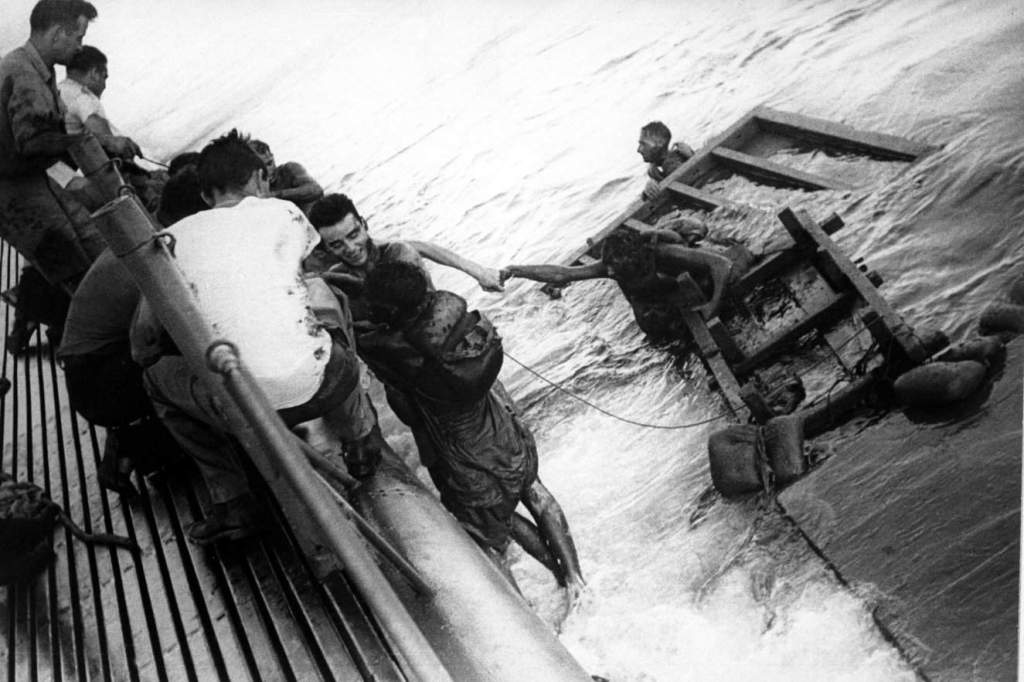
Sealion turned toward them at eighteen knots.
As the submarine approached the area, the ocean itself began telling the story. Debris stretched southwest toward the horizon. The boat passed through a heavy slick of diesel oil.
Then came the bodies.
At 1820 Sealion passed the first of many dead men floating on the surface.
Only then did the Americans begin to understand what had happened.
The convoy they had attacked had not carried only Japanese troops and supplies. Some of its ships had been carrying Allied prisoners of war. Men who had survived Japanese captivity had been aboard the very ships the American submarines had torpedoed. Now some of them were still alive in the South China Sea.
The hunters became rescuers.
The work continued into September 16. Survivors were brought aboard exhausted, burned, dehydrated, and suffering from exposure. Not all could be saved. At 1755 that afternoon, another unidentified survivor died aboard Sealion.
Text courtesy of Theodore Roscoe, from his book “U.S. Submarine Operations of WW II”, published by USNI.
Photo from NARA FILE #: 80-G-281718, Photo # HD-SN-99-02609, courtesy of dodmedia.osd.mil, Defense Visual Information Center.
PDF courtesy of Steve Burton.
Photo 80-G-281731 courtesy of NARA via Rob Hanshew and Tracy White @ Researcher @ Large. (NAVSOURCE)
At 2006 the crew conducted burial services. His body was committed to the deep.
By September 17, Sealion was heading back toward Saipan with the men she had rescued. The submarine passed through Balintang Channel shortly before two in the morning and departed the patrol area at 1145, making seventeen knots eastward.
Even then the danger had not ended.
Shortly after noon on September 18, an aircraft appeared twelve miles away. The crew attempted recognition signals. A single flash came back. Then the aircraft turned directly toward them.
At five miles, Sealion submerged. Through the periscope they could see the markings.
Japanese. A “Betty” bomber.
Once it had passed, Sealion surfaced and continued east.
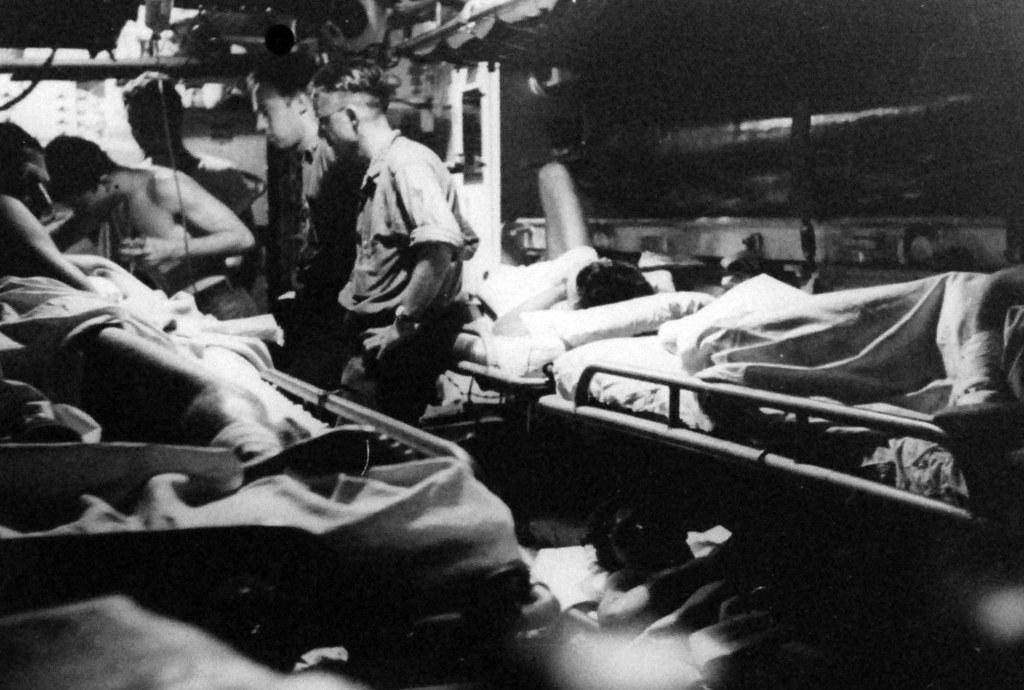
Later that afternoon she rendezvoused with the destroyer escort USS Case. Medical personnel came aboard to assist with the survivors. Then Case took station as escort and accompanied the submarine toward Saipan.
Text courtesy of Theodore Roscoe, from his book “U.S. Submarine Operations of WW II”, published by USNI.
Photo 80-G-281731 courtesy of NARA via Rob Hanshew and Tracy White @ Researcher @ Large.
There would still be another death. On the night of September 19, Private Douglass Ralph of the 5th Bedfordshire and Hertfordshire Regiment died aboard Sealion. At 2330 he was buried at sea.
The following morning the submarine entered Tanapag Harbor.
At 1110 on September 20, 1944, USS Sealion moored alongside the submarine tender Fulton. The surviving prisoners were transferred ashore to the Army General Hospital. The boat began disinfecting and cleaning her compartments while torpedoes were transferred aboard for whatever came next.
Thirteen days had passed since Sealion had left Saipan.
She had gone to sea as part of a wolfpack hunting Japanese shipping. She had fought a convoy at point-blank range on the surface, endured gunfire and depth charges, and helped send Japanese ships to the bottom.
Then she had discovered what the attack reports could never show on a radar screen.
There had been prisoners aboard those ships.
For the men of Sealion, the second war patrol had become something far more complicated than a tally of ships and tonnage. The same submarine that had stalked the convoy through the darkness now carried men rescued from its wreckage.
For several days in September 1944, the distinction between hunter and rescuer had become terribly thin.
- Official Navy & Submarine Archives:
- Sealion II (SS-315) ship history from the Naval History and Heritage Command 2.
- USS Sealion (SS-315) and Pampanito (SS-383) technical and historical datasets from the Submarine Photo Index 2.
- Sealion II (SS 315) Battle Flag history from the U.S. Naval Undersea Museum 2.
- SEALION’s Sounds from the Submarine Force Library & Museum Association 2.
- Eugene B. Fluckey Papers finding aids from the United States Naval Academy (USNA) 2.
- Convoy HI-72 Operational Records:
- Convoy HI-72: US Submarines versus Japanese Escorts in the Pacific War published by the National Institute for Defense Studies (防衛研究所) 2.
- Researches on Sunken Japanese Ships with the Allied POWs in Transit compiled by the POW Research Network Japan 2.
- Eyewitness Testimonies & Veteran Tributes:
- Recollections of USS Pampanito’s rescue of prison ship survivors by Lieutenant Commander Landon Davis 2.
- Rakuyo Maru – Roll of Honour records 2.
- 70th Anniversary of the Sinking of the Rakuyō Maru from the Australian War Memorial 2.
 Patrol Reports
Leave a comment