
The USS Dace (SS-247) represents one of the most storied combat records in the history of the United States Navy’s “Silent Service.” A Gato-class fleet submarine, the Dace distinguished herself as a premier instrument of undersea denial during World War II, earning seven battle stars and the prestigious Navy Unit Commendation. Her operational history is characterized by a high degree of tactical versatility, ranging from aggressive surface gun actions and the destruction of heavy cruisers to specialized commando insertions in enemy territory.
The vessel’s career serves as a historical microcosm for the evolution of American submarine warfare. Her journey reflects the broader transition of the U.S. Submarine Force: originating as a raw, mass-produced WWII fleet combatant and evolving into a specialized Cold War training and anti-submarine warfare (ASW) platform. Through technical modernization and international cooperation, the Dace helped bridge the gap between the era of unrestricted undersea commerce raiding and the sophisticated sonar-driven environment of the NATO alliance.
Industrial Genesis: The Victory Yard and Technical Blueprint
The industrial mobilization that produced the Dace was a landmark of American wartime manufacturing. Her keel was laid on July 22, 1942, at the Electric Boat Company in Groton, Connecticut. She held the distinction of being the first submarine constructed at the “Victory Yard,” a specialized expansion of the Electric Boat facility completed only days before her construction began to meet the Navy’s urgent requirement for fleet boats.
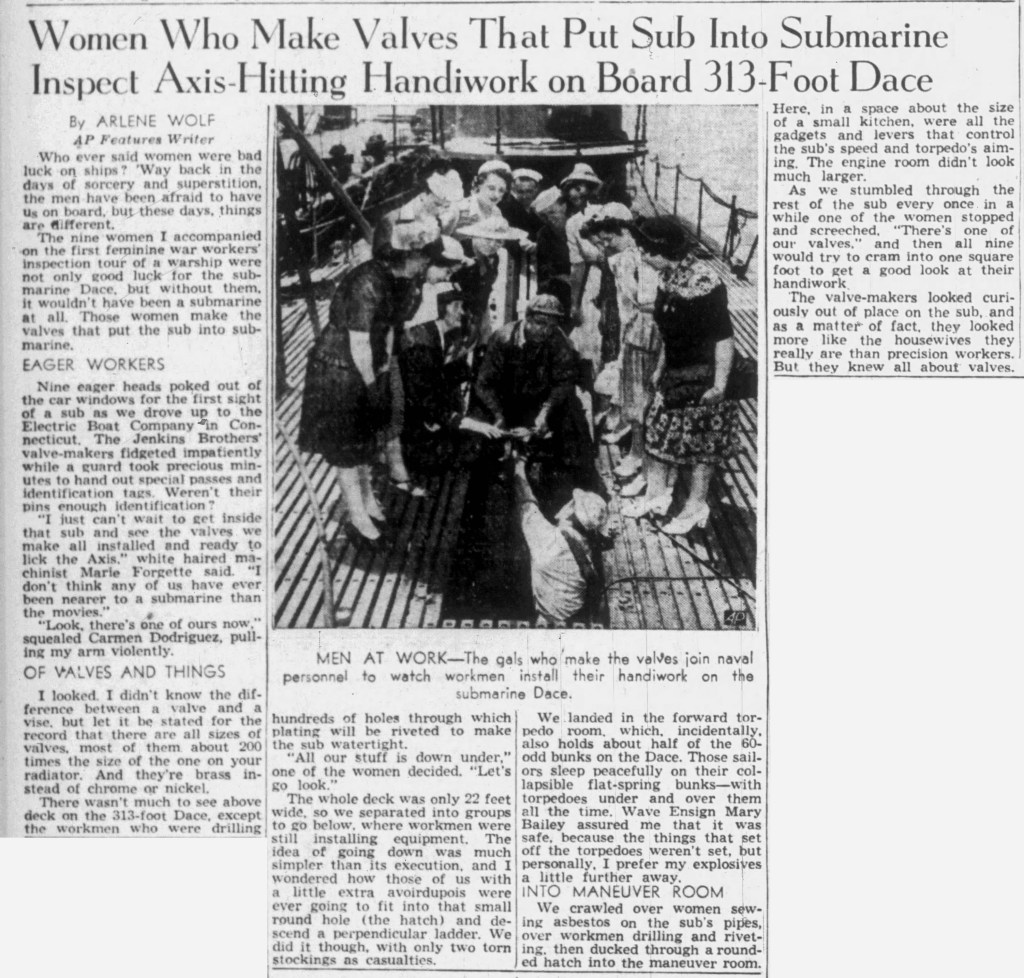
Launched on April 25, 1943, and commissioned on July 23, 1943, the Dace was placed under the command of Lieutenant Commander Joseph F. Enright. As a Gato-class archetype, she was optimized for long-range patrols in the Pacific, balancing high-capacity diesel propulsion with a formidable torpedo battery.
Technical Specifications: USS Dace (SS-247) at Commissioning
| Feature | Specification |
| Length Overall | 311′ 9″ |
| Displacement | 1,526 tons (surfaced) / 2,424 tons (submerged) |
| Propulsion | 4 General Motors Diesels (5,400 HP) / 4 GE Electric Motors (2,740 HP) |
| Armament | 10 x 21-inch torpedo tubes (6 bow, 4 stern) and 1 x 3-inch deck gun |
Cutting Her Teeth: The First Four War Patrols

The Dace’s early missions established her as a tenacious predator of Japanese shipping, while simultaneously proving her utility for unconventional naval operations.
- Patrols 1 & 2: Operating off Honshu and the approaches to Nagoya, the Dace made her first contact on November 7, 1943, damaging a freighter. On her second patrol south of Truk, she reported a “ghost sinking” on January 26, 1944. After firing a spread at a large tanker and recording five explosions, Japanese records later showed no ships damaged, suggesting a potential encounter with unrecorded naval auxiliaries or premature torpedo detonations.
- Patrol 3: Showcasing the multi-role capabilities of the Gato class, the Dace embarked a group of commandos at Langemak Bay on March 20, 1944. She scouted the Hollandia coast in New Guinea, successfully landing and retrieving reconnaissance teams by night. During this mission, she also escorted the severely damaged USS Scamp to safety at Manus.
- Patrol 4: Now under the command of Lieutenant Commander B. D. Claggett, the Dace endured a harrowing counterattack in the Davao Gulf. On July 9, 1944, Japanese escorts dropped 43 depth charges, shaking the vessel violently but failing to compromise the pressure hull. Following a day-long pursuit of a smoke contact, she successfully sank the tanker Kyoei Maru No. 2 during a midnight strike on July 27.
High Stakes in the Palawan Passage: The Battle of Leyte Gulf
The fifth war patrol of the Dace is regarded as one of the most strategically significant submarine missions of the Pacific War. Working in a coordinated “wolfpack” with the USS Darter, the Dace’s operations in the Palawan Passage fundamentally shaped the outcome of the Battle of Leyte Gulf.
- Strategic Reconnaissance: On October 23, 1944, the joint reconnaissance of Dace and Darter provided the U.S. Third and Seventh Fleets with the first definitive contact reports of Vice Admiral Kurita’s “Center Force.” This intelligence stripped the Japanese fleet of its surprise and allowed U.S. forces to reposition for the decisive engagement.
- Tactical Strike on the Maya: At 05:55, the Dace launched a spread of six torpedoes against the heavy cruiser Maya. Scoring four direct hits, the Dace achieved a catastrophic internal breach. The torpedoes struck the bow in the chain locker, opposite the No. 1 gun turret, the No. 7 boiler room, and the aft engine room. The Maya exploded and sank within minutes.
- The Rescue of the Darter: Disaster struck when the USS Darter ran hard aground on Bombay Shoal. Lieutenant Commander Claggett maneuvered the Dace alongside the stranded submarine to rescue all 81 crewmen. Carrying a total of 156 men in a hull designed for half that number, the Dace attempted to scuttle the Darter with torpedoes and deck gun fire to prevent capture before clearing the area as Japanese aircraft approached.
Mining the Depths and the Sea of Okhotsk: Final Wartime Missions
The Dace’s final war patrols were conducted under the command of Commander Otis R. Cole Jr., whose aggressive leadership earned him the Silver Star and Bronze Star.
During her sixth patrol, the Dace conducted a specialized mining mission in the South China Sea between Palau Gambir and the mainland. Following the deployment, a Japanese counterattack forced the sub to the bottom at 300 feet. Strong underwater currents dragged the Dace along the seabed, causing the vessel to “clank and scrape” loudly. Despite the noise, she successfully evaded detection and later surfaced to continue operations, sinking the naval auxiliary Nozaki on December 28, 1944.
On June 10, 1945, during her seventh patrol in the Sea of Okhotsk, the Dace engaged a convoy in dense fog. She closed the freighter Hakuyo Maru to a range of only 380 yards before firing a spread that sent the ship to the bottom. When a Japanese escort attempted a ramming maneuver, Commander Cole executed a “down-the-throat” torpedo attack, firing directly at the charging vessel before diving deep to survive a retaliatory depth-charge barrage.
Cold War Transformation: The GUPPY IB Modernization
Following the cessation of hostilities and a period in the Reserve Fleet, the Dace was selected for the Greater Underwater Propulsion Power (GUPPY) program. The 1954 modernization to the GUPPY IB standard was an interim configuration designed to optimize WWII hulls for higher submerged speeds and improved detection capabilities.
The conversion included several critical technical upgrades:
- Streamlined “Portsmouth Sail”: The replacement of the traditional bridge and cigarette deck with a smooth, enclosed fairwater to reduce submerged drag.
- Snorkel System: The installation of induction and exhaust masts, enabling the submarine to run its diesel engines while submerged to recharge batteries.
- Enhanced Sonar and Power: Integration of high-capacity GUPPY batteries and the BQR-2 sonar system, significantly increasing the sub’s submerged endurance and long-range tracking capabilities.

The Italian Chapter: Leonardo da Vinci (S-510)
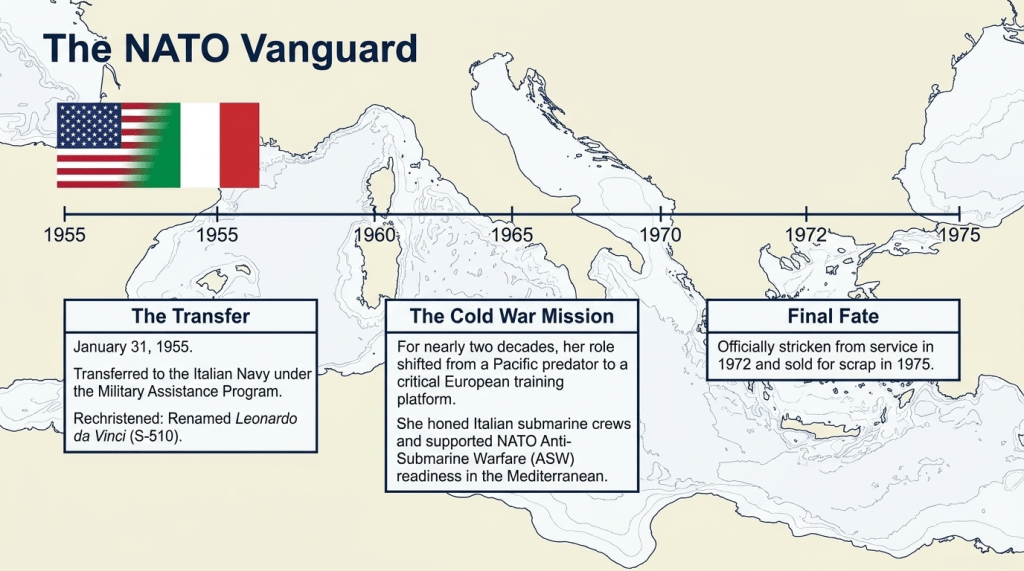
On January 31, 1955, the modernized Dace was transferred to the Italian Navy under the Security Assistance Program. She was commissioned as the Leonardo da Vinci (S-510), inheriting the name of Italy’s most successful WWII submarine and symbolizing the nation’s naval rebirth within the NATO alliance.
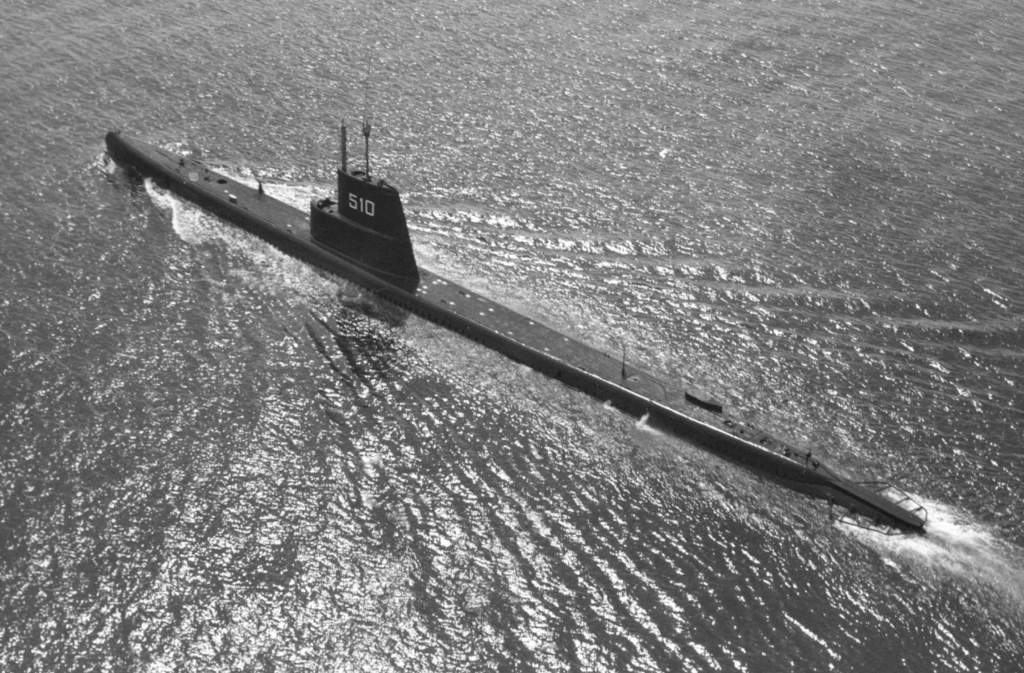
The Whopping size photo of the Leonardo Da Vinci (S-510). USN photo courtesy of Scott Koen & ussnewyork.com.
(NAVSOURCE.NET)
For nearly two decades, the Leonardo da Vinci served as a foundational asset for Italian undersea warfare. She was utilized as a primary anti-submarine warfare (ASW) training platform, conducting deep-dive drills in what Italian submariners described as the “immense blue” of the Mediterranean. Her service was critical in training Allied forces to detect and track the burgeoning Soviet submarine threat. The vessel was stricken from the U.S. Naval Vessel Register on October 15, 1972, and was officially deleted from the Italian Navy in 1973 before being sold for scrapping in 1975.
The Enduring Legacy of the Gato Class
The USS Dace (SS-247) concluded her combat career with an official credit of 28,689 tons of enemy shipping sunk. Her seven war patrols transformed her from a frontline industrial product of the “Victory Yard” into a versatile tactical asset that earned the respect of the entire Submarine Force.
Her legacy is defined by technical and strategic adaptability. From the Palawan Passage to the Sea of Okhotsk, the Dace proved the durability of the Gato-class design. By transitioning from a WWII hunter-killer to a crucial Cold War training vessel for a key European ally, the Dace ensured that the lessons of the “Silent Service” would continue to influence maritime security for decades after her first launch.


Leave a Reply