On October 21, 1944, the American submarine USS Darter (SS-227) was patrolling the waters off northwestern Borneo, watching a narrow passage through which the Imperial Japanese Navy might soon send its most powerful warships. Thousands of miles of ocean separated the submarine from the beaches of Leyte, where American soldiers had begun the liberation of the Philippines the previous morning. Yet the events unfolding ashore were about to transform Darter’s fourth war patrol into one of the most consequential submarine operations of the Pacific War.
Under Commander David H. McClintock, Darter was operating in company with USS Dace (SS-247), commanded by Commander Bladen Claggett. The two submarines occupied a position near the southern approaches to the Palawan Passage, a strategic maritime corridor connecting the South China Sea with the central Philippines.
Neither commanding officer could know precisely when the Japanese fleet would appear, or even whether it would choose their particular stretch of water. What they understood was that the American landings at Leyte demanded a Japanese response. If the enemy intended to bring its heavy surface forces against the invasion fleet, the Palawan Passage offered one of the most direct routes into the Philippine archipelago.
By the end of October 21, Darter would find the enemy she had been waiting for.
The Japanese Response to Leyte
The American landings on Leyte on October 20 marked the beginning of General Douglas MacArthur’s promised return to the Philippines. Supported by an immense naval armada, American troops came ashore to establish the beachhead from which the liberation of the archipelago would proceed.
For the Japanese, the invasion threatened more than the loss of another island. The Philippines occupied a critical position along the maritime routes connecting Japan with the petroleum resources of the Netherlands East Indies and the territories still under Japanese occupation in Southeast Asia. Losing control of those waters would further isolate the Japanese home islands from the fuel and raw materials required to sustain the war.
The Imperial Japanese Navy had prepared a response under Operation SHO-1, an ambitious plan intended to concentrate its remaining major surface forces against the American invasion fleet. The plan depended upon several Japanese naval formations approaching Leyte from different directions, drawing American naval strength away from the vulnerable transports and landing forces.
Among these formations was Vice Admiral Takeo Kurita’s powerful Center Force, assembled at Brunei Bay on the northern coast of Borneo. His command included some of Japan’s most formidable surviving warships, including the battleships Yamato and Musashi, supported by heavy cruisers, light cruisers, and destroyers.
To reach Leyte from Brunei, Kurita’s force would have to navigate northward through waters where American submarines were already operating.
The geography favored an alert submarine commander. Palawan Island formed a long barrier between the South China Sea and the Sulu Sea, while Balabac Strait provided an important passage near its southern end. Shoals, reefs, and restricted navigational channels complicated the movement of large warships, particularly at night.
McClintock understood the significance of that geography. It was possible to cover an enormous stretch of open ocean without encountering a single enemy vessel, but a submarine positioned near a likely transit route could turn a chance encounter into an operational advantage.
A Submarine on Watch
At midnight on October 21, Darter received news broadcasts reporting the American invasion of the Philippines. The information confirmed that the long-anticipated operation had begun and gave McClintock reason to expect a major Japanese naval reaction.
He directed his submarine toward Balabac Strait, intending to watch the approaches through which enemy warships might pass.
The decision reflected the initiative required of American submarine commanders operating far from immediate fleet supervision. McClintock did not possess a complete picture of Japanese intentions. He had to interpret the information available to him, consider the geography, and position his boat where an enemy encounter seemed most likely.
At 0815, Darter submerged in the western approach to Balabac Strait. During daylight, remaining underwater reduced the risk of detection by Japanese aircraft or surface vessels. The submarine could conduct its surveillance through the periscope while preserving the concealment necessary for an eventual attack.
The hours passed without the anticipated appearance of the Japanese fleet.
A submarine operating submerged was limited by the endurance and speed of her electric propulsion system. Once darkness provided greater protection against aerial observation, surfacing would permit Darter to operate on her diesel engines, recharge her batteries, and cover considerably more distance.
As evening approached, McClintock prepared to resume his surface patrol.
At 1824, according to the patrol report, Darter surfaced and began covering the southwestern approaches to Balabac Strait. The submarine was now positioned to search the waters ahead with radar, watching for the movement of Japanese ships through the darkness.
For the officers and men aboard Darter, the situation remained one of anticipation. They knew the invasion had begun, and they knew that the Japanese Navy possessed powerful forces capable of threatening the American landings. What remained uncertain was when and where those forces would appear.
That uncertainty ended shortly before midnight.
Contact at 26,000 Yards
At 2350 on October 21, Darter’s radar detected three surface targets at a range of 26,000 yards, bearing 261 degrees true.
The contacts were moving rapidly, and their radar signatures suggested substantial warships. McClintock’s tracking party estimated their speed at 23 knots on a base course of 020 degrees true. The vessels appeared to be heading northward through the dangerous waters southwest of Palawan.
Two minutes later, at 2352, Darter went to battle stations. McClintock ordered full power, bringing the submarine to approximately 18.8 knots as she began pursuing the unidentified formation.
The patrol report identified the contacts as three probable heavy cruisers. That assessment was important because it suggested the movement of major Japanese naval units toward the Philippines, precisely the development McClintock had anticipated when he heard the news from Leyte.
The encounter presented an immediate tactical problem. The Japanese ships were traveling several knots faster than Darter could manage, even on the surface with her diesel engines operating at maximum power.
McClintock also faced an unfavorable initial position. Darter was approximately 29 degrees forward of the targets’ beam when contact was established, leaving little opportunity to maneuver ahead of the formation. An attack would require the enemy to alter course, reduce speed, or otherwise present an opening.
The submarine nevertheless continued the pursuit.
The surrounding waters made the decision particularly hazardous. The region known on navigational charts as the Dangerous Ground contained extensive reefs, shoals, and poorly charted hazards. Running at maximum speed through such waters at night exposed the submarine to the possibility of grounding.
McClintock accepted the risk because maintaining contact offered something potentially more valuable than an immediate torpedo attack. Even if Darter could not reach a firing position, she could track the Japanese movement and warn American naval commanders that powerful enemy vessels were approaching the Philippines.
The Warning Goes Out
As Darter continued her high-speed pursuit, McClintock began transmitting contact reports.
The first reports went to USS Dace and Commander Task Force 71, identifying three probable heavy cruisers and providing the estimated course, speed, and position of the formation.
For the American command structure, such information was of immediate importance. The invasion fleet at Leyte included troop transports, supply vessels, landing craft, and naval forces supporting the troops ashore. A sudden appearance by Japanese battleships and heavy cruisers could threaten the entire operation.
Submarines operating along the likely approaches to the Philippines provided an early-warning capability that aircraft and surface patrols could not always maintain. Their ability to detect and follow enemy warships, particularly at night, made them valuable reconnaissance assets.
The reports from Darter also served a more immediate purpose. McClintock wanted to position Dace where she might intercept the approaching Japanese formation.
The two submarines were operating as a coordinated attack group, but they did not necessarily occupy the same tactical position. A target beyond the reach of one submarine might still pass within torpedo range of the other.
McClintock therefore continued transmitting the changing position and movements of the Japanese vessels, providing Claggett with the information needed to calculate a possible interception.
The fourth war patrol report records two contact reports to Commander Task Force 71 and eleven to Dace during the pursuit.
This coordination was particularly important because the Japanese ships were maintaining a speed that prevented Darter from gaining an advantageous position. McClintock understood that his best opportunity might be to guide his partner onto the enemy’s projected track.
The submarine continued through the Dangerous Ground at full power, keeping the targets under observation as the night progressed into October 22.
McClintock’s intentions were clear. He hoped the Japanese ships might zig toward his position, allowing an attack. Failing that, he intended to keep Dace informed of their movements and, if possible, obtain a visual identification after sunrise.
At 0100, the target position was calculated at approximately 7 degrees 31 minutes north latitude and 115 degrees 22 minutes east longitude.
For the moment, however, the enemy remained beyond reach.
The Fleet Beyond the Horizon
The pursuit continued into the early morning of October 22, but Darter could not close the distance.
At 0507, the submarine lost contact with the formation. McClintock’s attempt to gain an attack position had failed, although the information collected during the pursuit had been passed to the appropriate American commanders.
At 0625, Darter detected another large vessel, believed to be a battleship, at a range of approximately 38,000 yards. Once again, the submarine attempted to establish a useful tracking position, but the distance and speed of the contact prevented an attack. McClintock broke contact at 0659.
The submarine continued patrolling the Dangerous Ground throughout October 22.
Although neither encounter had produced a torpedo firing opportunity, the contacts reinforced the growing evidence that substantial Japanese naval forces were moving through the approaches to the Philippines.
For McClintock and Claggett, the problem was now one of finding the main enemy formation before it passed beyond their reach.
The decisive opportunity came shortly after midnight on October 23.
The two commanding officers had just completed a discussion of their coordinated patrol when Darter’s radar detected another contact. Initially uncertain whether the return represented rain or ships, the radar operator continued tracking.
At 0017, McClintock called across to Dace: “We have radar contact. Let’s go!”
This time, the contact developed into something considerably larger than the three probable cruisers encountered on October 21.
The submarines had found Kurita’s Center Force.
As the two American boats maneuvered at high speed to get ahead of the Japanese formation, Darter transmitted further contact reports. The intelligence confirmed the movement of a major enemy surface force toward Leyte, giving American naval commanders warning of the approaching threat.
The importance of the encounter extended beyond the two submarines. Kurita’s force represented a serious danger to the American invasion fleet, and its movement through Palawan Passage would become the opening phase of the naval engagements collectively remembered as the Battle of Leyte Gulf.
The Battle Begins
Before dawn on October 23, Darter and Dace maneuvered ahead of the Japanese columns.
At 0509, Darter submerged and prepared to attack. McClintock selected the Japanese flagship, the heavy cruiser Atago, as his principal target.
The torpedoes struck with devastating effect.
Atago sank in approximately nineteen minutes, forcing Vice Admiral Kurita to abandon his flagship. Although the admiral survived and subsequently resumed command, the loss disrupted the Japanese formation at a critical moment.
McClintock then attacked the heavy cruiser Takao, inflicting damage severe enough to remove her from effective participation in the coming battle.
Nearby, Dace delivered another successful attack, sinking the heavy cruiser Maya.
Within a remarkably short period, the two American submarines had sunk two Japanese heavy cruisers and crippled a third. The attacks inflicted serious losses upon Kurita’s force before it reached the principal American naval formations defending Leyte.
The Japanese commander would continue toward the Philippines, and the greater Battle of Leyte Gulf was still ahead. Nevertheless, the opening engagement demonstrated how effectively submarines could operate against major surface combatants when accurate reconnaissance, favorable geography, and coordinated maneuvering brought them into attack position.
The success also illustrated the importance of decisions made before the first torpedo was fired.
McClintock’s movement toward Balabac Strait on October 21, his willingness to pursue superior enemy forces through hazardous waters, and his continued coordination with Dace all contributed to the circumstances that made the October 23 attacks possible.
The Loss of Darter
The submarine’s success was followed almost immediately by disaster.
After the attacks on October 23, Darter continued attempting to locate and destroy the damaged Takao. The Japanese cruiser remained a valuable target, and McClintock sought another opportunity to finish her.
Shortly after midnight on October 24, while maneuvering in the vicinity of Bombay Shoal, Darter ran hard aground.
The grounding left the submarine stranded on the reef. Despite efforts to free her, the crew could not return the boat to navigable water.
With the submarine beyond recovery and the possibility of Japanese capture a serious concern, McClintock ordered the destruction of classified materials and sensitive equipment.
USS Dace came alongside to rescue the stranded crew. All 85 men were transferred safely, an extraordinary result given the circumstances and the danger of conducting the operation in enemy-controlled waters.
Attempts to destroy the abandoned submarine proved unexpectedly difficult. Demolition charges and subsequent American attacks failed to eliminate the wreck completely. Other American submarines later attacked the stranded hull to prevent the Japanese from obtaining useful equipment.
Although Darter was lost, her crew survived, and the Navy recognized the importance of the patrol. The submarine received the Navy Unit Commendation, while Commander McClintock was awarded the Navy Cross.
The Significance of October 21
The events of October 21, 1944, are sometimes overshadowed by the dramatic sinking of Atago and Maya two days later. Yet the earlier patrol deserves attention in its own right.
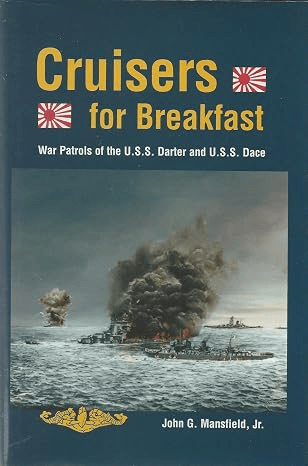
When McClintock received word of the Leyte landings, he recognized that the Japanese Navy would likely attempt to intervene. His response was to place Darter across a probable enemy route, relying upon the geography of the southern Palawan approaches to increase the likelihood of contact.
The radar detection at 2350 confirmed that significant Japanese warships were moving through those waters. Although the submarine could not overcome the unfavorable speed and bearing of the targets, McClintock continued tracking and reporting their movements.
That distinction matters. The encounter on October 21 was an important reconnaissance action, but the definitive detection of Kurita’s main Center Force occurred early on October 23. The two events formed successive stages of the same patrol rather than a single uninterrupted pursuit.
Darter’s actions demonstrated the broader value of American submarines during the final years of the Pacific War. Their contribution extended beyond the destruction of Japanese merchant shipping and warships. They also served as scouts, intelligence collectors, and advance warning stations for major fleet operations.
The successful attacks of October 23 would make Darter and Dace part of the opening chapter of the Battle of Leyte Gulf. The decisions made on October 21 explain how they came to be there.
McClintock had recognized the strategic situation, selected a likely enemy approach, and kept his submarine in position to exploit an opportunity. When that opportunity finally arrived, his crew was ready.
The Japanese fleet was moving toward Leyte. Two American submarines were waiting along its route.
And the Battle of Leyte Gulf was about to begin.
Sources
USS Darter (SS-227). Report of Fourth War Patrol, Serial 020, November 1944.
Naval History and Heritage Command. “Darter I (SS-227).” Dictionary of American Naval Fighting Ships.
Naval History and Heritage Command. United States Submarine Losses, World War II: Darter (SS-227).
Naval History and Heritage Command. “H-038-2: Leyte Gulf in Detail.”


Leave a Reply