October 19, 1944: The Fifteenth War Patrol and the Submarine Supply Operations That Supported the Liberation of the Philippines
By October 1944, the liberation of the Philippines was no longer a distant strategic objective. American forces were preparing to return to the islands they had been forced to abandon more than two years earlier. General Douglas MacArthur’s promised return would begin with the landings on Leyte on October 20, but the success of that invasion depended upon more than the soldiers, sailors, and airmen assembling for the assault. Throughout the occupied archipelago, Filipino guerrillas and American intelligence operatives had been fighting a largely unseen war, gathering information, harassing Japanese forces, and preparing the ground for liberation.
Keeping those resistance forces supplied presented an extraordinary logistical challenge. Japanese control of the principal ports, shipping routes, and population centers made conventional supply operations exceedingly dangerous. Aircraft could deliver limited quantities of material, but the geography of the Philippines and the demands of secrecy often made submarines the only practical means of reaching isolated guerrilla organizations.
Among the submarines assigned to this clandestine work, USS Narwhal (SS-167) occupied a particularly important place. Built during an earlier era of submarine development, she was considerably larger than the fleet submarines that had become the backbone of the American undersea campaign. Her great size, originally intended to provide the endurance and fighting capacity of a cruiser submarine, made her exceptionally well suited for carrying personnel, weapons, ammunition, and equipment into enemy-controlled waters.
On October 19, 1944, just one day before American troops landed on Leyte, Narwhal approached the southwestern coast of Negros Island. Her mission was to deliver a substantial shipment of military supplies to Filipino guerrillas and evacuate a group of civilians and other personnel. It was the kind of operation that rarely attracted public attention, but one that demonstrated the indispensable contribution of American submarines to the liberation of the Philippines.
A Cruiser Submarine Finds a New Purpose
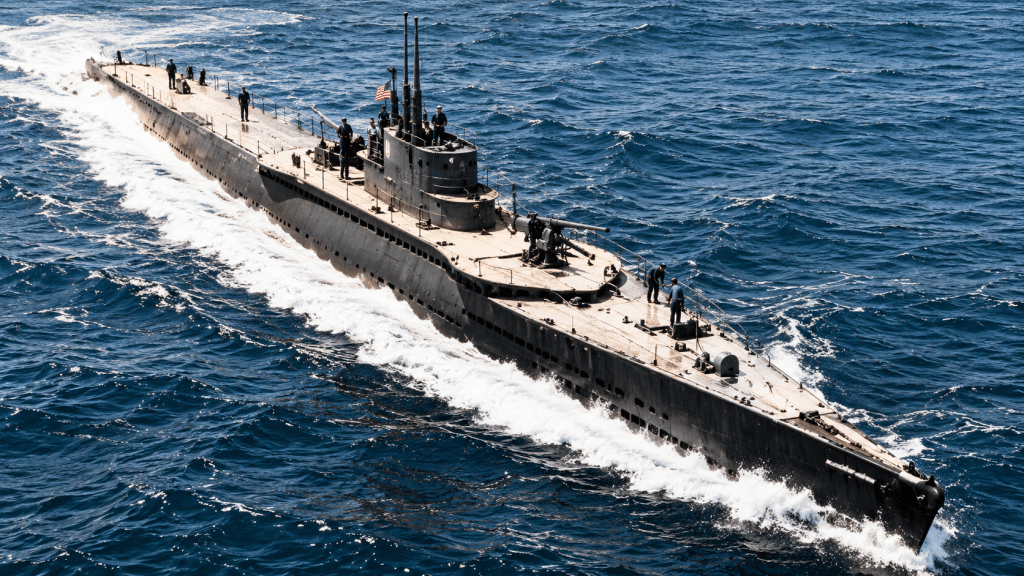
Narwhal began her existence as V-5, one of the experimental V-boats constructed during the interwar years. Laid down at Portsmouth Navy Yard in 1927, she represented an ambitious attempt to extend the operating range and capabilities of the American submarine force.
At approximately 371 feet in length and displacing 2,730 long tons on the surface, she was a giant by the standards of her day. Her design reflected the belief that submarines might operate independently across vast stretches of the Pacific, scouting ahead of the fleet and attacking enemy shipping far from established bases.
Her most conspicuous weapons were two 6-inch/53-caliber deck guns. These heavy weapons, substantially larger than those carried by most American submarines during the Second World War, were intended to give her considerable surface fighting power. They also illustrated the assumptions underlying her original design, when naval planners still anticipated that submarines might engage enemy vessels with gunfire as well as torpedoes.
By 1944, however, Narwhal’s greatest advantage was neither her guns nor her torpedo armament. It was the remarkable amount of internal space available within her enormous pressure hull.
The Gato- and Balao-class fleet submarines were highly effective offensive weapons, but their internal arrangements were designed around torpedoes, machinery, fuel, provisions, and the needs of their crews. Accommodating substantial quantities of additional cargo required considerable improvisation.
Narwhal offered a different possibility. By removing or rearranging equipment, including torpedo storage arrangements, her compartments could be adapted to accommodate extraordinary quantities of supplies. Depending upon the mission and the nature of the cargo, she could carry tens of tons of military equipment and large groups of passengers.
A submarine originally designed for independent offensive operations had become something equally valuable: an underwater transport capable of carrying the machinery of resistance directly into occupied territory.
SPYRON and the Secret Supply War
The clandestine submarine operations supporting the Philippine resistance became associated with SPYRON, the designation commonly rendered as Spy Squadron. These missions formed part of a larger intelligence and logistical effort coordinated through General Headquarters, Southwest Pacific Area.
One of the central figures in the program was Lieutenant Commander Charles “Chick” Parsons, whose extensive prewar experience in the Philippines and familiarity with its people made him an unusually effective intermediary between American headquarters and the guerrilla resistance.
Parsons worked within the Philippine intelligence and support organization associated with MacArthur’s headquarters and its intelligence section, headed by Major General Charles A. Willoughby. The program connected American military planners with resistance leaders who possessed indispensable knowledge of local conditions.
The submarines transported more than rifles and ammunition. They carried radio transmitters, codebooks, batteries, medical supplies, intelligence personnel, communications specialists, and other equipment necessary to sustain organized resistance.
These deliveries helped establish an intelligence network that extended across much of the archipelago. Guerrilla radio stations and coast watchers monitored Japanese naval movements, observed shipping traffic, and transmitted reports that could assist Allied commanders preparing for future operations.
The cumulative scale of the submarine supply effort was considerable. Figures assembled in accounts of the SPYRON operations credit approximately twenty submarines with forty-nine special missions, delivering some 1,325 tons of supplies and inserting 331 agents or commandos. Submarines also evacuated hundreds of individuals, including escaped prisoners of war, downed aviators, and civilians.
Those figures describe a program whose significance extended beyond the tonnage landed. Each successful mission strengthened the ability of resistance forces to communicate, coordinate their activities, and remain operational under Japanese occupation.
Narwhal became one of the most active submarines in this undertaking. Her nine secret transport missions demonstrated the value of a vessel whose original design had become obsolete for some aspects of submarine warfare but remarkably effective for a different and increasingly important mission.
The Fifteenth War Patrol
On October 11, 1944, Narwhal departed Mios Woendi, Dutch New Guinea, under the command of Commander William G. Holman, USNR. Her fifteenth war patrol would take her into waters controlled or threatened by Japanese forces at a particularly critical moment in the Pacific campaign.
The operational timetable was unforgiving. American forces were approaching the Philippines, and resistance organizations needed equipment and supplies before the invasion began. At the same time, the Japanese maintained naval patrols, coastal observation posts, and garrisons throughout the islands.
Narwhal’s first scheduled delivery took her to Tawi Tawi, near the southern end of the Sulu Archipelago.
On October 17, she approached Tongehatan Point on the northwestern coast of Tawi Tawi, near position 5°20.7′ north latitude and 120°10.4′ east longitude. There, she landed approximately ten tons of supplies for local resistance and intelligence personnel.
The shipment included signal lamps, radio transmitters, codebooks, medical supplies, and other equipment intended to strengthen the coast-watcher network operating near the Sibutu Passage.
That passage was strategically important because it connected maritime routes between the Sulu and Celebes seas. Reports from observers in the region could provide valuable information about Japanese shipping movements and the use of southern approaches to the Philippines.
The Tawi Tawi delivery was only the first stage of the patrol’s clandestine assignment.
Two days later, Narwhal would undertake a much larger operation on the coast of Negros.
Calipapa: October 19, 1944
The southwestern coast of Negros Island offered both opportunities and dangers for a submarine attempting a covert landing.
The waters near Calipapa included steep underwater approaches that permitted a large submarine to maneuver relatively close to shore. Such conditions were especially valuable to a vessel of Narwhal’s size, which could not risk entering shallow coastal waters without careful attention to the bottom contours.
On October 19, Narwhal approached the rendezvous area near 9°28.3′ north latitude and 122°33.5′ east longitude. Operating under cover of darkness, she was able to close to approximately 1,000 yards from the beach.
The landing required close cooperation with local guerrilla forces. Filipino boats, including bancas and outriggers, were prepared to receive the submarine’s cargo and transport it ashore. Prearranged recognition signals helped establish that the men approaching the submarine were the intended recipients rather than Japanese patrols or an enemy deception party.
The resistance organization receiving the shipment belonged to the Seventh Military District, associated with Lieutenant Colonel Salvador Abcede and the guerrilla forces operating on Negros.
For those waiting ashore, the submarine’s arrival represented an extraordinary logistical achievement. Weapons and supplies that could not readily be manufactured or obtained under occupation were arriving directly from the Allied military supply system.
The cargo amounted to approximately fifty tons of war matériel.
Among the weapons listed for delivery were M1 Garand rifles, Thompson submachine guns, carbines, and ammunition. The shipment also included mortar and 20-millimeter ammunition, radio batteries, and medical supplies.
The assortment reflected the varied needs of a guerrilla organization preparing for more extensive military operations. Small arms could equip additional fighters, while ammunition sustained units already operating in the field. Communications equipment enabled scattered formations to coordinate their activities and report enemy movements. Medical supplies were indispensable to organizations that often lacked reliable access to hospitals, surgical equipment, and pharmaceuticals.
Unloading such a quantity of cargo from a submarine offshore was difficult work. Every item had to be transferred from the ship to waiting boats and then carried to shore, all while maintaining security and minimizing the time the submarine remained exposed.
For Narwhal’s crew, the operation demanded seamanship and discipline of a different sort from a conventional torpedo attack. The danger came from remaining on the surface, close to hostile territory, while conducting a prolonged and physically demanding transfer of cargo.
The submarine also landed six personnel, including specialists whose intelligence and communications skills were needed by the resistance.
The movement of personnel did not proceed entirely in one direction.
As the supplies were brought ashore, Narwhal prepared to take aboard twenty-six evacuees. The group included twenty women and children associated with resistance families, one stranded mess attendant from USS Nautilus, and five prospective Navy mess attendants.
Their evacuation illustrated another essential function of the submarine supply missions. The vessels that carried arms and equipment into occupied territory also provided a means of escape for people who could not safely remain there.
The presence of women and children added to the responsibilities of the submarine’s crew. Living conditions aboard an American submarine were crowded even during ordinary patrols, and accommodating additional passengers required adjustments to sleeping arrangements, provisions, sanitation, and the daily routines of the ship.
Nevertheless, the evacuation removed vulnerable individuals from an environment in which discovery by Japanese security forces could have had severe consequences.
By the time the operation was completed, Narwhal had delivered a major shipment of military supplies, inserted essential personnel, and taken aboard a substantial group of evacuees.
The timing was remarkable.
Within hours, the Allied invasion of Leyte would begin.
On the Eve of Liberation
The American landings on Leyte on October 20, 1944, marked the beginning of the campaign to liberate the Philippines. The operation involved enormous naval and ground forces, but its success also depended upon the information and assistance provided by Filipinos who had resisted Japanese occupation.
The supplies delivered by Narwhal strengthened the guerrilla forces on Negros at a moment when Japanese commanders faced an expanding military crisis.
Armed resistance organizations could attack isolated positions, disrupt communications, interfere with road transportation, and force occupation troops to devote attention to local security. Such activities had the potential to complicate Japanese efforts to concentrate forces against the Allied landings.
The intelligence network supported by the submarine missions was equally important. Coast watchers and guerrilla radio operators provided information about Japanese shipping, troop movements, and naval activity throughout the islands.
These reports formed part of the larger intelligence picture available to Allied commanders as Japanese naval forces moved toward the Philippines.
The distinction between the broader intelligence network and the specific results of Narwhal’s October 19 landing is important. The equipment delivered at Calipapa strengthened communications capabilities, but the available outline does not establish that those particular radio sets transmitted specific sightings of Vice Admiral Takeo Kurita’s Center Force or Vice Admiral Shoji Nishimura’s Southern Force during the Battle of Leyte Gulf.
The significance of the operation is substantial without attributing individual battle reports to equipment that had arrived only hours before the invasion.
By supporting local resistance and communications networks, Narwhal contributed to the conditions that made the Allied return possible. The mission was one part of an extended effort in which submarines repeatedly penetrated Japanese-controlled waters to sustain the men and women fighting behind enemy lines.
The Return from Negros
With her cargo delivered and evacuees aboard, Narwhal departed the Negros rendezvous and began her return passage through the waters of the southern Philippines.
The submarine eventually reached Brisbane, Australia, on November 2, 1944, bringing her fifteenth war patrol to a close.
Her work in the Philippines had demonstrated how a submarine could contribute to a major military campaign without firing a torpedo. By carrying weapons, equipment, specialists, and refugees, she had performed a mission whose results could be measured in the continued effectiveness of resistance organizations and the survival of those evacuated.
Following her final patrol, Narwhal returned to the United States and was eventually decommissioned at Philadelphia Navy Yard.
Her wartime record included fifteen battle stars, an extraordinary achievement for a submarine whose service had combined conventional combat patrols with clandestine transport operations.
Yet her contribution to the Philippine resistance deserves particular recognition.
The familiar history of the American submarine campaign in the Pacific is dominated by the destruction of Japanese merchant shipping and warships. That campaign was unquestionably decisive in weakening Japan’s capacity to wage war. Alongside it, however, another form of submarine warfare unfolded in secrecy.
Submarines carried agents to isolated beaches, supplied guerrillas who had survived years of occupation, rescued people threatened by capture, and maintained communications between Allied headquarters and resistance movements operating deep inside enemy territory.
Narwhal was especially suited to this work because of the unusual characteristics of her design. The enormous cruiser submarine of the interwar years found a second purpose in the covert logistical war of 1944.
Her mission at Calipapa on October 19 was one of the clearest demonstrations of that purpose.
While American invasion forces prepared to land on Leyte, Narwhal was already at work along the coast of Negros, placing weapons and supplies in the hands of men who had never stopped fighting.
The liberation of the Philippines would be remembered through great naval battles, amphibious landings, and the advance of American armies. The submarine supply missions were a less visible part of that history, but they helped make the larger campaign possible.
For the officers and men of USS Narwhal, the events of October 19, 1944, represented a distinctive kind of victory: a dangerous mission completed, a resistance force strengthened, and twenty-six people carried toward safety.
Sources
Chicago Manual of Style, 18th edition, bibliography format
Blair, Clay, Jr. Silent Victory: The U.S. Submarine War Against Japan. Philadelphia: J. B. Lippincott, 1975.
Naval History and Heritage Command. “Narwhal II (SS-167).” Dictionary of American Naval Fighting Ships. Washington, DC: Department of the Navy.
Roscoe, Theodore. United States Submarine Operations in World War II. Annapolis, MD: United States Naval Institute, 1949.
United States Navy. USS Narwhal (SS-167), Fifteenth War Patrol Report, October 11–November 2, 1944. Historical operational records. National Archives and Records Administration.
Willoughby, Charles A., ed. Guerrilla Resistance Movement in the Philippines. Washington, DC: Department of the Army, 1963.


Leave a Reply