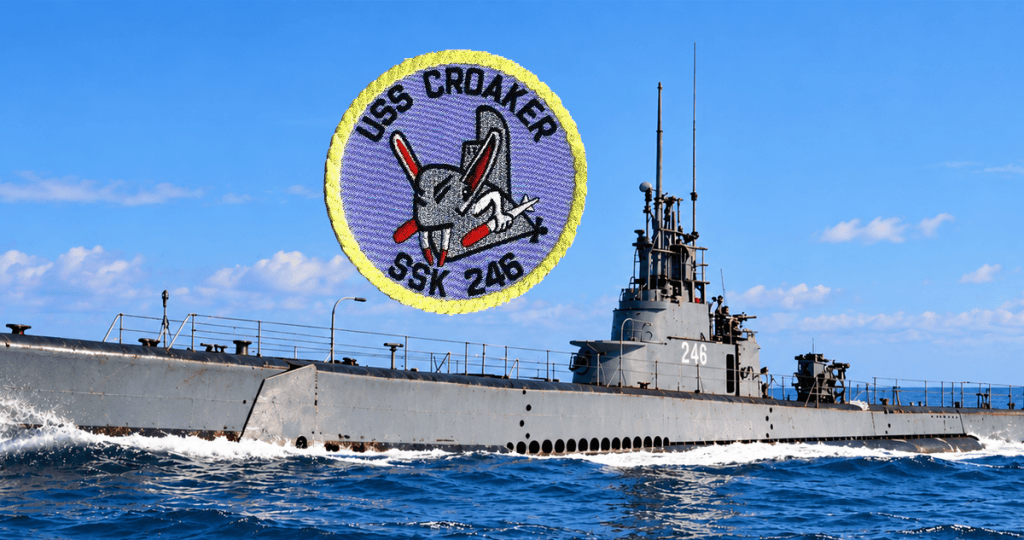
October 23, 1944 – USS Croaker SS-246 Patrols the Yellow Sea
At approximately 400 yards, the three-masted schooner was close enough for Croaker’s gun crews to observe their fire striking home. Tracers provided the means of correcting aim as the submarine’s automatic weapons fired into the darkness. Shells struck the hull, and the schooner’s masts fell under the attack. Then the 40 mm gun developed a familiar malfunction. Its crew had encountered the same trouble six days earlier, and the measures taken since that engagement had failed to eliminate it.
It was 0130 on October 23, 1944. Less than an hour earlier, Croaker had torpedoed a coastal freighter and watched it sink. Now, off Korea’s west coast, the submarine was conducting another kind of attack, engaging a small sailing vessel with gunfire at close range. The two actions would occupy only a short portion of her second war patrol, but together they illustrated how quickly the demands on a submarine’s crew could change.
The night’s work had begun well before midnight. On October 22, Croaker was patrolling near Osei To light, among the islands and coastal approaches of western Korea. At 2135, radar detected a ship at 17,000 yards. As the tracking party developed the contact, the target’s movement suggested a southerly course toward a passage between islands.
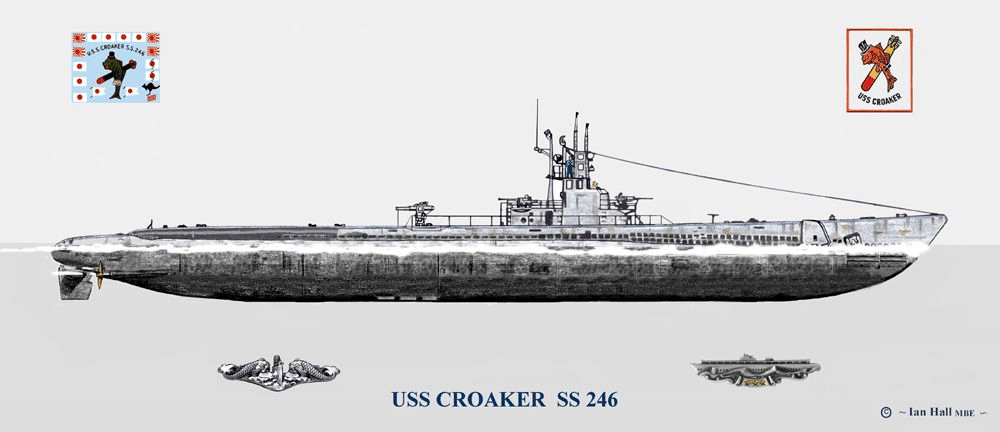
An immediate pursuit would not necessarily produce a favorable shot. Croaker began an end-around maneuver, working ahead of the target so that she could attack as it came through the passage. Such an approach required the submarine to turn a distant radar contact into a reasonably accurate understanding of the ship’s course and speed, then place herself where those calculations would become a firing opportunity.
For several hours, the engagement remained a problem of movement and position. The coastal geography helped define the target’s probable route, but the submarine still had to get ahead of it. By 0030 on October 23, Croaker had regained radar contact at 12,000 yards and began closing for the attack.
The target was an engines-aft coastal freighter, estimated at 2,000 tons. It was moving at approximately six and a half knots. Croaker approached on the surface, where she could use her radar and maneuvering speed to develop the shot.
The solution was complicated by a change in the freighter’s course. Croaker also faced a restriction of her own: damage to the port propeller limited the speed available for maneuvering. The combination produced a large track angle, placing the submarine in a less favorable firing geometry than her crew might have preferred.
Shortly before one in the morning, Croaker fired four bow torpedoes from approximately 2,600 yards. Three missed. One struck.
The result was decisive to the men watching from the submarine. The freighter sank in approximately two minutes, leaving little time for prolonged observation. After hours spent tracking and maneuvering, the visible conclusion came quickly.
Radar reported another contact on the freighter’s starboard quarter, interpreted as a small escort. No escort was sighted visually. That distinction mattered: the submarine’s crew had evidence of another vessel nearby, but darkness prevented them from establishing its identity by direct observation.
Within the hour, Croaker had another target ahead. At 0130, she went to battle surface stations against a three-masted schooner that appeared almost dead ahead. The vessel was estimated at approximately 30 tons, a fraction of the size of the freighter just attacked.
For this engagement, Croaker brought her smaller guns into action. The weapons employed were the 40 mm and 20 mm guns and two .30-caliber machine guns. At an average range of about 400 yards, the crews controlled their fire by watching tracers and adjusting their aim accordingly.
The action placed different demands on the men involved. The torpedo attack had depended on radar tracking, plotting, and a firing solution developed over time. Against the schooner, gun crews had to maintain their weapons, observe the movement of their fire, and keep hitting a small target in darkness. The distance was short, but a close target did not remove the practical difficulties of night shooting.
Their fire produced visible damage. Masts fell, and shells were observed exploding on the schooner or lodging in its hull. Compared with an earlier gun action, a greater percentage of rounds appeared to hit, and more shell detonations were observed. The captain attributed the improvement partly to the schooner’s heavier hull and partly to the crew’s growing experience in night firing.
The 40 mm gun, however, again proved troublesome.
On October 17, during an attack on a powered sampan, the weapon had suffered a malfunction associated with a live round failing to trip the mechanism properly as it entered the loading tray. The 20 mm gun had also experienced an ejection problem during that earlier engagement. These were the kinds of defects that could turn a gun crew’s attention from the target to the weapon at the moment its fire was needed.
Before the October 23 action, the amount of grease on the 40 mm automatic loader had been reduced. The same malfunction nevertheless recurred. After the second round was cleared, the gun functioned only intermittently, in what the report described as “watch-firing.” The crew could not rely on sustained automatic operation.
The remaining weapons performed satisfactorily, allowing the attack to continue despite the 40 mm difficulty. Over the course of the engagement, Croaker expended 20 rounds of 40 mm ammunition, 240 rounds of 20 mm, and 250 rounds from the two .30-caliber machine guns.
Those figures give the action a useful sense of proportion. This was a brief engagement against a small vessel, conducted with a relatively modest expenditure of ammunition. Its effectiveness depended on getting rounds onto the target, while the recurring malfunction limited the contribution of the largest weapon being used.
At 0150, the schooner appeared to have capsized. Croaker ceased firing and cleared the area.
The distinction between appearance and certainty remained important when the patrol was written up. The chronological account recorded the apparent capsize, but the detailed gun-action report classified the schooner as damaged. Falling masts and shell strikes were observable facts. Whether the vessel ultimately sank was less certain. The more restrained assessment preserved that uncertainty.
The freighter’s fate had been clearer. Croaker’s men had watched it sink after the torpedo hit. Even so, the October 23 attack records left both vessels unnamed. They were recorded through the characteristics the submarine’s crew could determine during the encounters: an engines-aft coastal freighter and a small three-masted schooner.
By 0600, Croaker had submerged and was proceeding south along Korea’s west coast. The night had required several hours of patient tracking, a torpedo approach complicated by an enemy course change and the submarine’s damaged propeller, and a close-range gun action interrupted by a persistent mechanical defect. Each engagement had produced its own problems, and each demanded a different response from the crew.
At daybreak, the submarine continued her patrol with those results behind her: a freighter observed sinking, a schooner heavily damaged and apparently capsized, and another demonstration that successful action depended as much on making equipment work under operational conditions as on finding a target.
Reference
USS Croaker (SS-246). “Report of Second War Patrol.” Narrative, October 22–23, 1944, p. 11; “Torpedo Attack No. 3,” pp. 25–26; “Gun Attack No. 1,” p. 35; and “Gun Attack No. 2,” p. 36. In the attached patrol-report compilation.


Leave a Reply