On November 3, 1921, readers of the Richmond Record-Herald encountered a submarine story that looked toward the next war. USS S-2 (SS-106), the newspaper reported, had covered 8,600 miles from Portsmouth, New Hampshire, to Pearl Harbor in 29 sailing days. Its headline proclaimed a long-distance speed record by a “lone American submarine.” Behind the enthusiastic language was a practical achievement: a small American submarine had completed a lengthy passage through two oceans and the Panama Canal under her own power. [1]
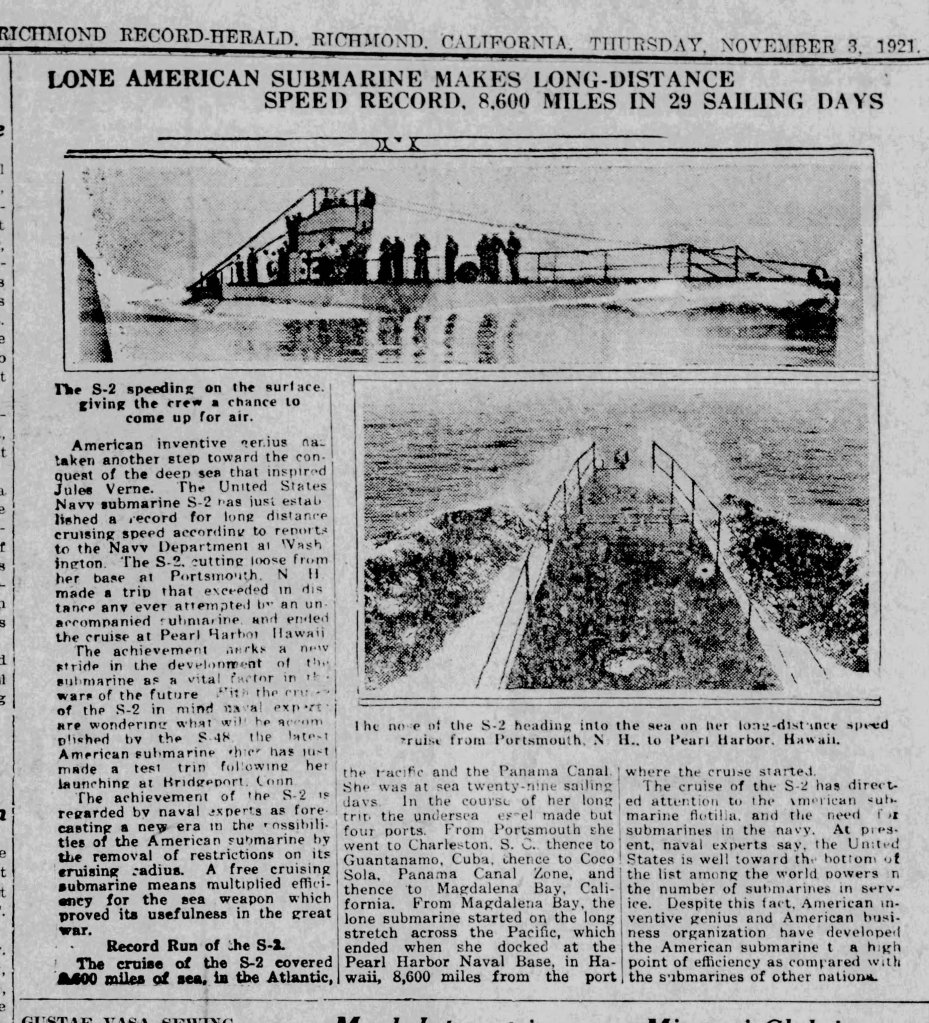
For a Navy with commitments stretching across the Pacific, the significance was readily apparent. Getting a submarine to a distant station was itself an operational problem. A boat might perform well near its base, yet still require substantial assistance to reach the waters where it was needed. S-2’s reported performance offered evidence that ocean passage could become a more dependable part of submarine service.
The distinction between the newspaper’s record and the deployment as a whole matters. The 8,600 miles described the passage to Hawaii, not simply a crossing of the Pacific. The 29 sailing days represented time underway, rather than the elapsed calendar time from departure to arrival. The newspaper did not identify its miles as nautical or statute miles, so the figure should be retained as published. Nor was November 3 the arrival date: it was the date Richmond readers received the story. [1]
S-2 was an experimental answer to the Navy’s search for a better submarine. Built by the Lake Torpedo Boat Company of Bridgeport, Connecticut, she entered commission on May 25, 1920, with Lieutenant Commander William M. Quigley in command. The Navy compared three different approaches to the same general requirements: the Holland-type S-1, Lake-type S-2, and Government-type S-3. At 207 feet long and 800 tons surfaced, S-2 had a listed complement of 38. Her published surface speed was 15 knots. [2]
Preparation for an extended deployment included attention to how the boat behaved on the surface. During 1921, S-2 received an enlarged above-water bow structure intended to improve seakeeping. Submarines of this generation depended on surface passage for long journeys, using their diesel machinery while running above water. A bow that better handled the sea therefore addressed an everyday operational need, even in a vessel whose principal distinction was its ability to dive. [3]
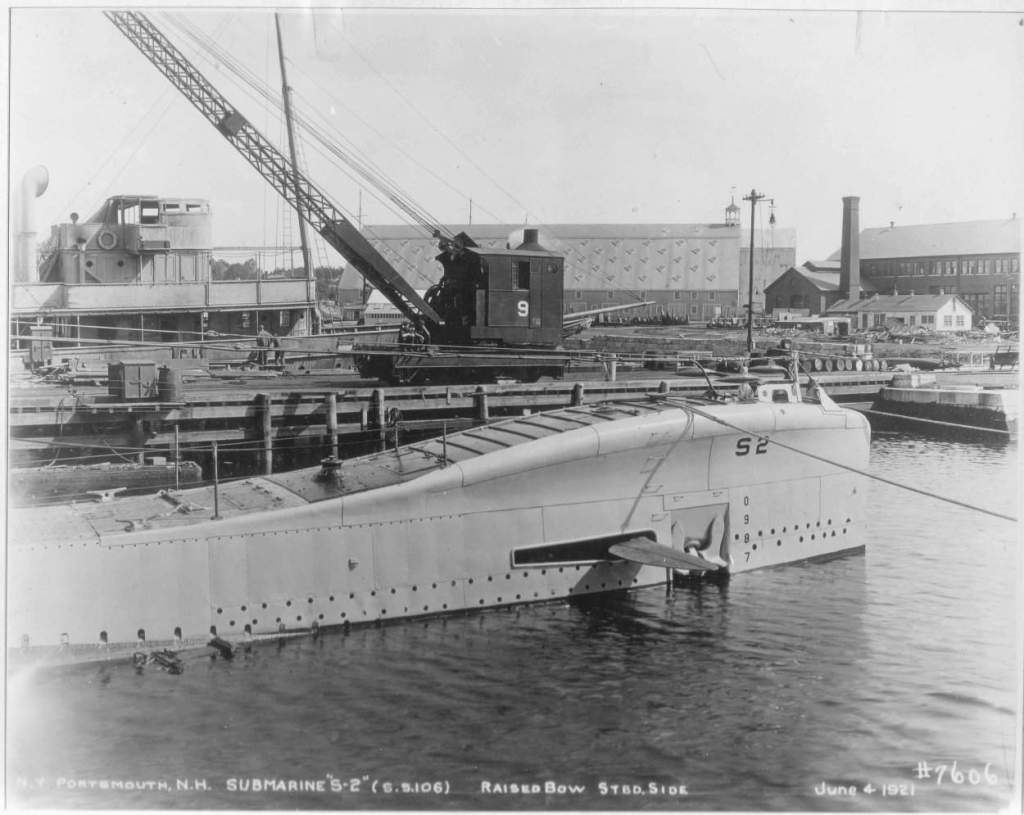
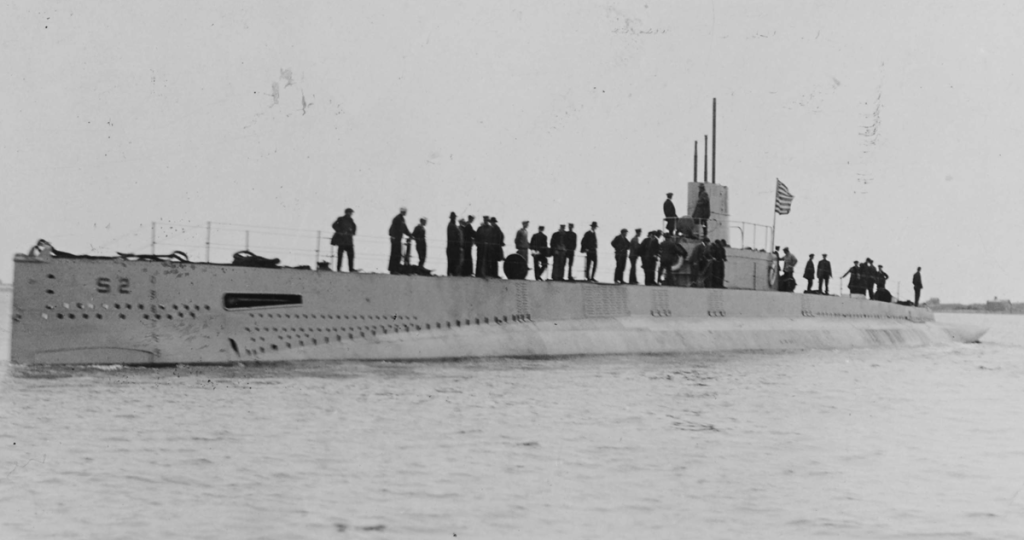
A photograph taken at Portsmouth Navy Yard on July 22, 1921, shows S-2 shortly before departure for Cavite in the Philippines. The Navy’s official history places her rendezvous that day with Submarine Divisions 18 and 12, beginning what it describes as the longest American submarine cruise then on record. This broader movement complicates the newspaper’s description of a solitary boat. The contemporary report presents S-2’s passage as unaccompanied; the official history places her within a deployment involving other submarines. Those accounts do not establish that she sailed every leg alone. [2, 3]
The newspaper supplied the itinerary to Hawaii. After Portsmouth came Charleston, South Carolina, and Guantanamo, Cuba, followed by Coco Solo in the Panama Canal Zone. Beyond the canal, S-2 called at Magdalena Bay on the Pacific coast of the Baja California peninsula, in present-day Mexico. The paper’s reference to “Magdalena Bay, California” should not be read as a stop in the American state. From there, the submarine made the long ocean passage to Pearl Harbor. The report counted four intermediate ports before Hawaii. [1]
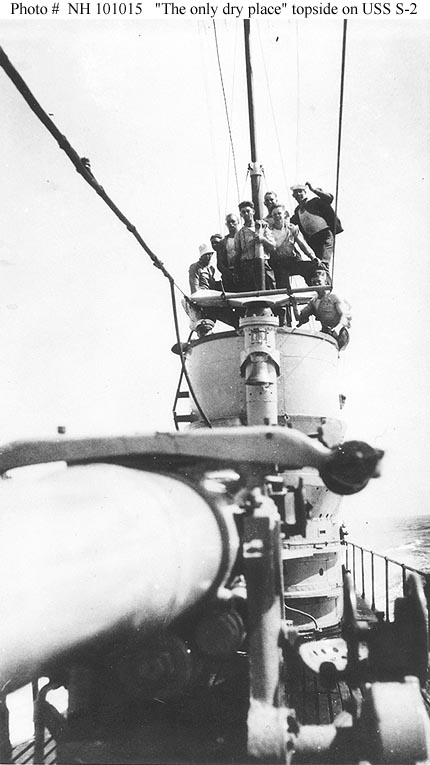
Surviving photographs bring the passage closer than the headline alone can. Images from August show the enlarged bow meeting the sea and crewmen gathering high on the fairwater. One photograph carried the caption “The only dry place topside.” Another records the close confines of the bridge on the subsequent passage between Pearl Harbor and Guam. These are useful reminders of the working scale of the achievement. An ocean crossing demanded sustained watchkeeping and maintenance aboard a boat with little shelter topside and limited space within. [4]
Earlier practice helps explain why the 1921 report attracted attention. In 1914, four American F-class submarines had reached Hawaii under tow by armored cruisers. That documented example provides a sound comparison with S-2’s passage under her own power. It does not establish that her voyage abruptly ended towing throughout the submarine force, or that no earlier submarine had crossed an ocean independently. Her achievement belongs within a continuing expansion of capability. [5]
The Hawaiian stop also included a reminder that reaching a distant base did not remove ordinary naval hazards. A photograph dated October 6, 1921, shows Chief Torpedoman’s Mate David J. Lohr beside damage to S-2’s after hull plating following a collision in which S-16 rammed her. Other photographs show S-2 in drydock at Pearl Harbor that October. The photographic record therefore adds a less triumphant episode to the newspaper’s celebration, without diminishing the passage already completed. [3, 4]
Hawaii was an intermediate destination in a deployment that continued west toward the Philippines. S-2’s place in this story rests on what her passage demonstrated in practice: a submarine could undertake a lengthy relocation and arrive across the Pacific with her own machinery having carried her there. The Richmond newspaper interpreted that achievement as an expansion of the submarine’s useful cruising radius. That was a reasonable contemporary assessment, even if its sweeping predictions outran the evidence. [1, 2]
The fleet submarines of the Second World War would embody far greater range and capability. S-2’s voyage was one step in the experience accumulated before those boats existed. For the men who took her from Portsmouth toward Asiatic service, the record consisted of successive passages, port calls, and watches completed. The 8,600-mile headline preserved the result; the enduring historical value lies in the growing ability of the submarine force to reach its operating areas under its own power.
Sources and editorial notes
1. Richmond Record-Herald, November 3, 1921, p. 3, “Lone American Submarine Makes Long-Distance Speed Record, 8,600 Miles in 29 Sailing Days.” User-supplied scan. The distance, sailing time, intermediate ports, and unaccompanied-voyage claim are attributed to this contemporary report; its precise record category has not been independently established.
2. Naval History and Heritage Command, Dictionary of American Naval Fighting Ships, “S-2.” https://www.history.navy.mil/research/histories/ship-histories/danfs/s/s-2.html
3. Naval Historical Center, Online Library of Selected Images, “USS S-2 (Submarine #106, later SS-106), 1920–1931.” See photographs NH 101010 and NH 101017. https://www.ibiblio.org/hyperwar/OnlineLibrary/photos/sh-usn/usnsh-s/ss106.htm
4. Naval Historical Center, same collection, Part II. Photographs NH 101012, NH 101015, NH 101018, and NH 101016 document the voyage and collision damage. https://www.ibiblio.org/hyperwar/OnlineLibrary/photos/sh-usn/usnsh-s/ss106-d.htm
5. Naval History and Heritage Command, Dictionary of American Naval Fighting Ships, “F-1 (Submarine No. 20).” https://www.history.navy.mil/research/histories/ship-histories/danfs/f/f-1.html
6 . Pigboats.com https://pigboats.com/S-2
ALL Images from NAVSOURCE


Leave a Reply