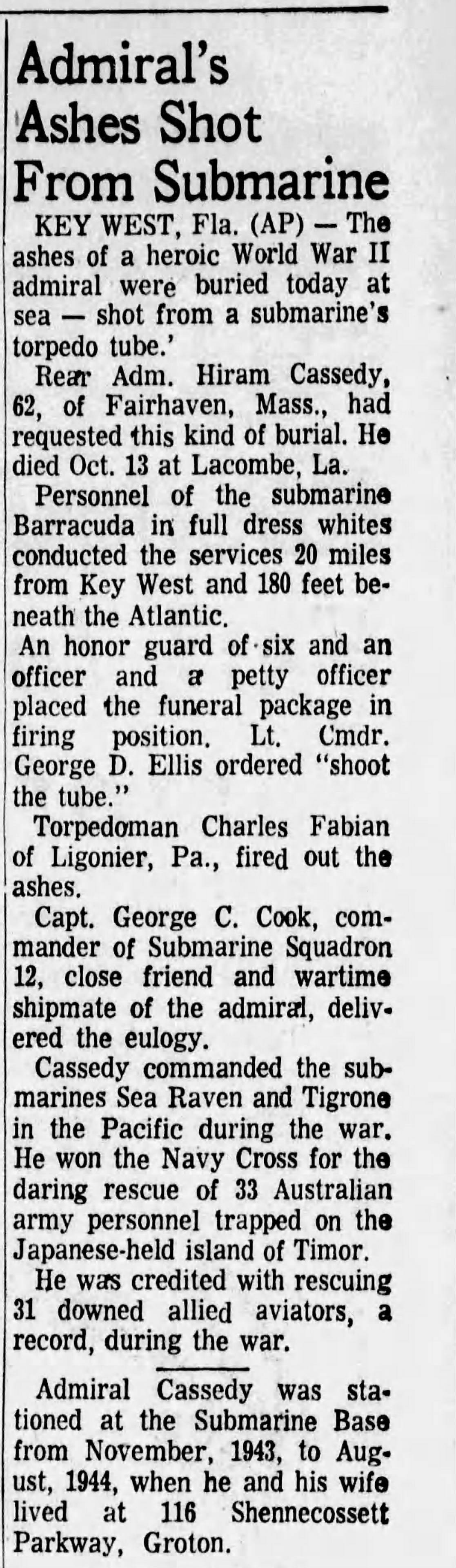
In October 1965, twenty miles off Key West, the submarine USS Barracuda carried the remains of Rear Admiral Hiram Cassedy beneath the Atlantic. At a reported depth of 180 feet, sailors in dress whites conducted the burial he had requested. An honor guard of six, accompanied by an officer and a petty officer, placed the funeral package in firing position. Lieutenant Commander George D. Ellis gave the order to shoot the tube, and Torpedoman Charles Fabian sent Cassedy’s ashes into the sea. Captain George C. Cook, commander of Submarine Squadron 12 and a wartime shipmate, delivered the eulogy. [1]
Cassedy had died on October 13 at Lacombe, Louisiana. The unusual ceremony, described in an Associated Press account published in The Day on October 29, returned a veteran submarine commander to the element in which he had earned his reputation. His career included torpedo attacks, narrow escapes, and the recovery of men who otherwise might never have come home. It also placed him at the edge of one of the submarine war’s enduring mysteries: the disappearance of USS Snook after an exchange of messages with his own boat in April 1945.
National history and Heritage Command
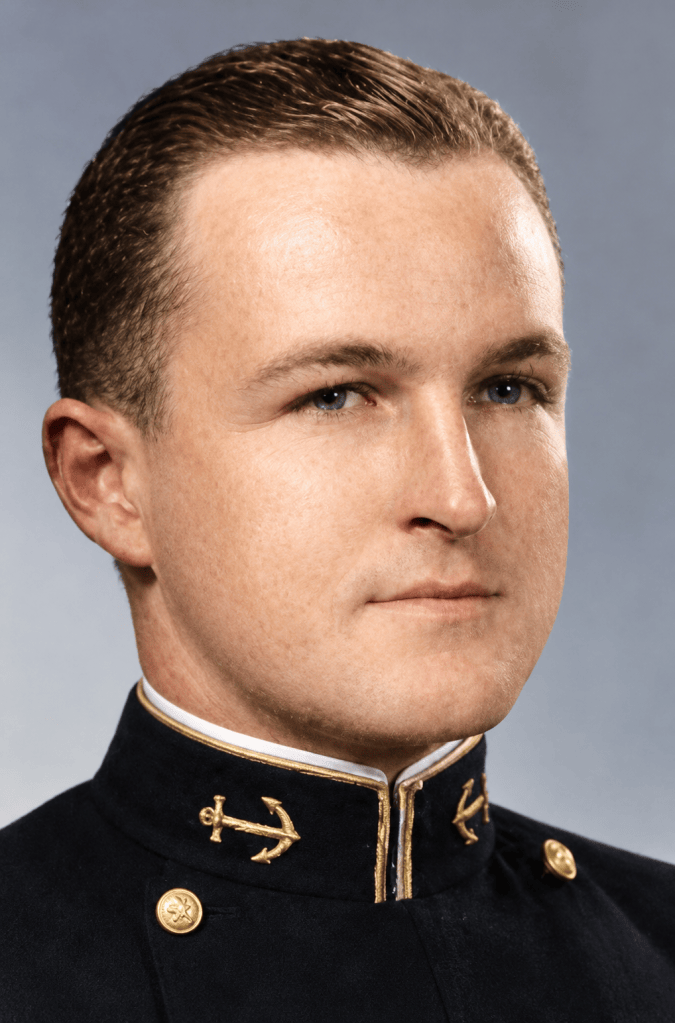
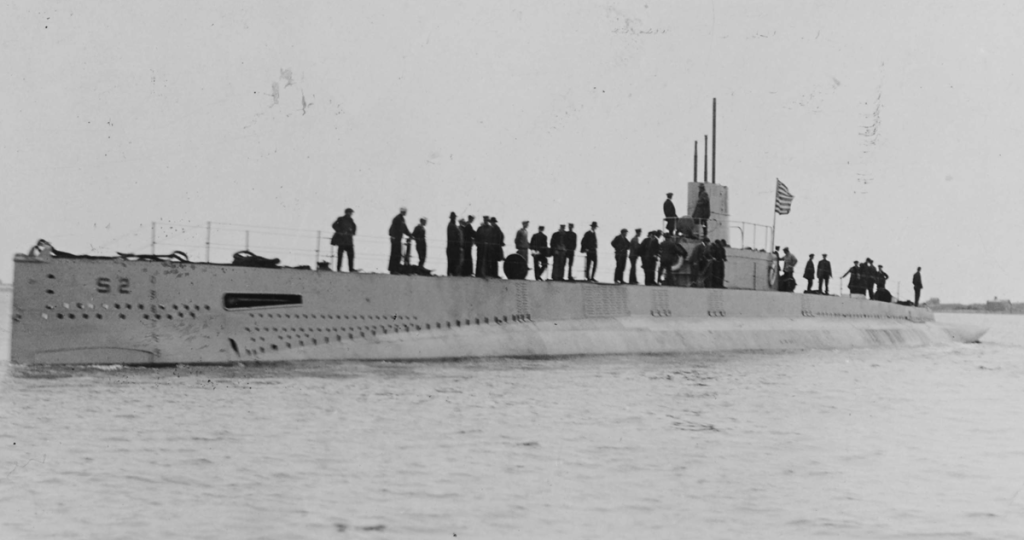
Born in Brookhaven, Mississippi, on July 4, 1908, Cassedy entered the Naval Academy in 1927 and graduated as an ensign on June 4, 1931. His first assignments took him aboard the destroyers Twiggs and Dickerson and the battleship New Mexico. Submarine training at New London followed in 1934. He served in S-48 and S-12 before helping fit out Perch at Electric Boat in Groton, Connecticut, and joining her when she commissioned in November 1936. These years gave him experience in both the older S-boats and the newer fleet submarines that would carry the American offensive into Japanese waters. [2]
After postgraduate instruction at Annapolis and a further destroyer assignment in Greer, Cassedy became executive and engineering officer in Sailfish. He was serving in the submarine in Philippine waters when war reached the western Pacific in December 1941. His work as executive officer, navigator, and assistant approach officer during three war patrols brought him the Silver Star. The citation emphasized his ability to navigate confined hostile waters and help maneuver the submarine into attacking position while preserving her ability to return to port. It was an early recognition of the judgment on which a submarine crew’s survival depended. [2]
In March 1942 Cassedy assumed command of Searaven. The following month he carried out the rescue that earned him the Navy Cross. On April 18–19, off Japanese-occupied Timor, he brought his submarine to a rendezvous with stranded Royal Australian Air Force personnel. Enemy forces knew the Australians were there and were attempting to capture them. Cassedy’s citation described the rescued men as emaciated and fever-ridden, and credited his preparation, navigation, and persistence with bringing them out while Searaven remained undetected. The later newspaper account put the number rescued at thirty-three. [1–2]
Rescue was only one part of his service in Searaven. Cassedy commanded her on six war patrols, receiving a second Silver Star and a Bronze Star with Combat “V” in addition to the Navy Cross. The award citations recorded attacks against Japanese shipping and successful escapes from enemy countermeasures. Their language belongs to the wartime assessment of those patrols, but the underlying demands are clear: a commander had to bring his boat close enough to strike, then find a way out under pursuit and depth charging. [2]
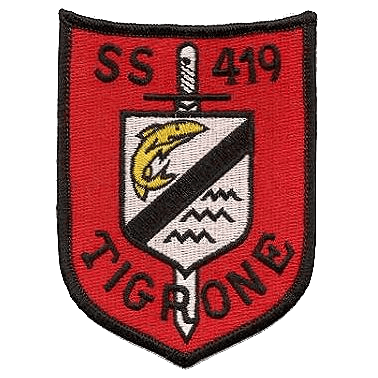
Detached from Searaven in October 1943, Cassedy served as an instructor at the Submarine School in New London before returning to new construction. On October 25, 1944, he commissioned Tigrone at Portsmouth, New Hampshire. By the spring of 1945, Commander Cassedy was taking the new submarine through her first war patrol in the South China Sea. He also exercised tactical command over a coordinated attack group whose membership changed as boats received other assignments. Snook, under Commander John F. Walling, was directed to join his group on April 1. Her ninth patrol would become her last. [2–4]
The boats operated in waters where hunting Japanese shipping overlapped with lifeguard duty for Allied aircraft. Such assignments required submarines to wait near enemy-held coasts, ready to recover airmen forced down during strikes. They also created a difficult problem of identification. A surfaced submarine could be seen by another submarine before either commander understood what he was looking at. Patrol-area boundaries and position reports reduced that danger, but they could not remove the uncertainty of a sudden sighting.
On the afternoon of April 8, Tigrone was on lifeguard station off Kuannan, near Hainan. According to the supplied patrol outline, at 1540 her lookouts noticed what appeared to be the remains of a ship’s wake. At first it seemed possible that Tigrone herself had left it during an earlier northerly run. Two minutes later the situation changed. An impulse bubble and a torpedo wake appeared about 500 yards away, bearing 340 degrees relative. The weapon was running shallow, at an estimated depth of six feet. [3]
Tigrone swung left. The torpedo passed abeam at less than sixty yards, a margin close enough to leave little room for a slower response. Cassedy submerged immediately, rigged the submarine for silent running, and remained below for more than two hours. The sound watch supplied no clear answer about the attacker. The outline reports that the sound operator was being relieved at the critical moment; once the station was manned, Tigrone’s own propeller noise obscured other sounds. The men had seen enough to escape a torpedo, but not enough to identify the submarine that had fired it. [3]
Cassedy’s first suspicion was deeply troubling. Tigrone was near the northern boundary of Snook’s assigned area. Had Walling mistaken her for an enemy patrol craft coming toward him? Details of the weapon seemed to leave that possibility open. Cassedy considered the small firing bubble, the shallow run, and a brown appearance suggestive of an American electric torpedo. Its apparent speed and wake also entered his assessment. These were observations made during a brief, dangerous encounter, rather than a positive identification. Nevertheless, the possibility that an American submarine had nearly torpedoed another demanded immediate investigation. [3]
That evening the question moved from the bridge to the radio room. At 1945 Tigrone asked Snook for her position at 0740 Zebra, or Greenwich time, and advised her of the attack. Snook’s reply at 2123 was incomplete, giving latitude without the longitude and time information Cassedy needed. Further messages revised patrol boundaries and repeated the request. One transmission was garbled and had to be sent again. The exchange proceeded in fragments until, at midnight, Snook supplied the requested position. [3]
As reconstructed in the supplied outline, Snook reported 18 degrees 40 minutes north, 110 degrees 40 minutes east, while Tigrone had been attacked at 19 degrees 40 minutes north, 111 degrees 39 minutes east. Those coordinates placed the boats well apart at the relevant time. Cassedy dismissed his suspicion of Snook and attributed the attack to an enemy submarine. The outline preserves his rueful acknowledgment: “silent apologies to Walling CO of Snook for my previous thoughts bordering upon manslaughter.” His relief did not require him to conceal the mistaken suspicion. He recorded it along with the information that had changed his mind. [3]
The distinction matters because the episode can easily acquire more certainty in the telling than the evidence permits. Cassedy’s reconstruction cleared Snook in his judgment. It did not establish the identity of Tigrone’s attacker. Nor does the torpedo incident establish what later happened to Walling’s boat. Even Snook’s reported longitude differs between the supplied outline and the Navy’s published loss account. The essential point survives that discrepancy: Tigrone exchanged messages with Snook on April 8, and the American boat Cassedy had feared was his attacker was still answering him that night. [3–4]
On April 9, Tigrone could no longer raise Snook. Orders followed directing Walling eastward toward Luzon Strait and then, on April 12, to lifeguard duty near Sakeshima Gunto in support of British carrier strikes. An order addressed to a submarine, however, is evidence of where she was wanted, not proof that she received it or reached the station. The April 10 message noted in Tigrone’s outline therefore cannot be treated as another transmission from Snook. Her confirmed radio contact with Cassedy had ended on April 8. [3–4]
The consequences became unmistakable later in the month. On April 20 a British carrier force reported an aircraft down in Snook’s assigned vicinity and an inability to contact the submarine. A further order required her to search and acknowledge. When no reply came, Bang was sent to search and rendezvous with her. Bang recovered the downed aviators but found no sign of Snook. On May 16 the missing submarine was presumed lost. The cause of her destruction remained unknown. Cassedy’s exchanges with Walling had become part of the surviving record of a boat that never returned. [4–5]
Cassedy continued the war in Tigrone. His Legion of Merit citation credited him with rescuing thirty Allied aviators during the submarine’s second patrol, from May 20 to July 3, 1945, in dangerous waters near the enemy coast. By the end of the war, according to the later newspaper account, he had rescued thirty-one downed Allied aviators. The work extended the service he had performed at Timor, bringing men aboard from waters in which remaining on the surface exposed the rescuers themselves to attack. [1–2]
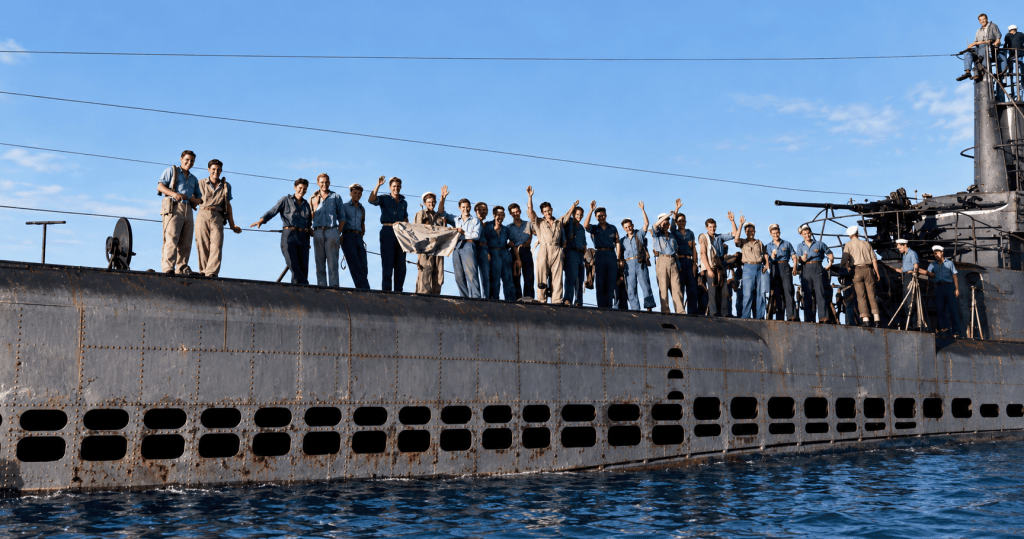
In July 1945 he became air-sea rescue liaison officer on the staff of the Commander in Chief, Pacific Fleet. There he helped instruct Army air commands in communications with submarines and procedures for recovering downed aviators. After the surrender he took part in handling captured Japanese submarines, bringing I-400 into port with a prize crew and later commanding I-14. He supervised a group of three former enemy submarines until their delivery to Pearl Harbor in January 1946. [2]
His postwar appointments ranged across the Navy. He served as gunnery officer on the Atlantic Fleet commander’s staff, commanded Destroyer Division 51, and headed the Undersea Warfare Section in the Office of the Chief of Naval Operations. Command of Submarine Squadron 7 followed, then the Naval War College, service as chief of staff to Commander Carrier Division 14, and command of the destroyer tender Shenandoah. Hospitalized in October 1955, he retired on April 1, 1956. Having attained captain in 1951, he advanced on retirement to rear admiral on the basis of his combat awards. [2]
Nine years later, Barracuda carried him below the Atlantic for the last time. The burial gave a submarine commander the final passage he had chosen, conducted by sailors using the machinery he had known in war. His record included men brought safely aboard at Timor and airmen recovered near Japan, as well as the unanswered silence that followed Snook’s last messages. At Key West there was an order, a firing, and a completed farewell. For Walling and his crew, the sea had left no such certainty.
Sources and editorial notes
1. “Admiral’s Ashes Shot From Submarine,” Associated Press, The Day, October 29, 1965. The opening follows the reported ceremony without assigning an exact burial date beyond October 1965. The clipping gives Cassedy’s age as 62; the official biography’s birth date of July 4, 1908, would make him 57 at death. The article therefore omits the disputed age. The clipping calls the Timor evacuees army personnel; the Navy Cross citation identifies them as Royal Australian Air Force airmen. Its thirty-one aviators is a wartime total, while the Legion of Merit citation credits thirty during Tigrone’s second patrol.
2. “Rear Admiral Hiram Cassedy, U.S. Navy, Retired,” Navy Biographies Branch, OI-450, May 1, 1956, four-page supplied biography, with a handwritten death notation. This is the principal source for his career and award citations. Its Sailfish paragraph contains an apparent chronological error, placing an April 1941 detachment before a May 1940 commissioning reference; the article avoids repeating that sequence. Wartime sinking claims in the citations have not been presented as independently verified postwar totals.
3. “Overview of April 1945 Patrol (First War Patrol),” supplied in OUTLINE _ Tigrone Patrol 1945.pdf, pp. 1–2.
4. Naval History and Heritage Command, “Snook (SS 279),” United States Submarine Losses in World War II. Consulted to check the early April chronology. The published account gives Snook’s April 8 position as 18°40′ N, 111°39′ E, differing from the supplied outline’s longitude of 110°40′ E. It identifies April 8 as the final contact with Tigrone and distinguishes later orders from messages received from Snook. https://www.history.navy.mil/research/library/online-reading-room/title-list-alphabetically/u/united-states-submarine-losses/snook-ss-279.html
5. Naval History and Heritage Command, “Snook I (SS-279),” Dictionary of American Naval Fighting Ships. Consulted for the April 12 and April 20 events and the May 16, 1945, presumed-loss date. The supplied outline incorrectly places the presumed-loss report in April. The article does not identify a particular Japanese submarine or attack as the cause of Snook’s loss. https://www.history.navy.mil/research/histories/ship-histories/danfs/s/snook-i.html


Leave a Reply