He was twenty-six years old when the hometown paper back in Monticello ran his photograph.
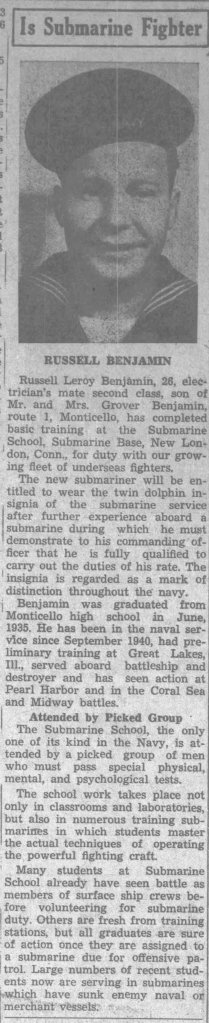
The headline called him a submarine fighter. The ink was grainy and the halftone blurred his face a little, but the pride was sharp enough to cut steel. Russell Leroy Benjamin, electrician’s mate, second class, son of Grover and Verda Benjamin of Route 1. A Monticello boy who had already seen Pearl Harbor, Coral Sea, Midway. Now he was headed to the Submarine School in New London, Connecticut, to join what the paper called “our growing fleet of underseas fighters.”
Monticello knew exactly what that meant. In 1943, submarines were not abstractions. They were the quiet answer to a loud enemy.
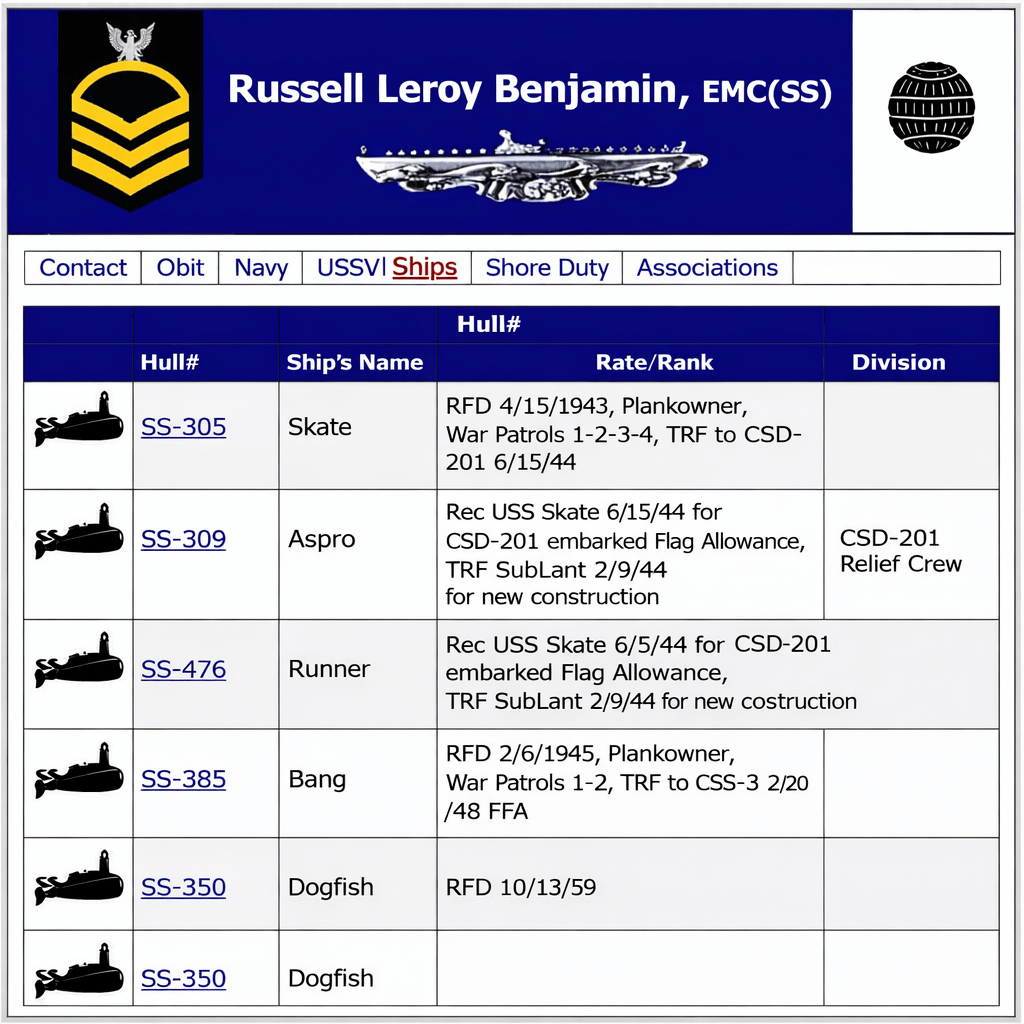
Richard Benjamin, plank owner of USS Skate, would have carried that clipping in his seabag. Not literally, perhaps. But in the mind, yes. Every man who ships out carries something with him. For some it is fear. For others, ambition. For a boy from Indiana, it is the weight of home. When the paper says you are one of a picked group of men, when your neighbors read that you have earned the right to wear the twin dolphins, you do not want to let Monticello down.
Skate was commissioned in April 1943 at Mare Island. Plank owners like Benjamin were there at the beginning. New steel. Fresh paint. Electrical panels that still smelled like varnish and ozone. An electrician’s mate would have known that boat the way a farmer knows his fields. The switchboards, the battery wells, the hum of the motors. When the lights flicker in a submarine, it is not an inconvenience. It is a warning. The ocean presses from every side. Electricity is life.
The first patrol took Skate west of Wake Island in September 1943. There is a way to tell that story with statistics. Six aviators rescued. One officer killed. Patrol successful.
But statistics are for reports. The patrol itself was noise and heat and sudden fear.
Skate’s first patrol put her into the new and dangerous business of lifeguard duty. American carrier planes were striking Wake, and if a pilot went down, there was only one hope between him and captivity or death. A submarine on the surface, running bold in daylight, daring shore batteries and prowling aircraft to take their best shot.
Imagine the bridge watch scanning a hard blue horizon while bombs burst near shore. Imagine the sound of a strafing run. The quick metallic chatter of machine-gun rounds snapping overhead. The dive alarm. The hatch slamming. The boat angling down.
Richard Benjamin would not have been on the bridge. He would have been below, near his panels, feeling the tremor as the boat passed through fifty feet, then one hundred. The lights dimming slightly as motors shifted load. Gauges twitching. Someone calling out depth. Someone else swearing under his breath.
Then back up again. Surface. Search. Repeat.
Six times they went in. Six American aviators were hauled aboard under fire. One of their own, Lieutenant (jg) Willis Maxson, was hit during the rescue operations and later died. The patrol report records his burial at sea. The crew gathered below decks, then on deck, and committed him to the Pacific.
There is no romantic way to say that. A man stands at attention. A prayer is read. The body slides. The sea takes him.
For a plank owner like Benjamin, that moment would have burned itself into memory. This was no longer training. No longer drills in San Diego. This was war, and the cost had a name.
When Skate returned to Pearl Harbor in late October, the patrol was judged successful. But the boat had been blooded.
The second patrol, beginning in November 1943, moved into the waters off Truk. If Wake was dangerous, Truk was the hornet’s nest.
Japanese shipping flowed in and out of that lagoon. Freighters. Destroyers. Carriers. Battleships. The Imperial Fleet used Truk as a fortress and a shield. Skate went in anyway.
Shortly after arriving on station, she closed a convoy and sank a 6,500-ton freighter. That is the official language. What it means in practice is that men in a darkened control room listened for the right moment. The fire control party whispering ranges and bearings. The captain waiting for the angle to steady. The order to fire.
Torpedoes leave with a metallic cough and a shudder. Then silence. Then counting. Then the distant, unmistakable concussion of impact.
Benjamin, down in the engine room or maneuvering space, would have felt it through the hull. A vibration. A slight tremor. Men glance at one another and say nothing. The boat angles away. Then come the depth charges.
If you have never been depth-charged, you have never known the sound of a steel drum struck by a giant. The explosion does not simply boom. It compresses. It shoves. The hull rings. Light bulbs flicker. Dust drifts down from overhead.
An electrician’s mate has no luxury of panic. Circuits must hold. Motors must respond. Batteries must not short. In a submarine, every man is a system. If one fails, all fail.
During that patrol, Skate also attacked heavily protected carriers. Three torpedoes struck one of them before the escorts drove her deep. The patrol report also credits her with damaging the battleship Yamato during a Christmas Day attack in a rain squall.
Whether every tonnage estimate held up after the war matters less than this: the men aboard believed they had struck at the heart of the enemy fleet. They had gone in under air cover, destroyer screens, and returned alive.
Proud plank owners do not boast loudly. But they know.
The third patrol, beginning in February 1944, kept Skate in the Carolines. By now, the crew had the feel of the boat. She was no longer new steel. She was their boat.
On February 16, 1944, Skate made one of her most celebrated attacks. At sundown she fired four torpedoes at the light cruiser Agano. Three hit. The cruiser stopped dead in the water.
Skate had to withdraw under depth charging. The destroyers came hard. Charges walked across the sea above her. Inside, the air grew warm and thick. Men counted silently. Five seconds between explosions. Ten. Then another.
Electrical gear takes a beating under that kind of shock. Panels rattle. Contacts arc. Benjamin and the other electricians would have been watching, listening for the wrong sound, the wrong smell. Burned insulation is the scent of disaster.
When the night came, Skate returned. Agano was burning. Before Skate could deliver a final shot, the cruiser rolled and sank on her own.
There is a cold satisfaction in that. Not hatred, not gloating. Just the knowledge that you did your job and lived.
Three patrols. Each one successful. Each one marked by tension, fear, exhaustion, and pride.
Back in Monticello, the hometown paper could not know the details. They could not print the tonnage figures or the names of ships struck. But they knew one thing. Their boy was part of something dangerous and necessary.
The clipping that had once announced his graduation from Submarine School would have taken on new weight. This was no longer theoretical training. Russell Leroy Benjamin was a plank owner of a boat that had rescued aviators under fire, attacked carriers, and sunk a cruiser.
The paper had called submarine school a picked group. It was right. The tests were physical, mental, psychological. But what the paper could not describe was the way that group became a family under pressure.
In a submarine, privacy disappears. You sleep in another man’s rack. You eat in shifts. You hear every cough, every laugh, every whispered letter from home. When the boat dives, you share the same air.
For Benjamin and the rest of the crew, pride was not abstract patriotism. It was pride in keeping the lights on. Pride in a torpedo that ran true. Pride in coming back.
He would go on to serve more than twenty years in the submarine service. After retirement, he worked at Electric Boat in Groton, the same yards where so many submarines were born. That is not coincidence. Men who have lived in steel tubes under the Pacific tend to feel at home around submarines for the rest of their lives.
When he died in 1992 at age seventy-five, the obituary in The Day of New London recorded his service plainly. Retired Navy Chief. World War II veteran. Submarine service more than twenty years. Member of the Submarine Vets of World War II. Masonic brother. Husband. Father.
Submariners speak of Eternal Patrol. It is not a dramatic phrase. It is quiet and steady. A man who once slipped beneath the surface now slips beyond it. The boat sails on without him, but the record remains.
Somewhere in Monticello, Indiana, a newspaper once printed the photograph of a young electrician’s mate in a flat cap. It spoke of picked men and growing fleets. It could not have imagined the depth charges, the rescue missions, the burning cruiser at dusk. But it knew enough.
It knew that one of its own had gone down to sea in submarines.
And in those first three patrols of Skate, with lights flickering and torpedoes running, with aviators hauled from the water and a shipmate committed to the deep, Russell Leroy Benjamin and the rest of that crew earned the right to wear those dolphins that the paper so proudly described.
They were plank owners. They were undersea fighters. And for a time, in steel and darkness, they carried Monticello with them.


Leave a Reply