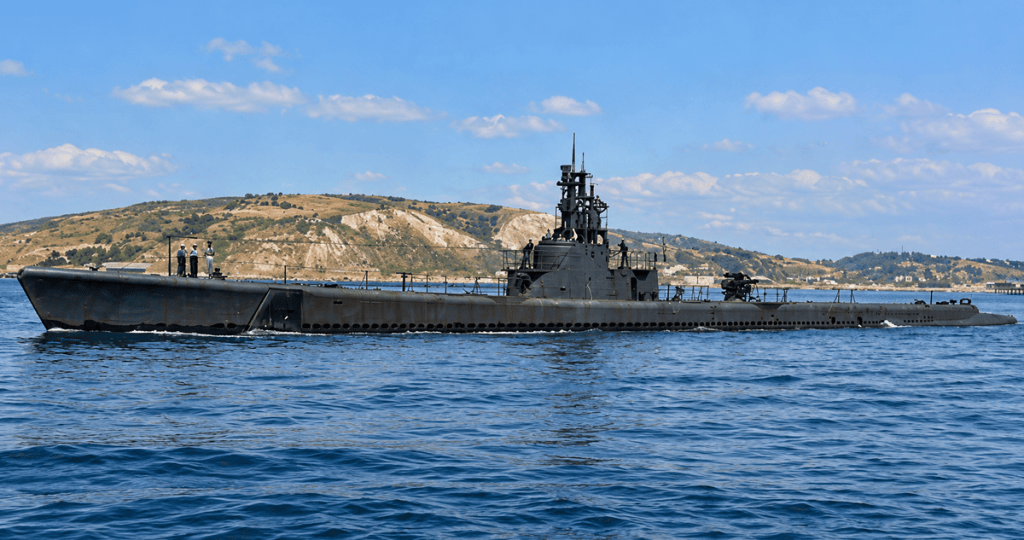
USS Kingfish SS-234 and the uncertain business of submarine warfare
October 27 1944
Shortly after midnight on October 27, 1944, USS Kingfish (SS-234) moved into position ahead of an escorted Japanese ship bound toward Iwo Jima. Her radar had provided the contact, and hours of tracking had brought her within striking distance. Then the moon set, visibility deteriorated, and the equipment that automatically set the torpedoes’ gyro angles failed to follow. Lieutenant Commander Talbot E. Harper and his crew would have to complete the attack using sound bearings and manual adjustments.
Before the day ended, Kingfish would make another attack, endure two depth-charge counterattacks, investigate the equipment failure, and continue the maintenance that kept a fleet submarine operating in enemy waters. The results would prove less straightforward than the sequence of events. One attack produced convincing evidence of destruction; the other appeared to have failed. Only later would the record credit Kingfish with two sinkings that day.
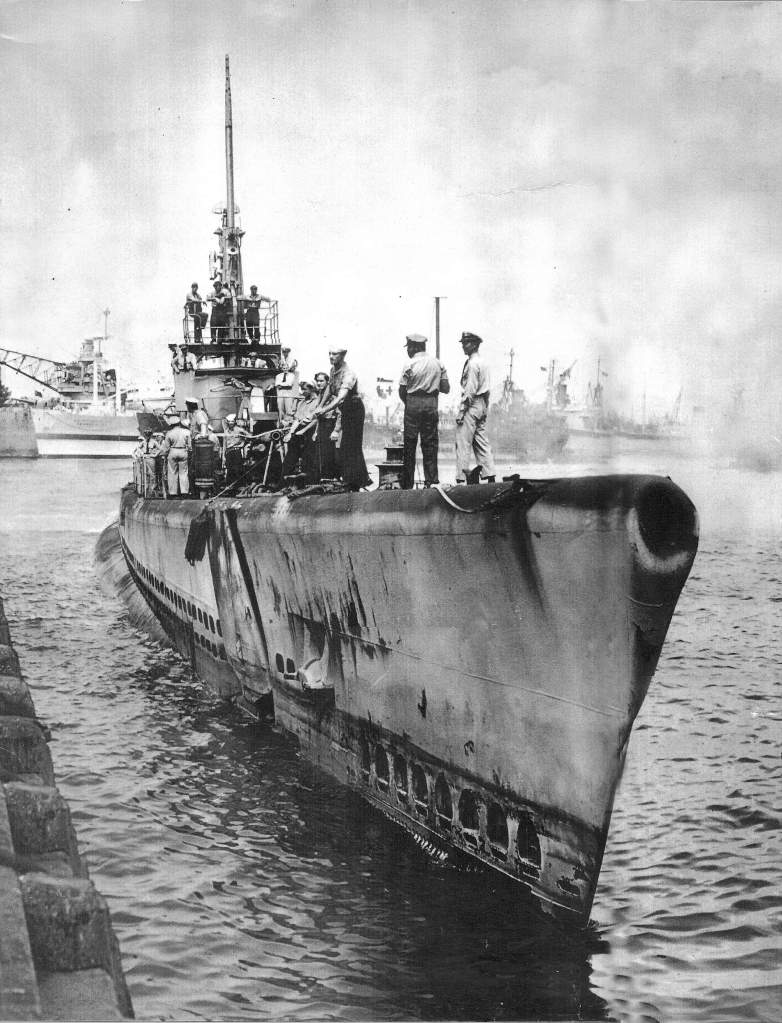
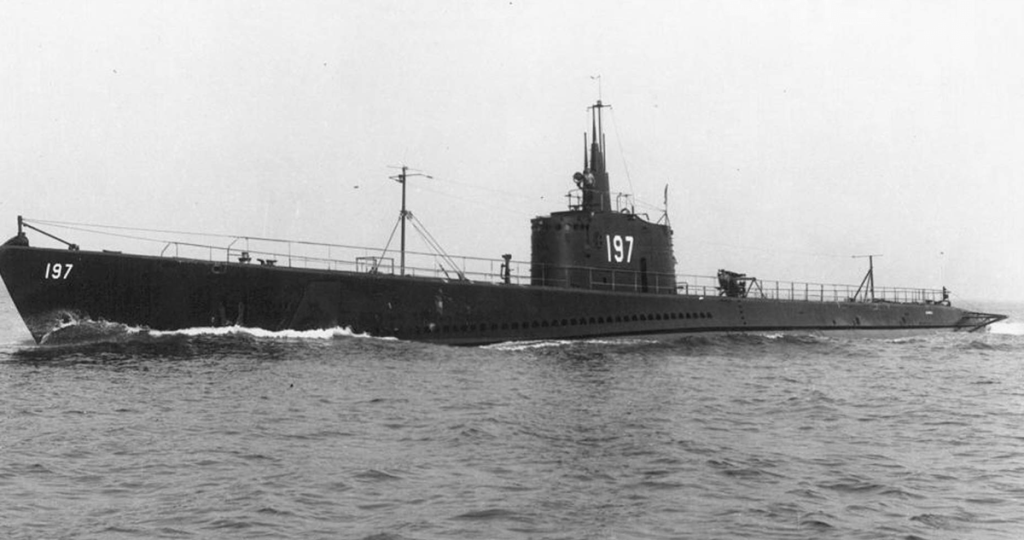
Commissioned in May 1942, the Gato-class submarine was already a veteran of the Pacific war. Her service had included attacks on Japanese shipping, special missions, and a devastating depth charging in March 1943 that required extensive rebuilding at Mare Island. Following another overhaul in 1944, she returned to combat under Harper, departing Pearl Harbor on October 12 for her ninth war patrol.
Her assigned waters lay among the Japanese island outposts south of the home islands. Chichi Jima and Haha Shima stood to the north of Kita Iwo Jima and Iwo Jima, with supply traffic moving between the scattered garrisons. Kingfish entered her patrol area on October 24 and attacked the freighter Ikutagawa Maru, which sank after being torpedoed. The escorts answered with an estimated twenty-four depth charges, but the submarine escaped and continued hunting.
On the evening of October 26, Kingfish patrolled across the route between Haha Shima and Kita Iwo Jima. At 2148, her SJ surface-search radar detected two vessels approximately 20,000 yards away. Harper shifted his attention to the new contacts and began working into position.
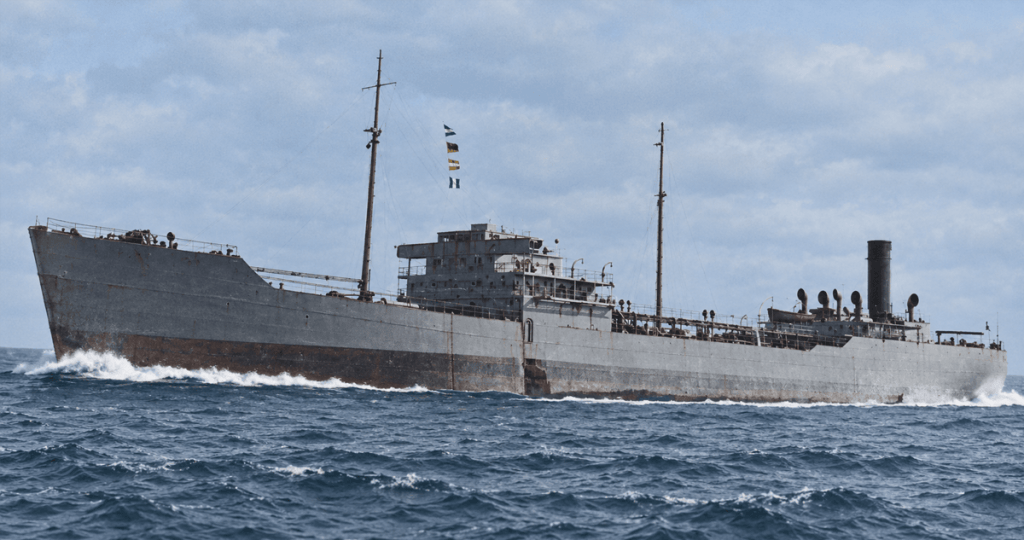
The larger vessel appeared to be a heavily loaded, medium-sized tanker with its engines aft. A patrol craft maintained station about 2,000 yards ahead, while the apparent tanker zigzagged along a southwesterly base course at six knots. At 2245, Harper put four engines on the line and ran ahead of the formation.
At 0022 on October 27, Kingfish submerged to radar depth, keeping enough of her radar installation above water to continue the approach. The escort was then about 8,000 yards away. Sixteen minutes later, the moon set, and the target steadied on its base course. Harper continued closing, then brought the boat to periscope depth when the escort was approximately 3,500 yards distant.
The darkness complicated the final approach. Neither target nor escort could be seen through the periscope when the moment came to fire. The automatic gyro-setting system also failed to follow the changing settings, requiring the crew to match the torpedo gyro angles by hand. At 0109, Kingfish fired from tubes one, two, and three on continuous sound bearings.
A minute later, two explosions arrived at the expected intervals, each followed by another explosion comparable in strength to the torpedo detonation itself. A subsequent reconstruction of the attack placed the first torpedo amidships and the third just inside the bow. Through the sound equipment and the submarine’s hull came noises interpreted as burning and structural breakup.
Harper turned left and went deep at 0112. The escort, which had begun pinging with the first torpedo explosion, dropped its first depth charge at 0118. Five more followed. None was judged particularly close, and at 0120 Kingfish could still hear sputtering and breaking-up noises from the direction of the target.
By 0207, Harper considered it safe to return to periscope depth. The submarine surfaced at 0234 and found only one radar contact, opening the range in the direction of the last sound contact. By 0250, that vessel had disappeared from the radar screen, and Kingfish cleared the area to the southeast.
The ship Harper had classified as a tanker was subsequently identified as the Japanese Army cargo vessel Tokai Maru No. 4, of 537 tons. Its loss illustrates the limits of identification during a submerged night attack. The crew could establish a course and speed, calculate an interception, and deliver torpedoes without being able to determine precisely what kind of ship occupied the far end of the firing solution.
At 0440, Kingfish submerged again, reloaded, and tested the forward gyro regulator. The regulator operated correctly during the test. The explanation advanced aboard the submarine was that stiff gyro-setting mechanisms, described in the report as “gyro pots,” on one of the torpedoes already fired had tripped the regulator’s overload relays. That remained a diagnosis rather than a demonstrated finding. Daily tests of the equipment were being made to watch for further trouble.
The morning brought three heavy but distant explosions at 0910, without an explanation recorded in the diary. The next opportunity developed at 1525, when masts appeared bearing southwest. Kingfish, then at approximately 25°09′ north, 141°37′ east, changed course to close.
Harper identified a small freighter accompanied by what appeared to be a new patrol vessel resembling the Shimushu class and another escort resembling a submarine chaser. Both apparent escorts were pinging. The formation zigzagged on a northeasterly base course at six knots.
At 1610, with the target approximately 3,700 yards away, Harper maneuvered for a ninety-degree starboard track. The leading escort initially appeared to be crossing into a favorable position for Kingfish. Then it presented a bow-on aspect. Further observations showed it swinging back and forth, alternately showing its starboard and port bows, complicating the submarine’s approach.
At 1623, Kingfish fired from tubes three, four, and six. While the firing bearings were being set, the target belched black smoke. As the torpedoes went away, sound reported that it was increasing speed. Harper turned right and took the submarine deep.
This time there were no sounds of torpedo hits. Nor were any end-of-run explosions heard. At 1630, the first depth charge exploded; by 1643, twelve had been counted. All were overhead in the submarine’s general vicinity, but none caused damage.
Kingfish withdrew eastward and reloaded her forward tubes. The crew also resumed watering the batteries, a maintenance task interrupted when the ships were sighted. In the patrol diary, the return to this ordinary work follows directly after the depth charges. Successful evasion preserved the boat, but continued attention to her machinery and batteries made the next operation possible.
When Harper surfaced at 1945, he reviewed the afternoon’s disappointing results. A fresh northeasterly wind had raised considerable rolling swells, making it seem improbable that the Japanese had spotted his periscope. He had noticed no change in the escorts’ pinging before firing. Although no aircraft had been seen, a later report from friendly aircraft indicated that the formation had air cover.
Harper decided against another pursuit. Kingfish would be starting late and beating into rough seas, with little prospect of predicting the target’s next course change. The submarine continued away from the encounter, her crew having heard nothing that confirmed a successful attack.
The later identification of the formation changed the account. It consisted of the landing ships T.138 and T.132, accompanied by submarine chaser CH-47. The Navy’s subsequent history records that T.138 sank, while CH-47 rescued survivors and T.132 continued to Iwo Jima. The attack Harper believed had missed had, in fact, destroyed another Japanese vessel.
October 27 ended with Kingfish intact after two attacks and eighteen depth charges. Her crew had overcome a failure in the torpedo-setting equipment, reloaded twice, and kept the boat ready while Harper made decisions from incomplete observations. The final accounting credited them with Tokai Maru No. 4 and Transport No. 138, but the patrol diary preserves the more difficult experience of the men who fought the actions: strong evidence in the darkness, apparent failure in daylight, and uncertainty after both.
That record gives the day its enduring significance. Behind the sinking credits stood trained sailors adjusting equipment by hand, maintaining machinery between contacts, and carrying out their duties without the benefit of knowing how the story would eventually be resolved.
References
United States Navy. USS Kingfish (SS-234). “Report of Ninth War Patrol.” Enclosure A, October 26–28, 1944, 4–6.
Naval History and Heritage Command. “Kingfish (SS-234).” Dictionary of American Naval Fighting Ships.


Leave a Reply