The 1977 Operation Petticoat remake and USS Roncador (SS-301)
My introduction to Operation Petticoat came through television. Before I discovered Cary Grant and Tony Curtis aboard the original cinematic USS Sea Tiger, there was John Astin commanding a pink submarine on ABC. The 1959 movie proved to be the better production, but the television version has retained a certain affection in my memory. Sometimes the first version of a story we encounter earns a permanent berth, even after we discover something better.
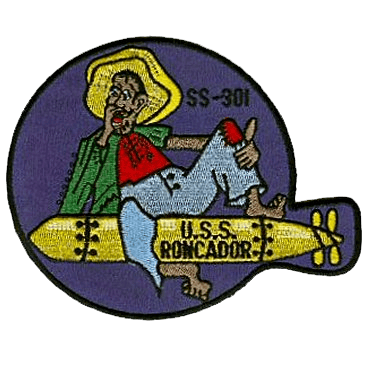
The television remake also had something that deserves attention beyond nostalgia. Beneath the pink paint was a real American submarine, USS Roncador (SS-301). By the time she became a television performer, she had already served the Navy, trained another generation, and survived several uncertain attempts to find her a civilian future. Playing Sea Tiger was one more unexpected chapter in a career that had begun during World War II.
In 1977, most viewers (including me) probably paid more attention to the nurses.
Another voyage for USS Sea Tiger
Universal Television’s adaptation reached ABC as a two-hour television movie on September 4, 1977, followed by the weekly half-hour series on September 17. The pilot also circulated under the title Life in the Pink, an appropriate description of a production whose most recognizable cast member needed neither dialogue nor a dressing room.
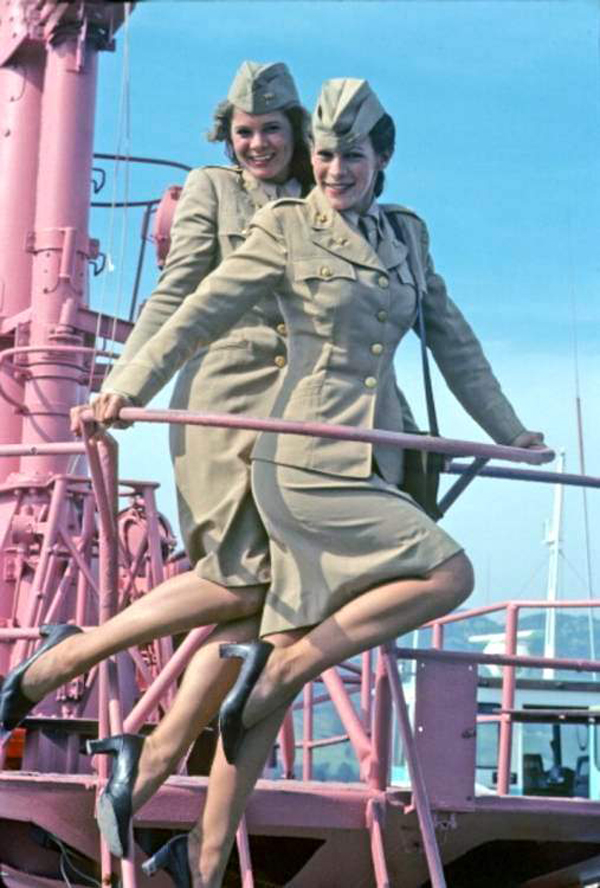
The premise preserved the familiar machinery of the original story. A battered American submarine, caught in the disastrous opening phase of the Pacific war, is restored to something approaching seaworthiness through determination, improvisation, and a supply officer’s flexible understanding of government property. Along the way, the boat acquires five stranded Army nurses and a paint job that would have been difficult to explain at a squadron inspection.
For television, the predicament became permanent. A movie could carry its passengers toward a destination and eventually resolve the confusion. A weekly sitcom needed the nurses to remain aboard, the captain to remain exasperated, and Sea Tiger to keep producing another half-hour of complications.
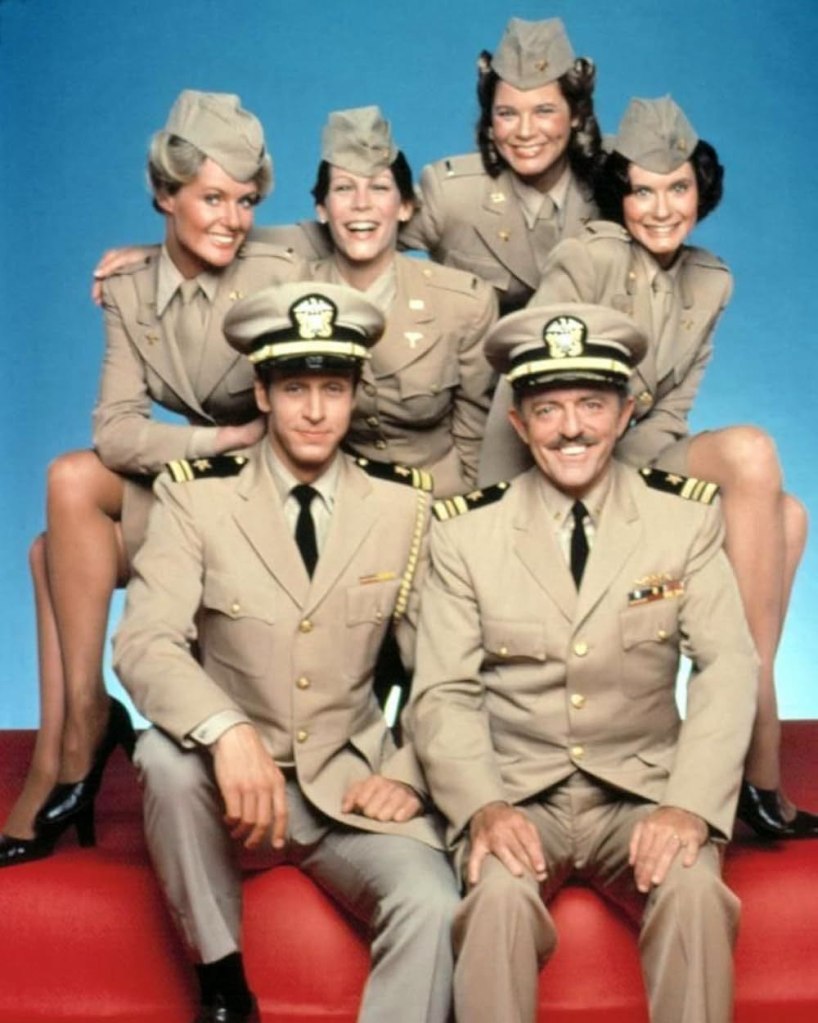
Astin inherited Lieutenant Commander Matthew Sherman, the role Cary Grant had played with such controlled frustration. Familiar to television audiences as Gomez Addams, Astin brought his own comic personality to a skipper struggling to maintain military order aboard a vessel apparently determined to defeat it. Richard Gilliland played Lieutenant Nick Holden, whose talent for obtaining supplies was considerably more dependable than his respect for ordinary procedure.
Jamie Lee Curtis supplied the production’s most appealing family connection. As Lieutenant Barbara Duran, she joined a remake of the film in which her father, Tony Curtis, had played Holden. The connection gave the television version a tangible link to its predecessor, even as it tried to establish its own identity. Among the supporting performers were Melinda Naud as Lieutenant Dolores Crandall, Richard Brestoff as Yeoman Alvin Hunkle, and Jim Varney as the pessimistic Seaman Broom.
It was broad comedy, and nobody needed submarine qualifications to recognize the formula. Close quarters provided misunderstandings; military regulations supplied obstacles; Holden supplied ways around them. The pink submarine made the whole business immediately identifiable.
A critic opens fire
Not everyone found the arrangement entertaining. On October 25, 1977, Newsday television critic Marvin Kitman published a review under the headline “Down to the depths in a coed submarine.” His assessment makes clear that affection for the series was hardly universal.
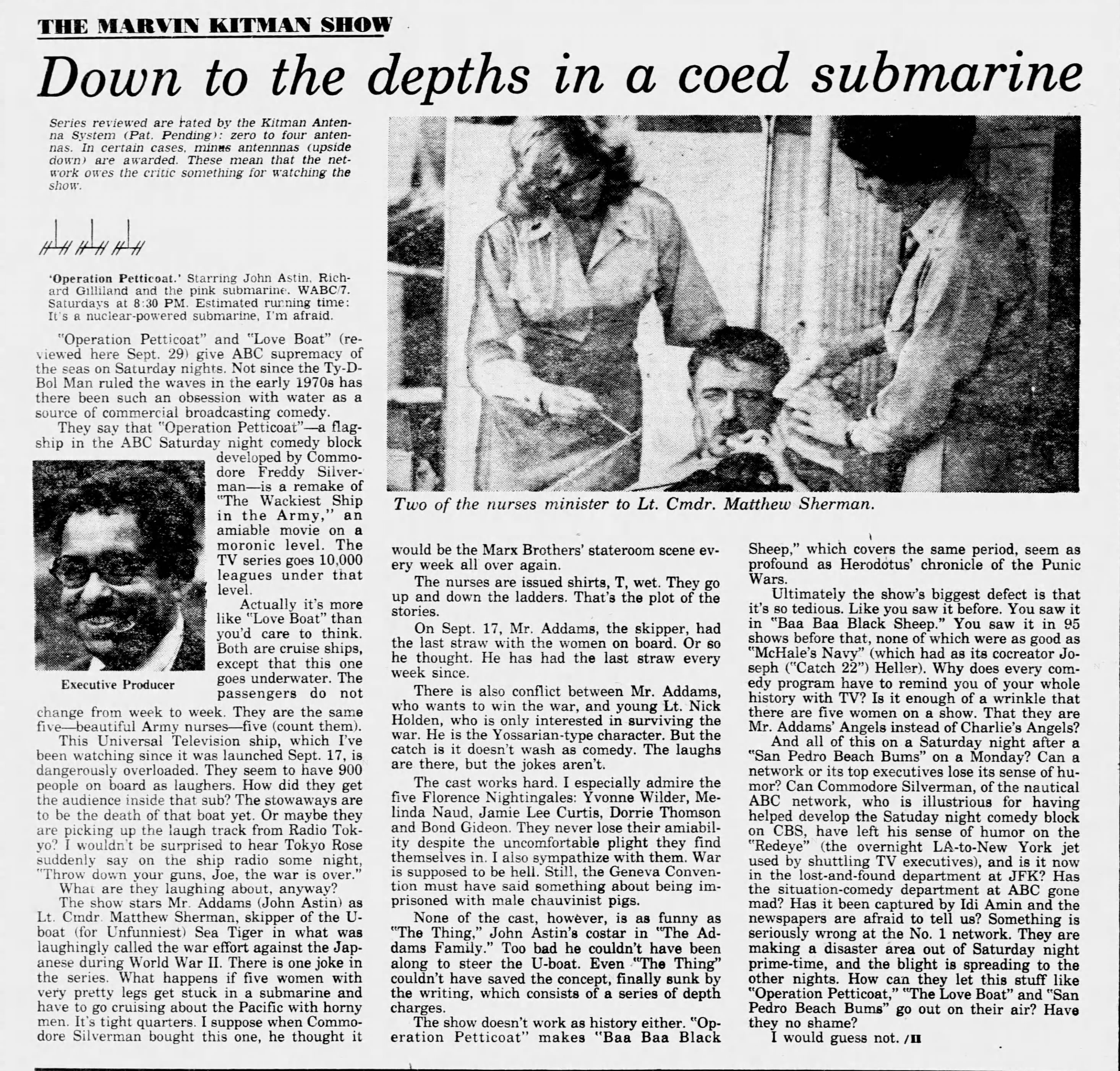
Kitman attacked the repetitive situations, the conspicuous laughter, and the dependence on putting women into a crowded submarine with interested sailors. He regarded the program as another variation on military comedies that television had already exhausted. He did, however, acknowledge the cast’s effort, particularly the actresses working within the material they had been given.
His review is useful because it captures the series before nostalgia had softened its edges. This was a new program competing for an audience in the autumn of 1977, and at least one prominent critic thought its jokes had arrived considerably older than its submarine.
There is room to accept much of that criticism and still remember the show fondly. Operation Petticoat was lightweight entertainment, dependent on familiar characters and situations. For viewers encountering Sea Tiger for the first time, those limitations did not necessarily prevent an enjoyable introduction to the story.
For submarine historians, meanwhile, the most interesting performer was waiting outside the soundstage.
The submarine beneath the paint
USS Roncador was a Balao-class fleet submarine, laid down at Cramp Shipbuilding Company in Philadelphia* on April 21, 1943. Launched on May 14, 1944, she entered commission on March 27, 1945, with the Pacific war approaching its final months.
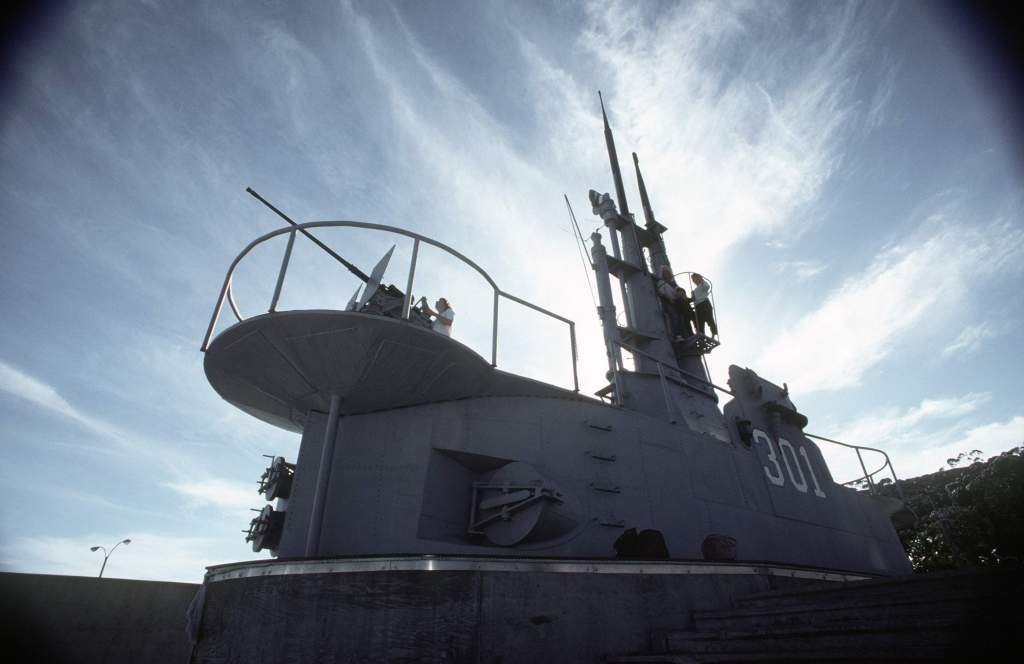
Her timing matters. Although built during World War II, Roncador did not conduct a wartime combat patrol. Her early service involved preparation and training rather than attacks on Japanese shipping.
Following shakedown, she arrived at Port Everglades, Florida, on May 26, 1945, and spent approximately two months assisting the development of antisubmarine warfare techniques. She departed for Panama on July 29 and conducted advanced training off the Canal Zone during August. Japan’s surrender overtook the wartime career for which she had been built.
After visiting Guantánamo Bay, Roncador headed into the Pacific, reaching Pearl Harbor on October 3, 1945. She remained in Hawaiian waters into the following year, then departed for San Francisco and inactivation in January 1946. Decommissioned on June 1, she joined the reserve fleet.
That might have been the end of her useful service. Instead, in February 1960 she received another assignment, supporting Naval Reserve training in Southern California in a noncommissioned status. Redesignated AGSS-301 in December 1962, she continued that work until she was stricken from the Navy list on December 1, 1971.
For a boat that had missed combat, training became a substantial part of her contribution. The equipment and compartments of an older submarine still offered practical instruction, connecting new trainees with the machinery and working spaces of the fleet boat era.
Her civilian future proved less settled. Plans to preserve her as a museum at Ports O’ Call Village in San Pedro failed to materialize. Sold for scrapping in January 1973, she nevertheless survived and briefly appeared on display at King Harbor in Redondo Beach in 1976. That September, she was resold to Nicolai Joffe of Beverly Hills.
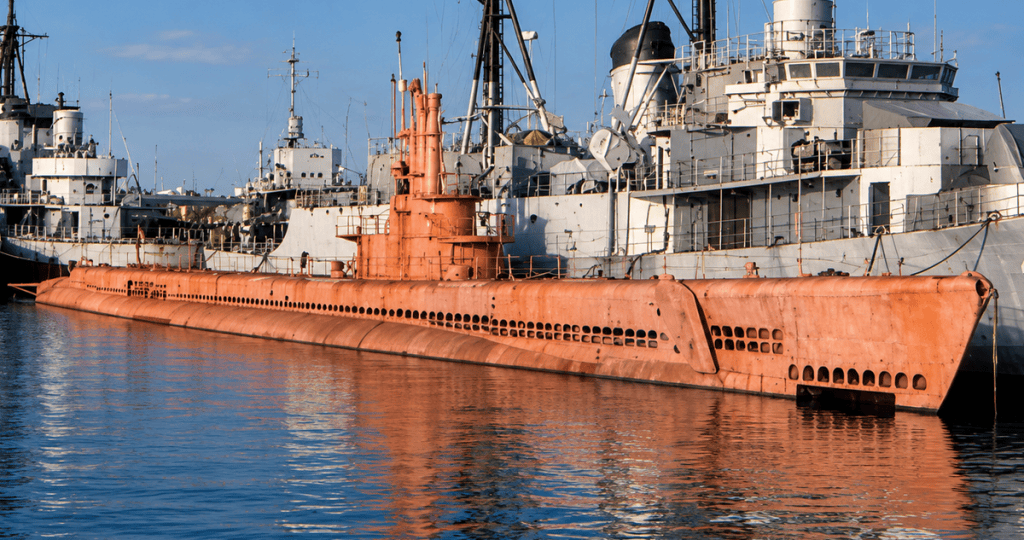
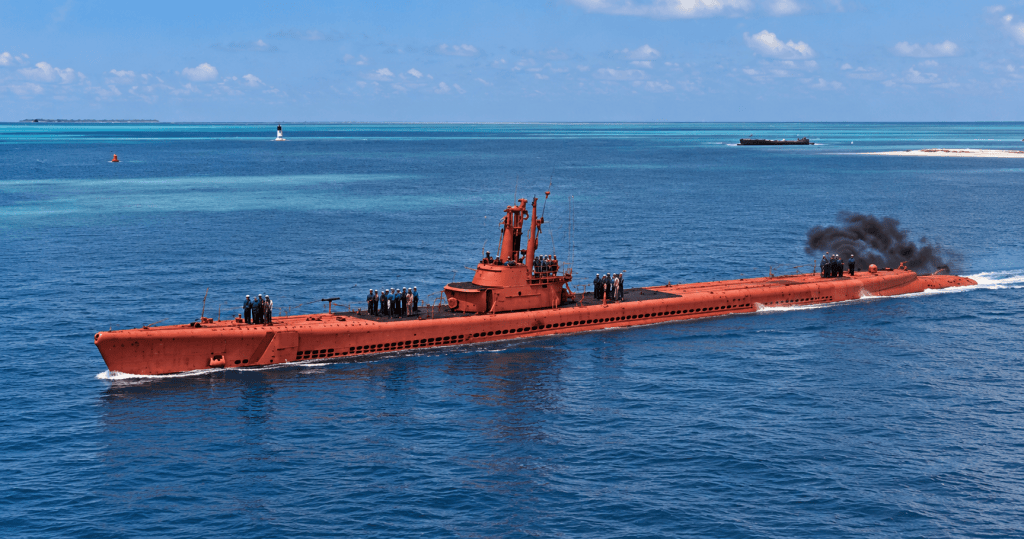
Then television found a use for her. Painted pink, the former Roncador portrayed Sea Tiger for the remake’s exterior filming. There was an absurd appropriateness to the assignment: a submarine that had repeatedly escaped the end of her career was now playing a fictional submarine kept going through ingenuity and improbable good fortune. Photographs document her television appearance and her presence at Long Beach after filming.
Changing the crew
The series itself proved harder to keep afloat. Between its first and second seasons, the production replaced fifteen of its eighteen regular performers. Astin, Gilliland, and Curtis departed; Naud, Brestoff, and Varney remained. Robert Hogan and Randolph Mantooth joined the new principal cast.
The overhaul also changed the premise. Sea Tiger became a lifeguard submarine assigned to rescue downed airmen, with nurses serving aboard as assigned personnel. That gave the boat a more continuing operational purpose, but it substantially altered the predicament around which the original comedy had been built.
Such an extensive change asked viewers to begin again with a program they had only recently learned to recognize. Whatever the merits of the individual replacements, much of the familiar ensemble was gone. The revised production failed to secure a lasting future, and the television venture ended after two seasons, with additional episodes broadcast in 1979.
Roncador eventually reached the end that her earlier owners had postponed. Her hull was scrapped, but a significant piece survived: the fairwater structure, commonly described as her conning tower, preserved at the submarine memorial at Ballast Point in San Diego. A historical photograph taken during its preservation even records traces of pink overspray from the television production.
That detail brings the two careers together rather neatly. The surviving structure belongs to a real Navy submarine, yet part of its recorded history includes an assignment as one of television’s least regulation-looking warships.
I still prefer the original Operation Petticoat. Cary Grant and Tony Curtis made a better film than the television adaptation could sustain as a weekly series. But the remake introduced me to Sea Tiger, and remembering it now leads to something more substantial than a verdict on old jokes.
Behind the actors was Roncador: built for a war that ended before she could patrol, retained to train others, and given an unlikely final public role. Her story deserves a place beside the comedy. For a little while in 1977, beneath all that pink paint, a veteran fleet boat had found another way to be useful.
*Cramp Shipbuilding in Philadelphia was problematic during World War II, with substantial difficulties delivering submarines (including USS Ling). Many of the boats they built had to be finished elsewhere and arrived too late to participate in the war.
Kitman, Marvin. “Down to the Depths in a Coed Submarine.” Newsday, Suffolk edition, October 25, 1977, 121. Supplied newspaper clipping.
“USS Roncador.” Supplied historical reference PDF.
“Article Outline: Patrol Reports: Re-boarding the Pink Submarine (1977–1979).” Supplied production outline.
NavSource Naval History. “Submarine Photo Archive: Roncador (SS-301).” Accessed October 25, 2026. https://www.navsource.net/archives/08/08301.htm.
Nostalgia Central. “Operation Petticoat.” Accessed October 25, 2026. https://nostalgiacentral.com/television/tv-by-decade/tv-shows-1970s/operation-petticoat/.
TV Guide. “Operation Petticoat: Season 1 Episodes.” Accessed October 25, 2026. https://www.tvguide.com/tvshows/operation-petticoat/episodes-season-1/1000180737/.
Military Gogglebox. “Operation Petticoat (1977).” February 3, 2021. https://militarygogglebox.com/2021/02/03/operation-petticoat-1977/.


Leave a Reply