USS Hawkbill, Navy Day 1945, and the Silent Service Comes Home
On Sunday, October 21, 1945, a crowd gathered along the Willamette River in Portland, Oregon, to witness something that few Americans had ever seen. A United States Navy submarine was preparing to dive, right there in the middle of the city, within sight of the waterfront and the people who had come to watch.
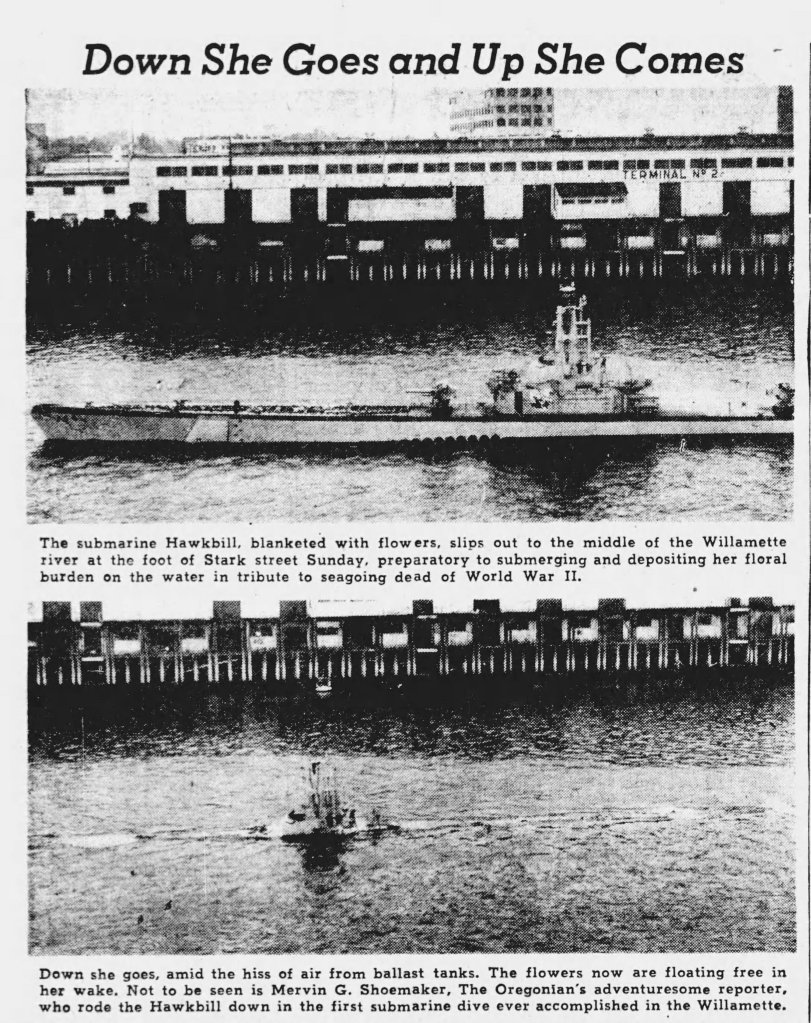
The submarine was USS Hawkbill (SS-366), a veteran of the Pacific War. Her deck was covered with flowers, placed there in remembrance of the men who had gone to sea during World War II and never returned. As the submarine moved away from the foot of Stark Street and into the river, she carried those flowers toward a ceremony that was both a public demonstration of naval technology and a tribute to the dead.
The war had ended only weeks earlier. Japan had formally surrendered aboard USS Missouri on September 2, bringing to a close nearly four years of American fighting in the Pacific. The submarines that had spent those years operating in enemy waters were returning to American ports. Their crews, whose accomplishments had often been concealed by wartime secrecy, were beginning to receive recognition for what they had done.
For the people gathered in Portland, Hawkbill offered a rare opportunity to see the Silent Service in action.
The submarine slowed, and preparations began for the dive. Air hissed from the ballast tanks as water entered. The long, dark hull settled lower in the Willamette. The deck gradually disappeared, followed by the superstructure, until the boat slipped completely beneath the surface.
The flowers remained behind, floating freely in the submarine’s wake.
It was the first submarine dive ever conducted in the Willamette River, according to contemporary newspaper accounts. For those watching from shore, the spectacle must have seemed extraordinary. A vessel longer than a football field had disappeared beneath the muddy water, carrying its crew into a world that most Americans knew only through photographs, newsreels, and newspaper reports.
For the men aboard Hawkbill, however, there was nothing particularly extraordinary about the maneuver. They had done it countless times before, often in waters where an enemy destroyer might be waiting overhead.
This time, the people watching wanted the submarine to come back up.
A Civilian Goes Below
Among those aboard Hawkbill that Sunday was Mervin G. Shoemaker, a staff writer for The Oregonian. He had been invited to accompany the crew on the dive and describe the experience for the newspaper’s readers.
His account, published the following morning under the headline “Writer Goes Along on Submarine Dive, Describes Feelings Under Willamette,” captured something that wartime reporting had seldom been able to convey: the experience of descending beneath the surface from the perspective of someone entirely unfamiliar with submarine life.
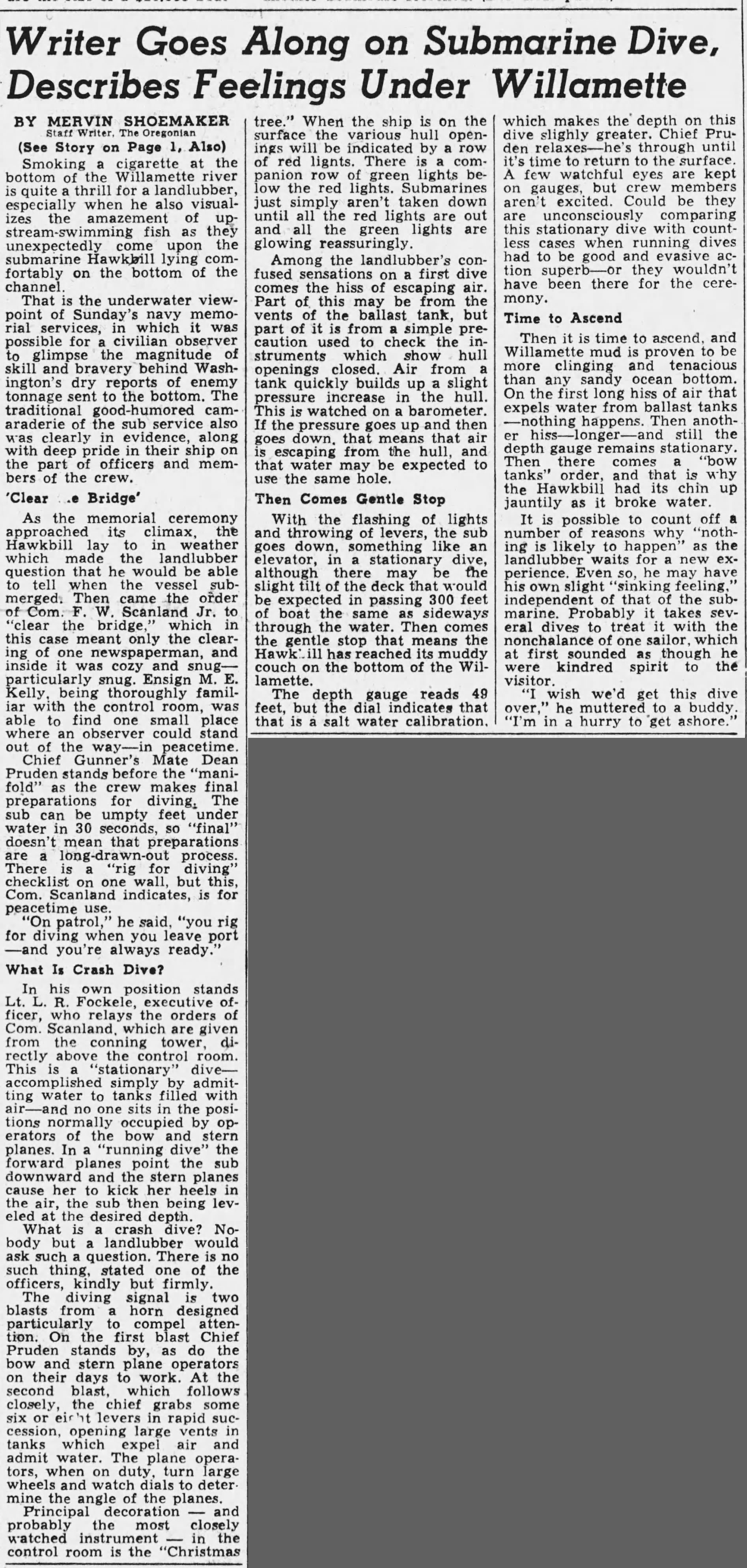
Shoemaker found himself in the control room, surrounded by machinery, instruments, valves, and men who appeared thoroughly accustomed to their cramped surroundings. Space was limited, and he had to find a small place to stand without interfering with the crew.
Chief Gunner’s Mate Dean Pruden was overseeing preparations for the dive. Commander F. W. Scanland Jr. ordered the bridge cleared, while Lieutenant L. R. Fockele, the executive officer, relayed commands from the conning tower.
The crew proceeded through the familiar sequence of preparing the boat for submergence. Valves were operated, vents opened, and instruments checked. Shoemaker watched the men at their stations as they performed duties that had become routine through training and experience.
The newspaper reporter had entered an unfamiliar world, but the sailors around him were simply doing their jobs.
As the dive began, Shoemaker heard air escaping from the ballast tanks. The submarine started downward, accompanied by the movement of the depth indicators and the changing sounds of the machinery.
He described the sensation as something like riding an elevator, although the submarine was not making any significant forward progress. There was a slight change in the angle of the deck as the crew controlled the descent.
The depth gauge eventually registered 49 feet, although Shoemaker observed that the instrument was calibrated for salt water rather than the fresh water of the Willamette.
At that depth, Hawkbill settled into a stationary dive.
The reporter was fascinated by the experience. He watched the instruments, listened to the escaping air, and tried to understand the procedures taking place around him. The crew, meanwhile, appeared almost indifferent to the novelty of the occasion.
They had spent the war doing this under circumstances considerably less comfortable.
Shoemaker also noticed the confidence with which the men operated the submarine. Commands were given and acknowledged. Instruments were watched. Each man understood his responsibilities, and there was little of the excitement that the civilian visitor might have expected.
When the time came to surface, the crew blew water from the ballast tanks. Air rushed through the system, and the submarine began to rise. The depth gauge moved toward the surface, and Hawkbill finally broke through the river once more.
The entire experience had been remarkable for Shoemaker. For the crew, it was another successful dive.
That contrast was perhaps the most revealing part of his account.
The American public had spent nearly four years hearing about submarine warfare. Now, for a few minutes, one civilian had been permitted to see how it worked.
The War Beneath the Pacific
During World War II, the United States submarine force fought a campaign unlike any other conducted by the American military.
While the great carrier battles and amphibious invasions dominated newspaper headlines, submarines operated independently across enormous stretches of the Pacific. Their patrols took them into Japanese-controlled waters, through heavily defended shipping lanes, and along the approaches to enemy ports.
Their primary mission was to destroy Japanese shipping.
Japan was an island empire dependent upon maritime transportation. Its industries required imported raw materials, particularly oil and iron ore. Its armies and garrisons throughout the Pacific depended upon ships to deliver food, ammunition, fuel, and reinforcements. The Japanese merchant marine was essential to maintaining both the country’s economy and its ability to wage war.
American submarines attacked that system relentlessly.
Working far from friendly bases, often without immediate support, submarine crews searched for convoys and individual ships. They approached their targets, calculated firing solutions, launched torpedoes, and attempted to escape before enemy escorts could respond.
When an attack was successful, the consequences could extend far beyond the loss of a single ship. A tanker sunk at sea meant fuel that would never reach Japan. A freighter carrying ammunition or supplies represented cargo that would never reach an isolated garrison. The cumulative effect of these attacks became one of the decisive elements in Japan’s defeat.
By the end of the war, American submarines were credited with sinking approximately 55 percent of the Japanese merchant shipping tonnage destroyed by American forces. They also accounted for more than 200 Japanese naval vessels, including major warships.
These accomplishments were achieved by a force that represented only a small fraction of the Navy’s total wartime personnel.
The cost was terrible.
Fifty-two American submarines were lost during World War II, and more than 3,500 submariners died. The submarine force suffered one of the highest casualty rates of any American military service community.
For many of those lost boats, there had been no final message explaining what happened. A submarine might depart on patrol, report its position or an attack, and then disappear. Only after the war, through examination of Japanese records and other evidence, could some of those losses be reconstructed.
Others remain mysteries.
This was the world in which Hawkbill and her crew had served. Her wartime patrols had taken her into the Pacific campaign against Japanese shipping, where her men had performed the same demanding duties that Shoemaker witnessed in the comparative safety of the Willamette River.
The flowers that covered her deck on October 21 were therefore more than decoration. They represented the boats that had never returned, and the thousands of men whose families would never experience the homecomings taking place across America that autumn.
Opening the Silent Service
For much of the war, the American public had known relatively little about the daily operations of its submarine force.
The Navy released information about successful patrols, decorated commanding officers, and notable actions, but operational security imposed substantial restrictions on what could be reported. Patrol areas, intelligence sources, tactics, and technical capabilities were often withheld. Even the results of individual attacks could remain uncertain until long after a submarine returned to port.
Submarine warfare was also inherently difficult to portray.
A carrier task force could be photographed launching aircraft. Marines could be filmed advancing across a Pacific island. Battleships could be seen firing their enormous guns.
Submarines generally fought their battles beyond the sight of friendly observers.
A successful patrol might last weeks or months, with little outward evidence of what had occurred until the boat returned to base. The men who had conducted the attacks might receive a brief period of rest and then depart again, often before the public learned much about their previous patrol.
By October 1945, the situation had changed.
The Japanese surrender removed many of the operational security restrictions that had governed wartime reporting. The Navy could begin revealing more about its submarine campaign, including the scale of the destruction inflicted upon Japanese shipping and the extraordinary demands placed upon submarine crews.
Navy Day provided an ideal opportunity.
Observed annually on October 27, Navy Day had long been an occasion for public demonstrations, ship visits, ceremonies, and recognition of naval service. In 1945, it carried particular significance. The country was celebrating victory, and the Navy had an opportunity to show Americans the ships and men who had helped achieve it.
Across the United States, naval vessels arrived in ports where civilians could see them, visit them, and learn about their wartime service.
The Hawkbill dive in Portland was one of those events.
It allowed the public to witness the defining capability of a submarine, its ability to disappear beneath the surface. Shoemaker’s presence aboard the boat provided something equally valuable: a description of the men and procedures that made that capability possible.
The demonstration also offered a glimpse of the professional discipline that had sustained the submarine force through four years of war.
There was no enemy waiting above Hawkbill that Sunday. No depth charges, no hostile aircraft, and no convoy to intercept. The crew was operating in an American river before a friendly audience.
Yet the procedures were familiar. The attention to instruments, the orderly execution of commands, and the practiced movements of the sailors were the same habits upon which their survival had depended during the war.
For Americans accustomed to reading about submarines as mysterious weapons operating somewhere in the Pacific, the demonstration made the Silent Service considerably more understandable.
Another Submarine, Another American Port
On the opposite side of the country, another veteran submarine was preparing to participate in the Navy Day celebrations.
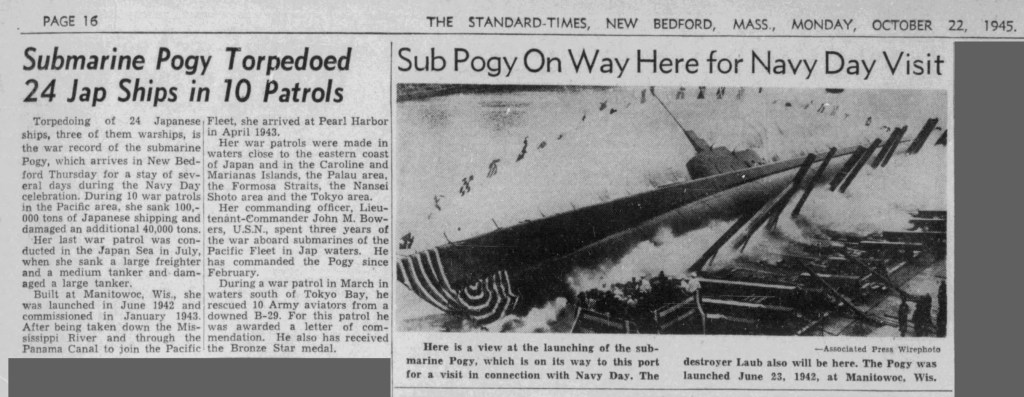
USS Pogy (SS-266) was expected to arrive in New Bedford, Massachusetts, on Thursday, October 25, for a several-day visit. The New Bedford Standard-Times announced her impending arrival in its October 22 edition, accompanied by a photograph of the submarine’s launching at Manitowoc, Wisconsin, in June 1942.
The newspaper’s account emphasized Pogy’s impressive wartime record.
During ten Pacific war patrols, she had operated in waters near Japan, the Carolines, the Marianas, the Formosa Strait, and other contested areas. Contemporary reports credited her with torpedoing 24 Japanese vessels, including three warships, and with sinking approximately 100,000 tons of shipping while damaging another 40,000 tons. These were wartime figures, reflecting the claims available to reporters at the time rather than necessarily the totals established by subsequent postwar assessments.
The newspaper also described an episode that demonstrated another important role performed by American submarines.
During a patrol south of Tokyo Bay in March 1945, Pogy rescued ten American Army airmen from a downed B-29 bomber. The operation earned recognition for her commanding officer, Lieutenant Commander John M. Bowers.
Throughout the Pacific campaign, submarines had performed lifeguard duties for American aviators operating near enemy-held territory. They waited in dangerous waters, often close to the Japanese coast, prepared to rescue men who had been forced down at sea.
Such missions required submarines to expose themselves to additional risks, sometimes remaining in areas where enemy aircraft and patrol vessels were active.
For the people of New Bedford, Pogy’s arrival promised an opportunity to see a submarine that had participated directly in the destruction of Japanese shipping and the rescue of American servicemen.
In Portland, Hawkbill had demonstrated how a submarine operated. In New Bedford, Pogy brought the record of the Pacific submarine campaign to an American waterfront.
Both events served the same larger purpose.
The Navy was bringing the Silent Service home and allowing Americans to see the boats and meet the men who had carried out one of the most consequential naval campaigns of the war.
The Men Who Made It Possible
The submarines themselves were remarkable machines, but their accomplishments depended upon the men who operated them.
A fleet submarine was a complicated collection of machinery, weapons, electrical systems, hydraulic equipment, and instruments. Keeping such a vessel operational for weeks at sea required men with specialized skills and a thorough understanding of their responsibilities.
Diesel engines had to be maintained. Batteries required constant attention. Torpedoes had to be prepared and serviced. Navigation demanded precision, particularly during submerged operations. Sonar operators listened for enemy vessels, while radiomen maintained communications under difficult conditions.
In the control room, men operated the systems that allowed the submarine to dive, maintain depth, and return safely to the surface.
Fire controlmen performed another essential function. Their work involved the instruments and calculations required to determine a target’s course, speed, and position, and to translate that information into a torpedo firing solution.
The success of a submarine attack depended upon the coordinated work of the commanding officer, the tracking party, the torpedo crews, and the many other men whose duties made the attack possible.
By 1945, these sailors had accumulated an extraordinary body of practical experience.
Many had entered the Navy as young men with little knowledge of submarines. They had undergone training, qualified in their duties, and learned to live and work in an environment that demanded both technical competence and mutual trust.
The experience had transformed them into skilled professionals.
But the war was over.
The same men who had spent years operating complicated weapons systems and navigating hostile waters were beginning to return to the civilian lives they had left behind.
Some would remain in the Navy, continuing careers that had begun during the war. Others would be discharged and return to their families, jobs, schools, and communities.
For many, the transition would not be simple. They had been away for years, and the world they were returning to was different from the one they had left.
Nevertheless, the desire to go home was powerful.
In October 1945, while Hawkbill was making headlines in Portland and Pogy was preparing for her visit to New Bedford, a small newspaper in North Carolina reported the return of one of those men.
His name was Harold McGee.
Thirty-Eight Months Away
On October 22, 1945, the Hickory Daily Record published a brief article under the headline “Newton Submarine Crewman Returns After 38 Months.”
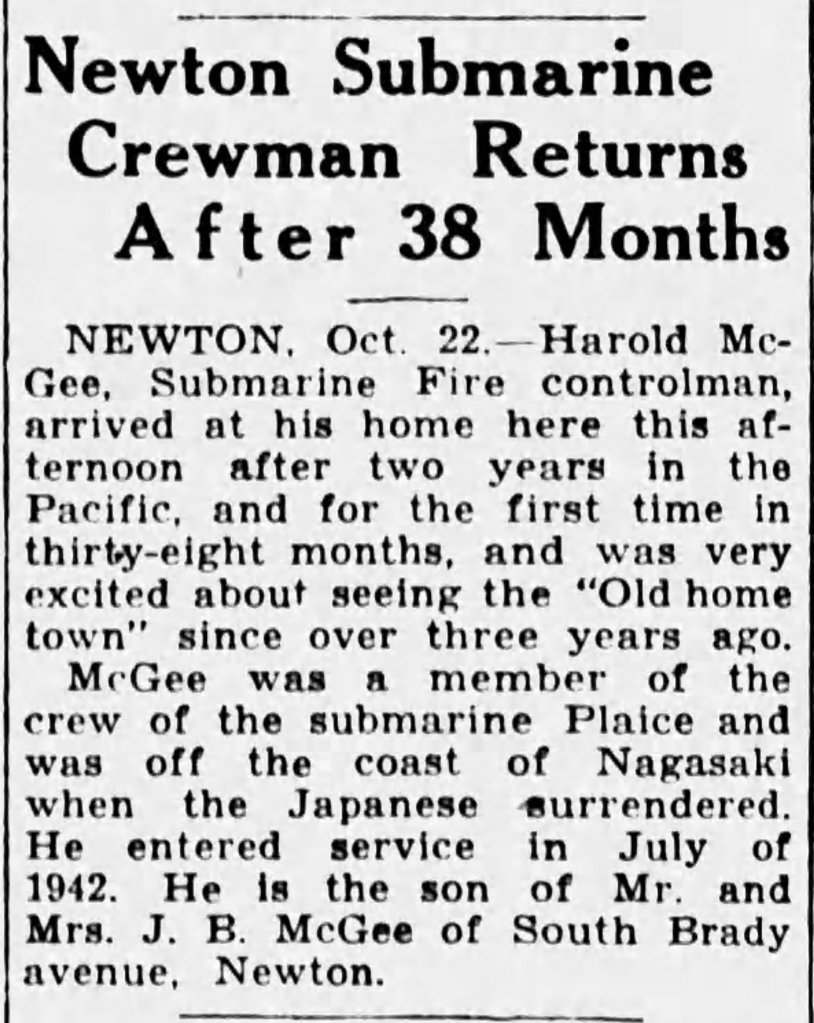
The story concerned Harold McGee, a submarine fire controlman who had arrived at his home in Newton, North Carolina, that afternoon.
McGee had entered the Navy in July 1942, seven months after the attack on Pearl Harbor. He had spent two years serving in the Pacific and had been away from home for 38 months.
He was a member of the crew of USS Plaice (SS-390), another veteran of the submarine campaign against Japan.
According to the newspaper, Plaice had been operating off the coast of Nagasaki when the Japanese surrendered.
McGee was the son of Mr. and Mrs. J. B. McGee of South Brady Avenue in Newton. The newspaper reported that he was excited to see his hometown again after more than three years away.
There was nothing especially elaborate about the announcement.
It did not provide a detailed account of his wartime patrols. It did not describe the attacks in which his submarine had participated or the dangers he had encountered. There was no extended interview about his experiences.
The article simply informed the people of Newton that one of their own had returned.
Yet the brief notice tells us something important about the end of the war.
McGee had spent years in one of the most technically demanding and dangerous branches of the Navy. As a fire controlman, he had served in a rating central to the submarine’s ability to attack enemy ships. His responsibilities were part of the complicated process that allowed a submerged submarine to find a target, calculate a firing solution, and launch its weapons.
He had served aboard a submarine operating in the Pacific during the final years of the war, when American boats were penetrating ever closer to the Japanese home islands.
Now he was back in Newton.
The war that had taken him away in 1942 was finished. The submarine patrols, the watches, the machinery, and the uncertainty of operating in enemy waters were behind him, at least for the moment.
He could return to the streets and familiar places of his hometown.
The Hickory Daily Record had no need to explain the strategic significance of submarine warfare to tell its readers that Harold McGee was home. The news was important because the community knew the family and because a young man who had been absent for more than three years had returned safely.
Across America, similar stories were appearing in local newspapers.
Sailors, soldiers, Marines, and airmen were returning to communities that had followed their service through letters, photographs, casualty reports, and occasional newspaper announcements.
Some came home to celebrations. Others returned quietly. Many were eager to resume lives interrupted by the war.
For the submarine force, these homecomings were particularly meaningful because so many men had not survived to experience them.
Fifty-two submarines would never return to an American port. Thousands of families would never receive the news that their sailor had arrived home.
Harold McGee was among the fortunate ones.
The Silent Service Comes Home
On the Willamette River, the flowers drifted across the surface after Hawkbill disappeared beneath them. They honored the men who would never return, whose submarines remained somewhere beneath the Pacific.
The ceremony was a reminder of the cost of victory, but it also marked a change in the relationship between the American public and the men who had fought beneath the sea.
For years, the submarine force had carried out its missions with relatively little public attention. Its successes were often reported only in general terms, and many of its operations remained secret. The men who served aboard those boats understood that their work was important, even when the details could not be shared with the people at home.
Now the war was over, and the country was beginning to learn more about what they had accomplished.
In Portland, spectators watched Hawkbill dive and return to the surface. In New Bedford, residents prepared to welcome Pogy, a submarine whose wartime patrols had carried her into the heart of the Pacific campaign. Across the country, newspapers were publishing the stories of returning sailors and the boats aboard which they had served.
The public demonstrations and newspaper accounts helped bring the Silent Service into the national story of victory.
But for the men themselves, the end of the war meant something more personal.
They had spent years learning their duties, standing their watches, and carrying out their missions. They had lived in crowded compartments, endured the dangers of combat, and depended upon one another for survival. They had helped sever Japan’s maritime lifelines and bring an end to the Pacific War.
Now they were returning to the towns and families they had left behind.
Most would never become famous. Their names might appear once in a local newspaper, announcing that they had arrived home safely, and then disappear into the ordinary business of American life.
Harold McGee had entered the Navy in July 1942. Thirty-eight months later, he was home in Newton, North Carolina.
He had done his job.
And now, like thousands of other American submariners, he had come home.
Historical References
The Oregonian (Portland, Oregon), October 22, 1945. “Down She Goes and Up She Comes”; Mervin G. Shoemaker, “Writer Goes Along on Submarine Dive, Describes Feelings Under Willamette.”
The Standard-Times (New Bedford, Massachusetts), October 22, 1945, p. 16. “Submarine Pogy Torpedoed 24 Jap Ships in 10 Patrols”; “Sub Pogy On Way Here for Navy Day Visit.”
Hickory Daily Record (Hickory, North Carolina), October 22, 1945. “Newton Submarine Crewman Returns After 38 Months.”


Leave a Reply