
If you ever spot an Ohio-class submarine on the horizon, you are seeing something most people will never witness in their lives. They are not meant to be seen. They are built for silence, shadows, and deterrence. USS Michigan (SSBN-727), later redesignated SSGN-727, was one of these giants, a steel colossus born of Cold War necessity. She was my ship. My home under the waves for four years.
On paper, Michigan’s story is a neat series of dates, specifications, and strategic milestones. But inside those steel walls lived men who sweated, cursed, and laughed their way through patrols that most of the world never even knew had happened. This story is not only about the numbers and facts. It is about the memories, the mishaps, and the friendships that turned an impersonal war machine into a family.
Patrol Reports, and SSBN727.org, exist for that very reason. To preserve the voices of those who served. Because the truth is, if we do not tell our stories, then history becomes little more than a cold ledger. This is the tale of Michigan, but it is also the tale of those who sailed her.
The Cold War was not a conflict fought in trenches or open battlefields. It was fought in boardrooms, laboratories, missile silos, and beneath the seas. When the United States realized that its deterrence strategy needed an upgrade, the answer came in the form of the Ohio-class submarine. Bigger, quieter, more capable, these vessels carried the most powerful weapons system the Navy had ever fielded.
Michigan’s story began at Electric Boat in Groton, Connecticut. Her keel was laid on April 4, 1977. When she slid into the water on April 26, 1980, she embodied decades of naval engineering lessons. She was commissioned on September 11, 1982, into a world still locked in the tense balance of Mutually Assured Destruction. At 560 feet long and displacing almost 19,000 tons submerged, she was the second Ohio-class boat homeported at Bangor, Washington, arriving there in March 1983.
To the public, she was a ghost. To us, she was home.
The first time I saw her, I had to stop and stare. She was a massive, gleaming black hull, looking almost alive as she rested aside the Delta Pier. I remember thinking she was like something out of a science fiction story. The reality hit quickly. Science fiction did not prepare you for the nerves of your first day as a sailor on one of these machines.
The names that stick with me from that first day are burned in memory. Karl Schaub. Chief Richard “Dick” Long. Chief Robert Peck. My “sea dad” Mitch, who looked out for me and taught me how to keep from drowning in both work and stress. Sean Bagby, roomie and partner in crime. Those men were larger than life when I was just a kid learning how to wear the uniform right.
No one forgets their qual process. It was the crucible. You studied until your head pounded. You traced systems with grease pencil diagrams. You memorized valves, pumps, and procedures until you saw them in your sleep. If you thought you had learned everything, the next watchstation would humble you all over again.
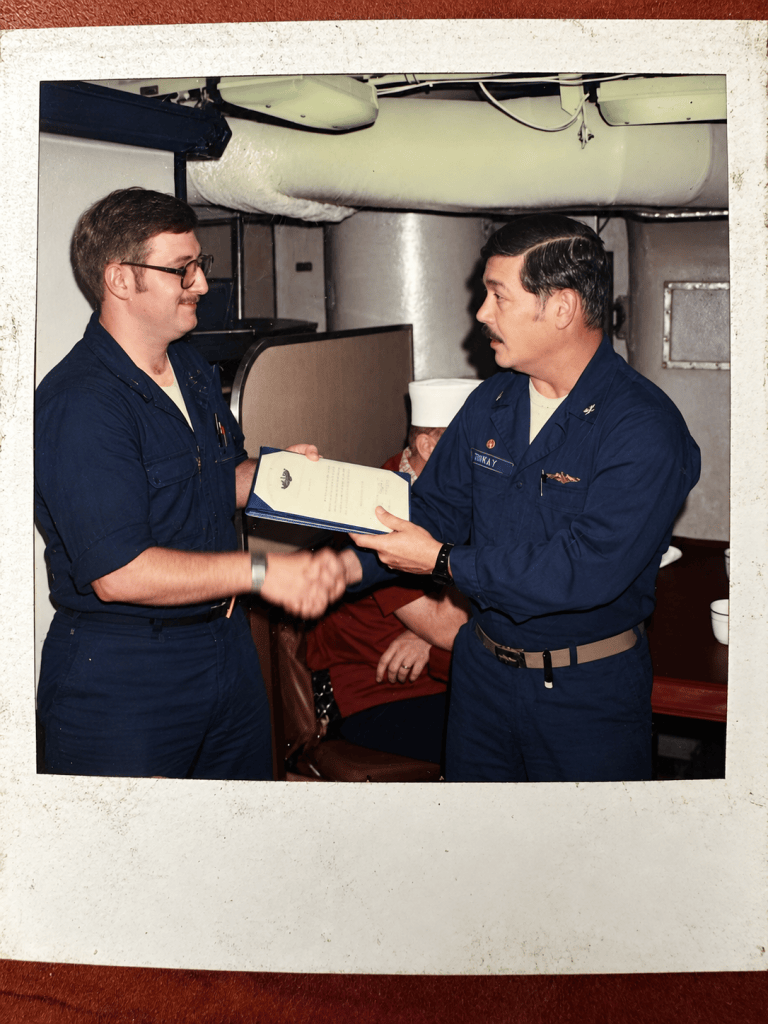
Missile Compartment Roving Patrol was one of the the learning processes. Endless ladders, cramped passages, a silence broken only by the hum of machinery. You walked with your senses tuned for anything wrong, terrified you might miss the sound or smell that meant trouble.
I still recall my first dive. Standing there, in Machinery 2 lower level, when the potable water tank overflowed. The whistling and splashing sounded and felt like the boat was flooding. Water was shooting everywhere next to the Depth Control Tanks. My heart was ready to pound its way out of my chest. MM1(SS) “Bull” Durham, calm as ever, explained it was nothing to panic over. That moment was a lesson in what separated panic from survival. Submarines, and submariners, teach you fast.
And then, at last, the day you pin on your dolphins. That little silver emblem was more than a piece of metal. It was your proof. You had passed the test. You were no longer a rider. You were a submariner.
Cold War SSBN life was a strange mixture of routine, secrecy, and camaraderie. A crew of just over 150 men lived packed into compartments smaller than most houses. You drilled constantly. Fires. Flooding. Missile casualties. You learned to react before you even thought about reacting.
Outside the hull, the Cold War raged in its quiet way. We knew we carried weapons that could end the world. We knew our mission was to make sure no one dared start that war. One shipmate put it best: “Too much job, not enough adventure.” He was right. There was little glamour. The adventure was mostly in the imagination of those who did not have to clean bilges at 0200, or run fire drills until their ears rang.
But in that pressure cooker, we became a family. You learned who you could lean on. You learned how to handle boredom. You learned the kind of humor that only makes sense 500 feet under the ocean.
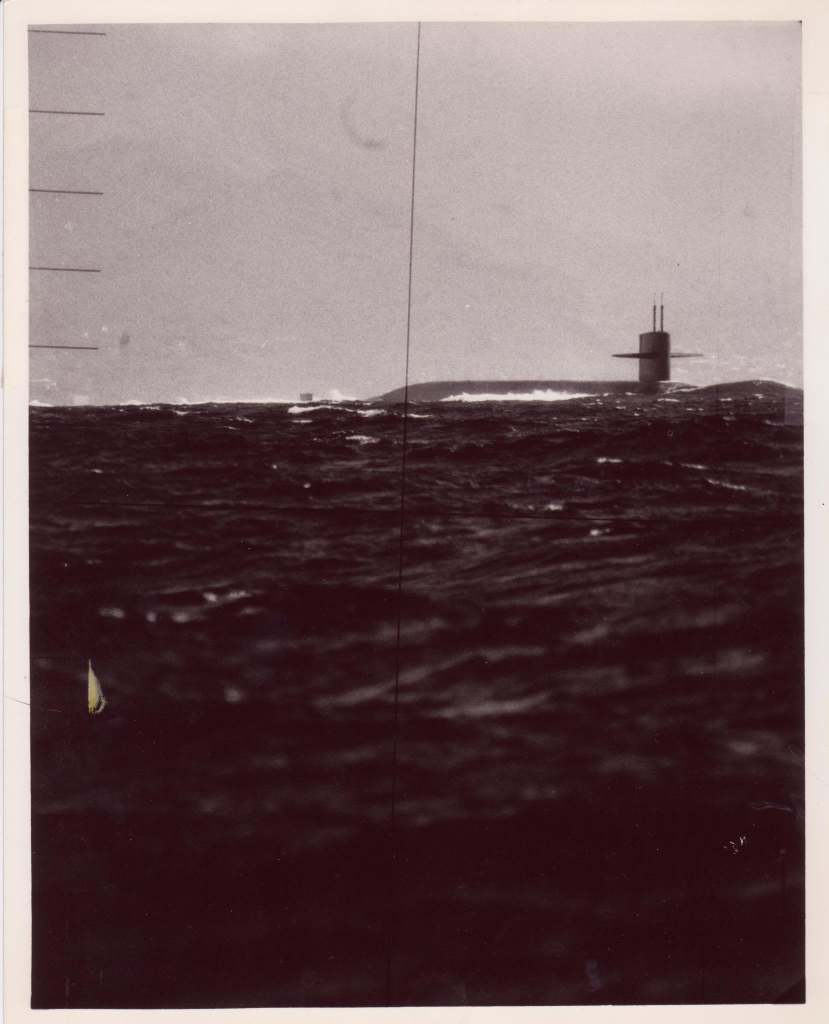
By Patrol 13, I thought I had seen it all. That patrol taught me different.
It began with an ear-popping shift in pressure. Then a dull thud. The 4MC crackled to life with words no submariner wants to hear: “Fire in the engine room.”
I ran toward smoke and found myself staring at a mist of hydraulic oil filling the compartment. The Emergency Propulsion Motor clutch had failed, igniting oil and blowing out a thrust bearing collar. We suddenly had a giant hole in our oil system, and an atmosphere filled with atomized hydraulic oil.
We surfaced, but the diesel engine would not start. Fans strained to clear the air. The engineering crew worked magic, building a makeshift oil system with plastic bags and tape. It kept us moving long enough to limp home at three knots.
When we reached port, the boat started sinking at the pier. Blown baffles. We drydocked in record time. After repairs, the rest of the patrol was run short-handed in the Strategic Fire Control Division, port and starboard watches after losing a fire control supervisor to a medical condition.
That patrol gave me a second birthday. The sea had reminded us it is always hunting for weakness. The lesson never left me: complacency kills. Training and yes, luck, are what carry you home. My dad would later tell me, “Luck is the residue of design.”
By 2003, the Cold War was history, but Michigan still had life in her. She completed 67 deterrent patrols before being removed from strategic service. Instead of being retired, she went in for a rebirth.
At Puget Sound Naval Shipyard, she underwent an Engineered Refueling Overhaul and conversion. The missile tubes that once carried Tridents were reconfigured to hold 154 Tomahawk cruise missiles. Compartments were redesigned to carry special forces. Communications and navigation got modern upgrades. On June 12, 2007, she returned to service as SSGN-727.

The new Michigan prowled the Pacific. She made port calls in Japan, Guam, South Korea, Singapore, Hawaii, and Australia. In 2010, she surfaced alongside her sister ships in a rare show of force aimed at reminding China who rules the seas. In South Korea, she docked with a dry deck shelter on her back, sending a message to North Korea that America’s special forces could launch from beneath the waves at any time.
The boat continued to make history. In 2016, Chief Dominique Saavedra became the first enlisted woman to qualify submarines aboard Michigan. It was proof that the brotherhood could open its ranks without losing its spirit.
And she is still out there. Into 2026, her record shows constant deployments and overhauls, carrying out missions that remain unspoken but no less vital.
That is where Patrol Reports comes in. SSBN727.org is intended to be more than a website. It is a repository of memory. A place where stories, photos, and videos combine into a living history. For me, it answers a question my son once asked: “Who were you? What did you do?”
Each story is a thread in a larger fabric. Together, they show what it was to be a submariner in a way official histories never will. They capture the sweat, fear, and laughter that kept us human in the face of impossible responsibility.
Reunions and social media have brought us back together. Old friends show up again, and the years fall away. Kurt still checks in. Others, like Master Chief Adamson and Bull Durham, are gone. Remembering them matters. Telling their stories keeps them alive. That is what Patrol Reports is about.
From Cold War sentinel to 21st-century vanguard, USS Michigan has carried the burden of deterrence and the edge of modern warfare. Her crews carried the weight of responsibility that most will never understand.
For me, and for those who served beside me, she was more than steel. She was home, she was challenge, and she was survival. The legacy of Michigan is not just in what she accomplished but in the lives of those who walked her decks.
The boat still sails. Her story continues. And through Patrol Reports, those who served will ensure that when history remembers Michigan, it remembers the people as much as the steel.
In 2018, the Precom and 1980s Gold Crew held a reunion in Silverdale, WA. I had the honor of being the Emcee, and to deliver these brief remarks:
THOUGHTS ON MY CREW
This is for those of you who never sailed aboard our ship. I hope that you understand me. It is hard, sometimes, to put into mere words what I am trying to say to you about your spouses, your fathers, your brothers, your friends.
Look around you. You see men who once upon a time were so very young. Even the COB was young…er…
And what they, what we, accomplished was to change the world. We built upon a legacy of FBM sailors that began in 1960, and we carried it through to the conclusion of its first and foremost purpose. We maintained the peace.
More than that, these men were friends, they were brothers, in some cases they were fathers. They were leaders, they were technicians, and they were the experts.
And each time the hatches closed, and the ship went down into the deep, my life depended on each and every one of them. And their lives depended upon me. For years I have told my various audiences that being 23 years old and having the responsibility for targeting and launching TRIDENT missiles was a high level thing. But the truth is that is was not wanting to let any of these men in this room and the others who are not here, down, was much more important to me.
THOUGHTS ON TODAY’S CREW
We had our dreams, our goals, our likes and dislikes. We had our moments of joy and even, on one bad Halloween night, we had our our moment of fright.
I have had the opportunity to meet a few of the current crew members, including two of the women who have qualified aboard Michigan and wear the Dolphins. Like us, the men – and now women – who sail Michigan into the annals of history, have their hopes, and dreams. They sleep in our old bunks, use our old facilities, eat at our old tables, and shoot the breeze in our old corners and hideouts.
They are younger than we can remember ourselves ever being.
And they are every bit as good as we once were.
Rest easy tonight. USS Michigan, our boat, our home, is still patrolling the deep.
 Patrol Reports
USS Michigan SSBN 727 Blue crew Precom, Commissioning, Florida, Panama, Shellback, Bremerton refit, and 5 patrols. RM2 SS Scovil. So many memories. Like it was yesterday.
LikeLiked by 1 person