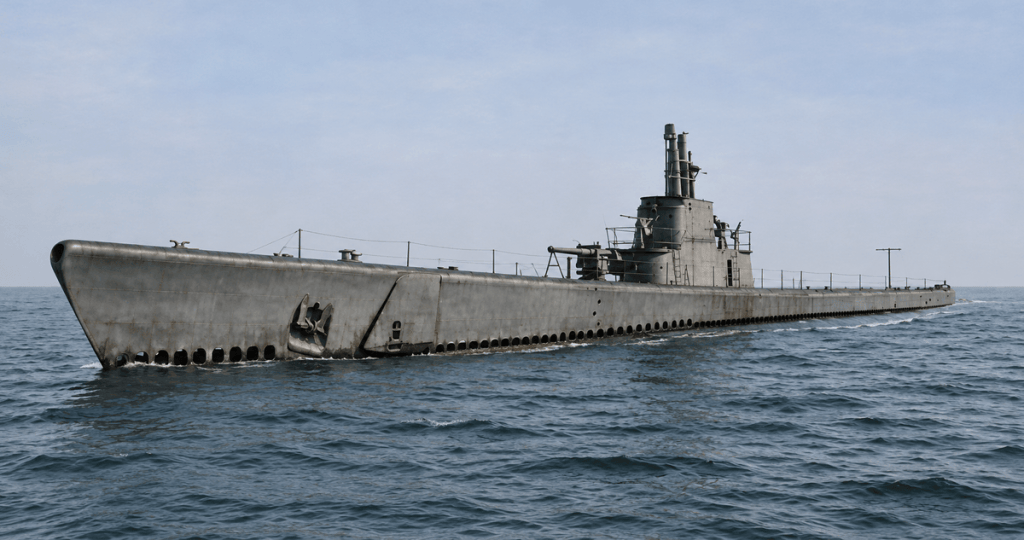
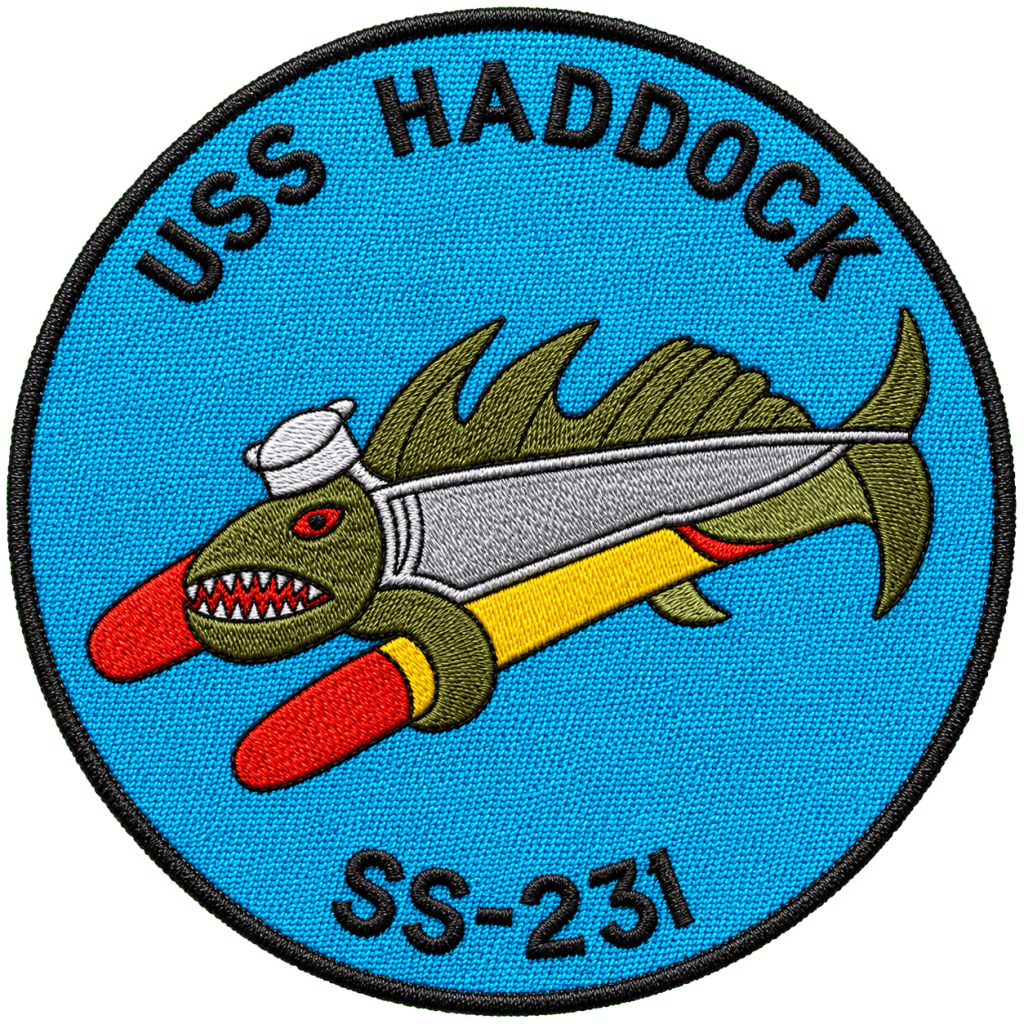
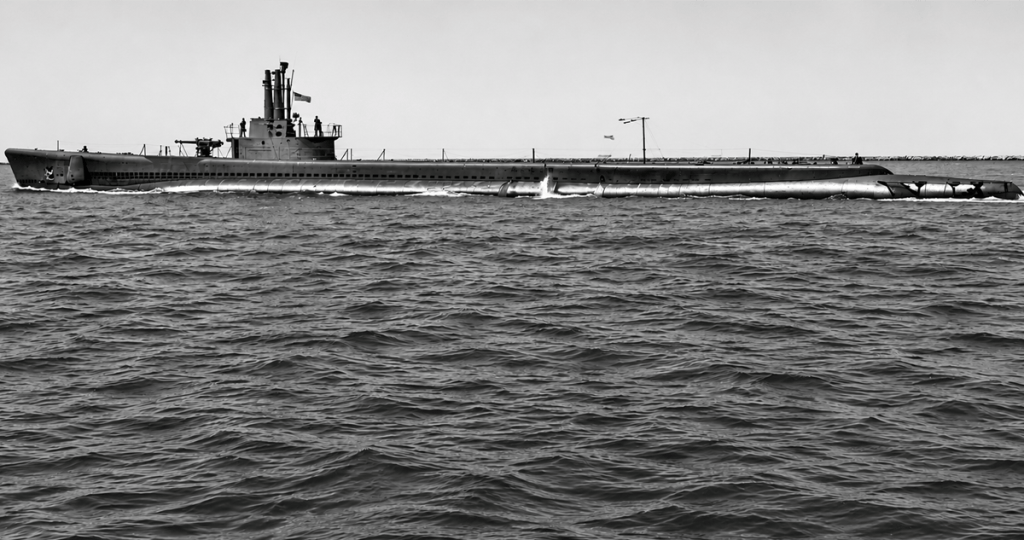
At 0205 on November 6, 1943, USS Haddock (SS-231) closed on two tankers for another attack. Ten torpedoes had already gone into the water, six at the merchant ships and four at their escort. Explosions had been heard, and the tankers had slowed, but both remained underway. Lieutenant Commander Roy M. Davenport still had contact. His crew had reloaded the forward tubes with the four torpedoes remaining aboard.
The targets now offered an unusual opportunity. They were almost alongside each other, with one vessel’s bow projecting slightly ahead of the other. Their escort had fallen astern. Davenport judged that a carefully placed spread might reach both tankers. He would make the attack on the surface, using radar and the target bearing transmitter, then leave the patrol area with nothing left in the tubes.
Haddock was on her seventh war patrol, operating near Truk in the Caroline Islands. Truk, now generally known as Chuuk, lies north of New Guinea in the western Pacific. Its sheltered lagoon served as a major Japanese naval base, and the shipping routes approaching it offered American submarines opportunities to attack vessels sustaining Japan’s fleet and island positions. Tankers were particularly valuable targets because the movement of fuel depended upon ships that Japan could ill afford to lose.
The encounter had begun the previous evening. Haddock submerged at 0500 on November 5 for a day of periscope patrol and surfaced at 1830. At 2054, her lookouts sighted a convoy reported as two ships with one escort. The merchant vessels were subsequently identified in the patrol report as loaded tankers resembling the Gen’yo Maru class. The escort appeared to be a destroyer, although its class could not be determined.
Moonlight complicated the approach. Clouds were present, but the moon would not set until about 0015. Davenport elected to track the convoy from a distance, draw ahead, and wait for darkness. The targets were making 13.5 knots on a base course of 293 degrees true. When first sighted, they had been just abaft Haddock’s beam, so obtaining a favorable firing position required both patience and continued movement on the surface.
At 2338, Haddock closed sufficiently to establish radar contact at 14,500 yards. By 0018 on November 6, she had brought the range inside 8,000 yards for a final check of the tracking solution. The tankers were in open column, with their escort ahead. Davenport planned to engage every vessel: three bow torpedoes at each tanker, followed by a turn to bring four stern tubes to bear on the escort. The forward torpedoes were set to run at ten feet; those aft were set at six.
At 0044, Haddock closed to attack. The first bow firing began at 0059-48, with three torpedoes directed at the leading tanker and three immediately afterward at the second. The reported ranges were 3,150 and 3,040 yards. Each spread used five-second firing intervals. Less than thirty seconds after the first recorded firing time, Haddock began swinging left to bring her stern tubes into position. At 0103-06, four more torpedoes went toward the escort.
The results were mixed. The report describes two low-order explosions against the first tanker, followed by one clearly observed good hit and another low-order explosion against the second. Both vessels slowed. For a time, the second was tracked at only two knots, although both were later making 10.3 knots. Whatever damage had been inflicted, the ships were still moving.
The stern attack produced even less certainty. One click was heard, suggesting that a torpedo might have struck without detonating properly. Davenport nevertheless claimed no damage to the escort. Its continued speed, and a subsequent increase in speed, did not support a claim that it had suffered a successful torpedo hit. That qualification deserves attention: the report records the suspicious sound while expressly declining to turn it into a confirmed result.
Haddock maintained contact while the crew reloaded forward. Four torpedoes remained, and the two damaged tankers were drawing close together. By 0205, Davenport saw what he described as effectively an extra-long target. An appropriate spread could strike both ships without requiring a separate firing solution for each.
At 0214, Haddock fired all four torpedoes from the forward tubes. The range was 3,220 yards. Davenport aimed slightly forward of the middle of the nearer tanker, using an eight-second firing interval and a one-degree divergent spread. The report records three hits on that vessel, forward, amidships, and aft. The last explosion was reported to have ignited the entire ship. The remaining torpedo was believed to have struck the farther vessel’s bow.
To the men observing from Haddock, the result appeared decisive. The farther target was reported sunk within a minute, with its disappearance observed visually and by radar. The nearer vessel was reported to have gone down within about eight minutes. The account also described the escort departing southward without launching another depth-charge attack, although it had dropped a few charges during the earlier engagement.
At 0225, Davenport broke off. Haddock had expended every torpedo after nine days on station and set course for Pearl Harbor. At 0549, she submerged to rest after the night’s activity while conducting periscope patrol. She surfaced at 1610 and continued homeward. At 1910, a message to Commander Submarine Force, Pacific Fleet, reported the results and the boat’s departure from the area.
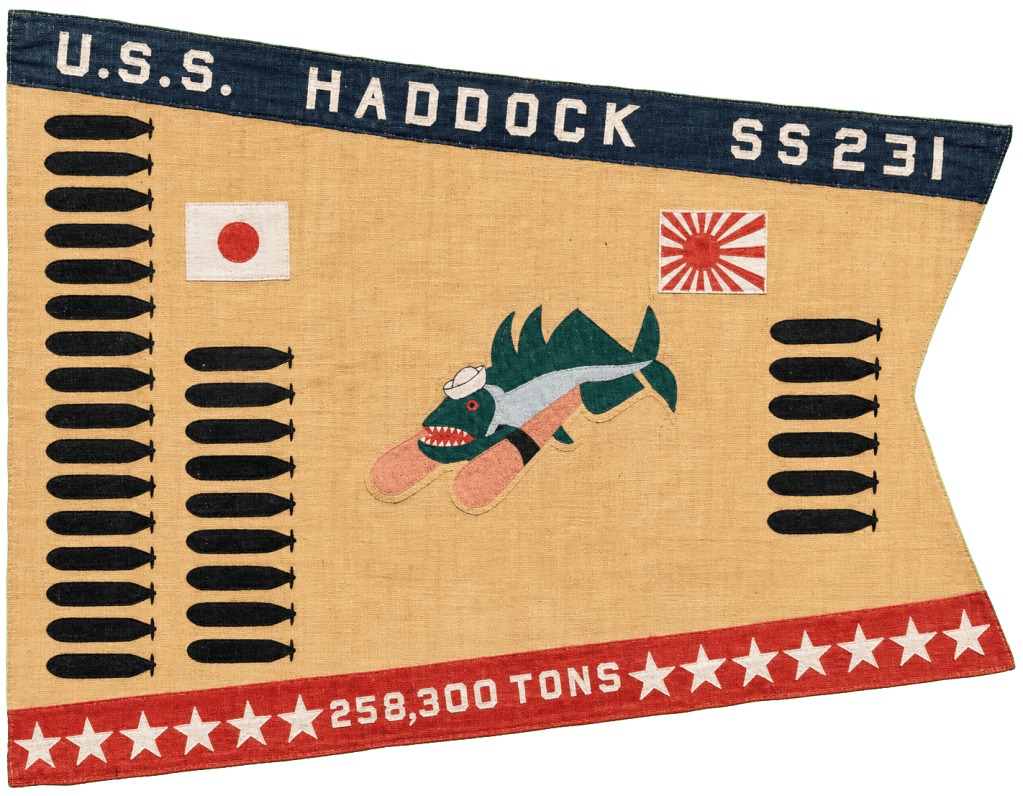
The postwar record requires a qualification to those reported sinkings. The Joint Army-Navy Assessment Committee did not award Haddock a sinking on November 6, 1943. Its final list contains no loss credited to the boat on that date. The Navy’s official chronology identifies the convoy’s tankers as Gen’yo Maru and Hoyo Maru and the escort as Yakaze. It records Haddock torpedoing Hoyo Maru, while Yakaze damaged herself by colliding with Gen’yo Maru during evasive maneuvers. The chronology also records a separate torpedo attack on Hoyo Maru by USS Scorpion (SS-278).
Those findings leave us with two different kinds of evidence. Haddock’s patrol report preserves what her crew observed and concluded during the engagement. The later assessment sought to establish which Japanese vessels were actually lost. Fire, explosions, and the disappearance of a target from sight and radar could convince experienced observers that a ship had sunk without ultimately establishing its destruction. The surviving evidence does not justify converting Haddock’s two contemporary claims into two confirmed losses.
The attack still merits close attention. Davenport tracked the convoy through moonlight, coordinated bow and stern attacks, maintained contact after uncertain results, and returned with his last four torpedoes. His crew carried out the reload and supported another surface approach while an enemy escort remained nearby. A careful account can recognize that performance while retaining the distinction between a reported sinking and a confirmed loss. On November 6, Haddock fought an aggressive and damaging action; the postwar record determines how its results should be described.
Sources
USS Haddock, Report of Seventh War Patrol, Enclosure (A), pages 7–10; supplied scan SS-231_HADDOCK.pdf, PDF pages 149–152. All attack times above follow the report’s K time designation.
Joint Army-Navy Assessment Committee, Japanese Naval and Merchant Shipping Losses During World War II, appendix, USS Haddock. https://ibiblio.org/hyperwar/Japan/IJN/JANAC-Losses/JANAC-Losses-6.html
Robert J. Cressman, The Official Chronology of the U.S. Navy in World War II, entry for November 6, 1943. https://ibiblio.net/hyperwar/USN/USN-Chron/USN-Chron-1943.html


Leave a Reply