Ansel Sampson and USS Rasher’s First Five War Patrols
Patrol Reports | November 5, 2026
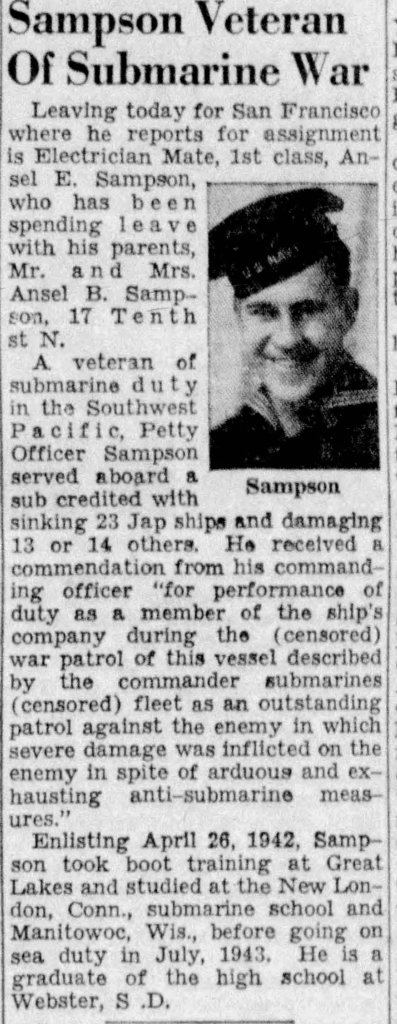
On November 5, 1944, readers of The Forum encountered a small story about a sailor leaving home. Electrician’s Mate First Class Ansel E. Sampson had been visiting his parents, Mr. and Mrs. Ansel B. Sampson, at 17 Tenth Street North. Now he was departing for San Francisco to report for assignment. The photograph beside the article showed a young man in Navy uniform; the headline identified him simply as a veteran of the submarine war.
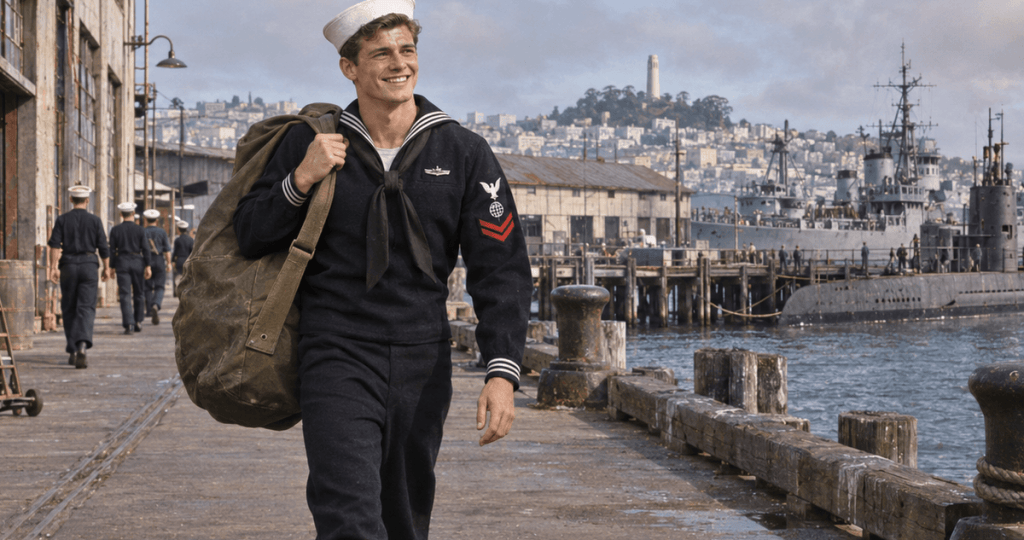
For his family, the important news was that he had come home and was leaving again. Across wartime America, servicemen and their families repeated that experience whenever leave brought them together. A visit interrupted the separation, but it did not end the obligation. Sampson’s departure belongs to that larger history of millions of American soldiers and sailors whose service required them to leave familiar lives behind, sometimes repeatedly, and return to the fight.
The newspaper could say little about where he had been. It reported that his submarine had been credited with sinking 23 Japanese ships and damaging another 13 or 14, but did not name the boat. Even the commendation it quoted contained censored references. Today, we can identify his submarine as USS Rasher (SS-269), whose first five war patrols had carried her from the waters of the Netherlands East Indies to the convoy routes west of the Philippines.
Sampson was leaving Rasher for another assignment, most likely USS Tilefish (SS-307). His later service record lists Tilefish among his boats, although the newspaper does not identify his next command. What it does establish is the direction of his life that November: after leave with his parents, an experienced submarine electrician was reporting back to the Navy while the Pacific war continued.
From the Great Lakes to the Pacific
Sampson enlisted on April 26, 1942. According to the hometown article, he completed boot training at Great Lakes, attended submarine school at New London, Connecticut, and trained at Manitowoc, Wisconsin, before going to sea in July 1943. He had graduated from high school in Webster, South Dakota. Those few lines describe the transformation of a civilian into a trained petty officer entrusted with machinery on which a submarine’s survival depended.
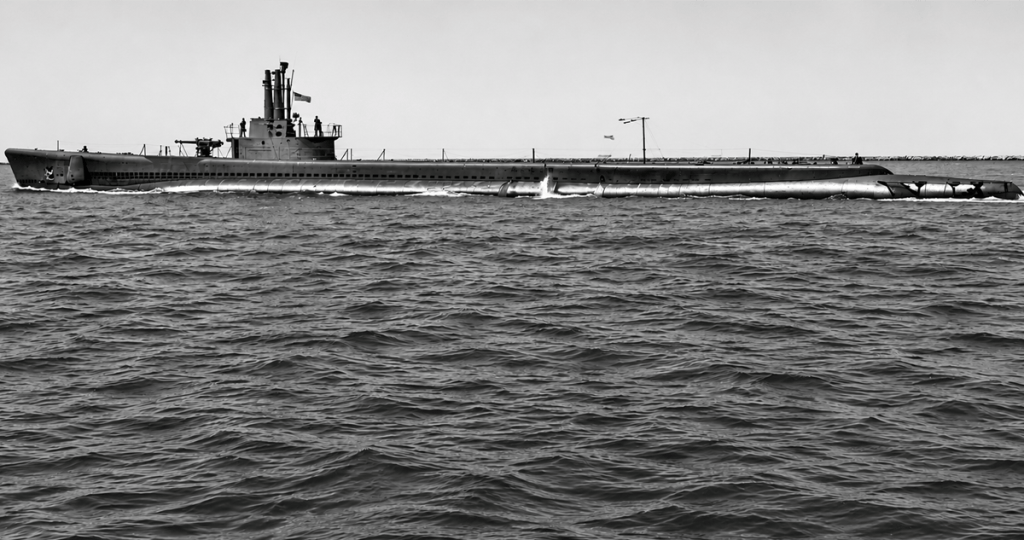
Manitowoc was also Rasher’s birthplace. Commissioned on June 8, 1943, the Gato-class submarine began her career on Lake Michigan, far from the enemy shipping lanes she would eventually patrol. Her journey to combat took her through the inland waterways to New Orleans, then through the Panama Canal and across the Pacific to Australia. Sampson’s training and Rasher’s preparation converged in a crew learning to operate a new boat before taking her into war.
Five Patrols in Enemy Waters
Rasher’s first patrol lasted from September 24 to November 24, 1943, under Commander Edward S. Hutchinson. Her operating area included the Makassar Strait and Celebes Sea, among the islands of what is now Indonesia. These passages connected Japanese bases and carried the ships moving troops, fuel, and supplies through the occupied southern empire. Islands narrowed the routes, but aircraft and escorts made approaching those routes dangerous.
On October 9, Rasher sank Kogane Maru. Four days later, off Ambon, she attacked an escorted convoy and sank Kenkoku Maru before evading the response from surface escorts and an aircraft. Koryu Maru followed on October 31, and the tanker Tango Maru on November 8. The boat returned to Fremantle with four sinkings later credited to her by JANAC. For Sampson and his shipmates, their first patrol had established both the opportunities and the demands of submarine combat: finding targets, attacking them, and keeping the boat functioning through the enemy’s counterattack.
Lieutenant Commander Willard R. Laughon commanded the second patrol, which began December 19, 1943, and ended in January 1944. Rasher hunted in the South China Sea, including waters off Borneo, and laid mines in the approaches to Saigon. Premature torpedo explosions and alert escorts frustrated several attacks. In an engagement with a tanker convoy early in January, USS Bluefish sank Hakko Maru while Rasher pursued other targets; Rasher received credit for sinking Kiyo Maru. The distinction matters because two submarines could fight the same convoy without either crew knowing immediately what the other had accomplished.
The second patrol also shows why the submarine war cannot be reduced to a succession of successful shots. Considerable effort could produce little confirmed destruction. A crew still had to maintain its equipment, stand its watches, and remain ready for the next contact after an attack failed. Reliability aboard the submarine could not eliminate defective torpedoes or unfavorable circumstances, but it kept those setbacks from becoming the end of the patrol.
Rasher’s third patrol, February 19 to April 4, 1944, returned her to the Java and Celebes seas. On February 25 she sank the cargo vessel Tango Maru, a different ship from the tanker sunk during her first patrol, and the transport Ryusei Maru. Nittai Maru followed on March 3, and Nichinan Maru on March 27. Together they represented a severe blow to Japanese transportation in the region.
There was also a human cost concealed by the ship names and tonnage figures. Japanese transports carried forced laborers and Allied prisoners as well as Japanese military personnel. The February sinkings killed large numbers of people aboard those vessels, including captives. That history belongs alongside the account of Rasher’s military effectiveness. The destruction of enemy shipping was central to the American campaign, while the people carried in its holds were not all there willingly.
The fourth patrol ran from April 30 to June 23, 1944. Again operating around Makassar Strait and the Celebes Sea, Rasher sank Choi Maru on May 11, the converted gunboat Anshu Maru on May 29, the naval tanker Shioya on June 8, and Koan Maru on June 14. It was another sustained attack on the shipping network supporting Japan’s scattered forces. Four patrols had now required Sampson and the rest of the crew to repeat the cycle of combat, return, refit, and departure.
Commander Henry G. Munson took Rasher out on her fifth patrol on July 22, 1944. This time the principal hunting ground lay west of Luzon, the large Philippine island bordering the South China Sea. Rasher operated with Bluefish, and later shared in the destruction of a convoy also attacked by USS Spadefish. Early in August, Rasher sank Shiroganesan Maru. Her greatest engagement came on the night of August 18–19 against convoy HI-71.
Using radar in darkness and bad weather, Rasher repeatedly maneuvered into firing position. The ships she sank in the engagement included the tanker Teiyo Maru, the cargo ship Eishin Maru, the transport Teia Maru, and the escort carrier Taiyo. Other submarines struck the scattered convoy as well. By the time Rasher turned toward Midway, she had expended her torpedoes. The fifth patrol ended September 3, and she subsequently reached San Francisco for overhaul.
Postwar accounting credited Rasher with 18 vessels totaling 99,901 tons, all sunk during those first five patrols. That assessed total differs from the wartime claims reported in Sampson’s hometown newspaper. The difference reflects the difficulty of determining results during combat and the later examination of Japanese losses. Either way, the record describes an extraordinary opening year for a submarine and her crew.
The Men Who Kept Her Fighting
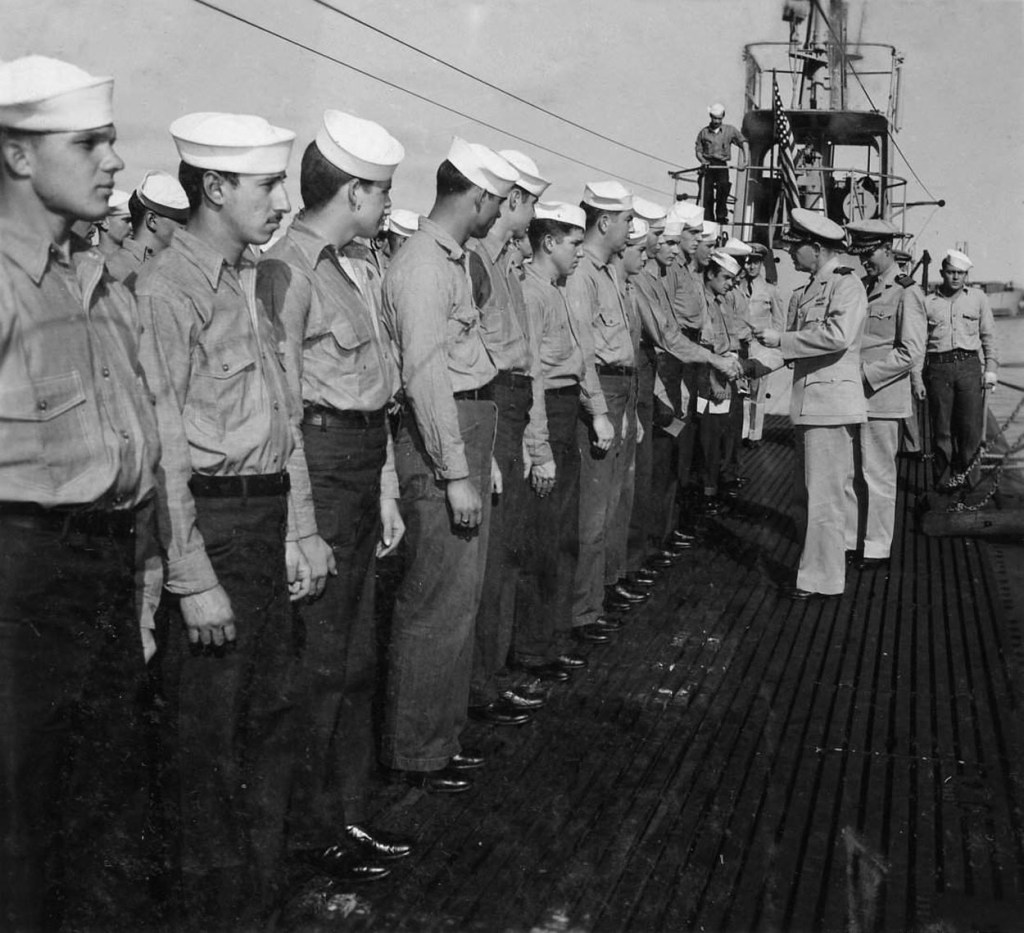
Behind the attacks stood the technical work that made them possible. The patrol-report personnel assessment highlighted in Rasher’s record praised the engineers, electricians, radiomen, auxiliarymen, and radar technicians for keeping equipment in excellent condition, and noted commendation entries for the men responsible. The fifth patrol’s recognition of the radar technicians similarly connected successful attacks with the sustained effort required to keep essential gear operating.
For an electrician such as Sampson, that praise addressed the foundation of his contribution. Rasher depended on electrical power for submerged propulsion and for the many systems that allowed her crew to operate beneath the surface. Batteries, motors, controls, and distribution equipment required knowledgeable attention throughout a patrol. Their condition affected how the submarine could fight and how she could escape. The men maintaining them were participants in every attack, even when their stations lay far from the periscope.
Sampson’s personal commendation, quoted in The Forum, recognized his performance as a member of the ship’s company during an outstanding patrol carried out despite strenuous enemy antisubmarine measures. The censored wording does not identify which patrol it covered. It nevertheless preserves official recognition of his part in a collective achievement. Rasher’s successes belonged to the whole boat, including the electricians whose work kept her ready to answer the captain’s orders.
A Name to Remember
After the war, Sampson settled in Van Nuys, California. His submarine service extended beyond Rasher and Tilefish; his memorial record lists a succession of other boats and his eventual advancement to master chief interior communications electrician. He went on Eternal Patrol in 1975. The young first class petty officer photographed during wartime leave had become a career member of the Silent Service.
Remembering him brings the history back to the family visit reported on November 5, 1944. The newspaper preserved a moment between assignments, when a sailor’s record of combat met the ordinary business of leaving home again. Ansel Sampson was one of the many men who served in World War II submarines, and one of the millions whose wartime lives alternated between separation and brief reunion. His name deserves its place beside the record of the boat he helped keep fighting.
Sources
The Forum, November 5, 1944, p. 11, “Sampson Veteran Of Submarine War” (supplied clipping).
USS Rasher history (supplied PDF); “The Lethal Five” outline (supplied), including its summary of patrol-report personnel commendations.
Naval History and Heritage Command, Dictionary of American Naval Fighting Ships, “Rasher (SS-269).” https://www.history.navy.mil/research/histories/ship-histories/danfs/r/rasher.html
JANAC, Japanese Naval and Merchant Shipping Losses, appendix listing losses by U.S. submarine. https://www.ibiblio.org/hyperwar/Japan/IJN/JANAC-Losses/JANAC-Losses-6.html
Eternal Patrol Memorial, Ansel Earland Sampson (supplied image); Sea Poacher Association, We Remember Submarine Sea Poacher, memorial roster, lists November 1975. https://www.seapoacher.com/2.pdf


Leave a Reply