
At a quiet submarine base in the Pacific in July 1945, the war still raged, but the mood had shifted. The end was near, and with it came time for reflection. Two veteran submariners sat nursing beers, their bodies young but their eyes older than they had any right to be. One of them was Chief Machinist Ray E. Cain, better known throughout the Silent Service as “Stinky.” His grin told half the story. His words, printed in the Winchester Sun that summer, told the rest.
“We’re not an ice cream navy,” he said, raising his glass. “We want a drink when we can get it.”
There was no bravado in the way he said it. Just truth. The kind that’s earned the hard way, fifty feet under the waves with your life depending on men who knew you better than your own brother. Cain had seen what long war patrols could do to a man. He’d watched nerves fray, tempers flare, sanity bend under the heat and pressure of deep dives and enemy waters.
“Submariners want to get tight when they get in,” Cain said. “And they do.”
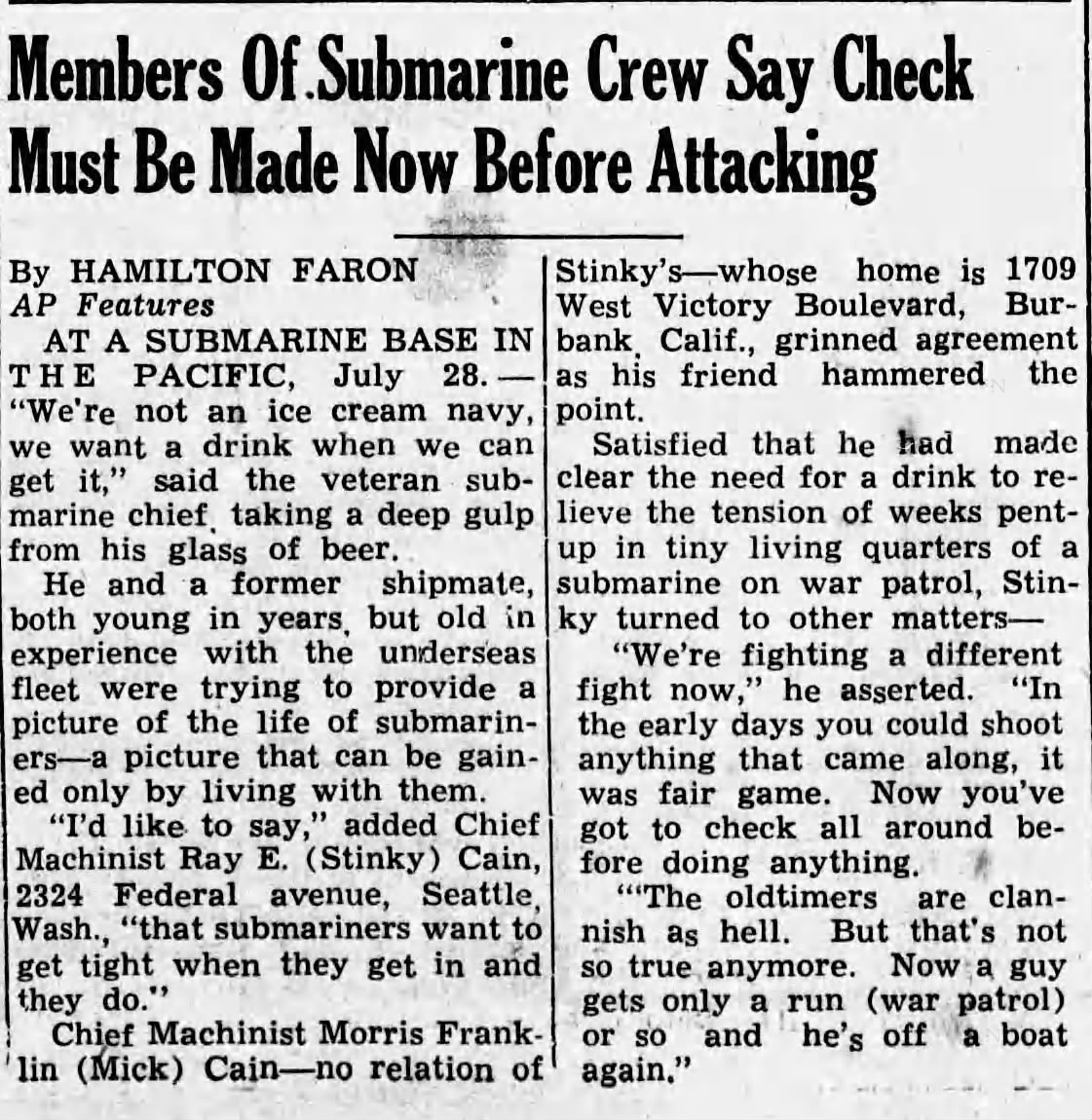
In the early days of the war, patrols were looser. The rules, if they existed, were simple. If it moved and flew the Rising Sun, you sank it. But things changed. By 1945, rules of engagement had grown stricter. Identification had to be certain. Mistakes were no longer excused by chaos. And rotation came quicker. The old-timers might have stayed aboard for half a dozen runs or more, but now, Cain noted, “a guy gets only a run or so and he’s off a boat again.”
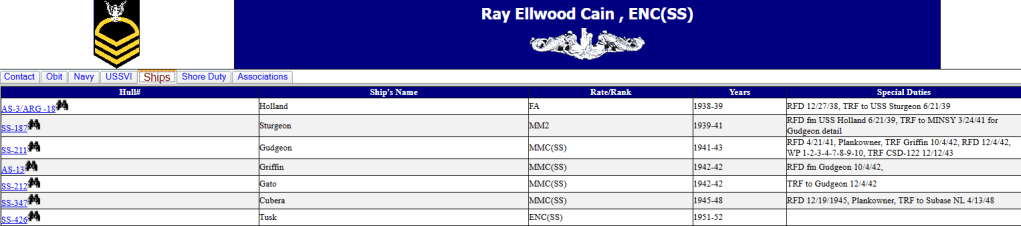
Back in December of ’41, the rules were clearer. The USS Gudgeon (SS-211) had just been commissioned that spring. She was fresh, sharp, and among the newest of the Tambor-class submarines. When the Japanese attacked Pearl Harbor, Gudgeon wasn’t in port. She was at Lahaina Roads, out on exercises. Eleven days later, she got orders to make history.
Her first patrol began on December 11. Lieutenant Commander Elton W. “Joe” Grenfell had the conn. His orders were explicit. Unrestricted warfare. Anything flying the enemy flag was fair game.
Getting to the patrol area off Kyushu took time. Gudgeon had no radar. She submerged during daylight and ran on the surface at night, conserving fuel and keeping the batteries charged. The patrol itself lasted 51 days, of which only 12 were spent on station. Some commanders criticized the cautious approach. Others praised it. What mattered most, though, was what happened once they arrived.
After days of poor visibility and false starts, on the evening of January 9, 1942, Gudgeon found her first true target. A freighter, roughly 5,000 tons. She fired three torpedoes in a night attack. At least one hit. Possibly two. Sound reported reverberations. A thud shook the boat. Then silence. The freighter was gone.
But the moment that truly marked Gudgeon’s name in submarine history came on the morning of January 27. Near Midway Island, sound picked up fast screws on the port bow. Grenfell spotted a Japanese submarine running on the surface. They moved into attack position. Three torpedoes fired. Two struck. The enemy boat vanished beneath the waves. Gudgeon became the first American submarine to sink an enemy warship in World War II.
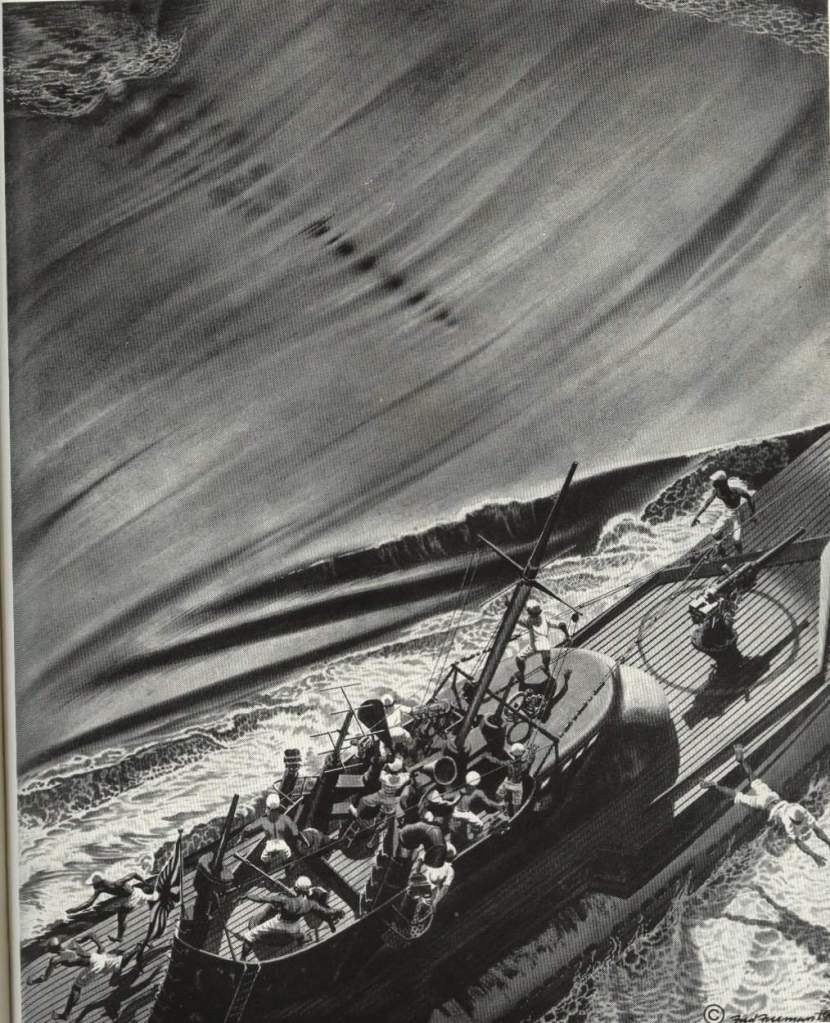
The success was celebrated, but it came at a cost. The mission was long, the conditions rough. Water was rationed to less than two gallons a day per man. The crew lived on canned meat, powdered eggs, and faith. The garbage system was efficient. The torpedoes were cared for like sacred relics. Morale remained high, but the strain showed in small ways. Requests for war news were constant. They wanted to know what was happening in the world they’d left behind.
Cain had been part of that world. He served on boats like Gudgeon, under conditions most Americans would never understand. Later in life, long after the war and the silence of the Pacific had faded, he stayed close to the men who shared those spaces. He became an officer in the United States Submarine Veterans of World War II. He told stories. He remembered names. He honored the ones who didn’t come home.
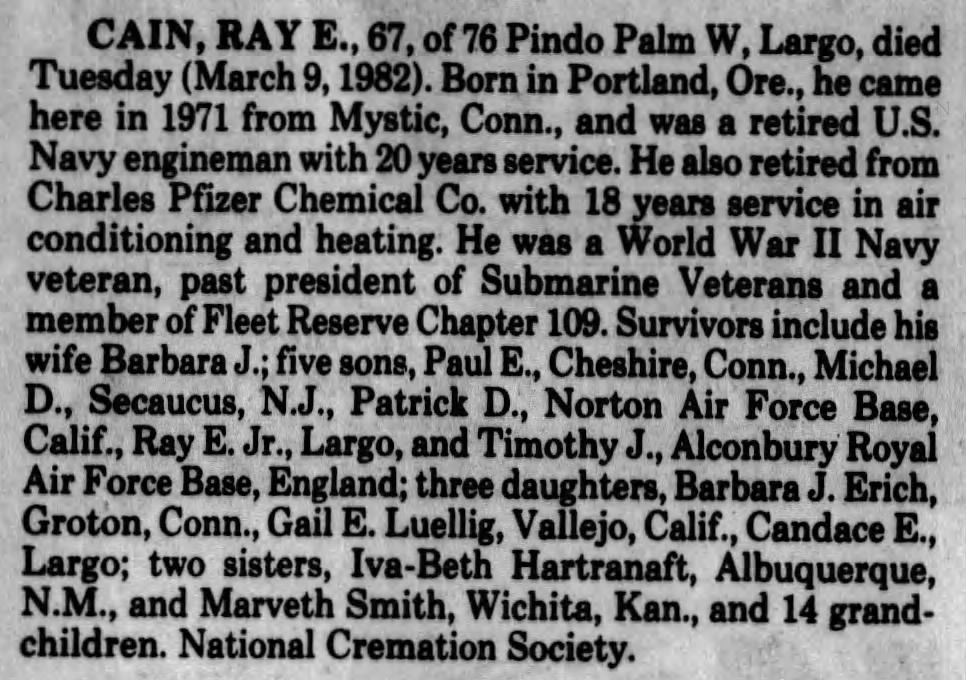
He passed away in Largo, Florida, in 1982 at the age of 63. By then, he’d logged 22 patrols. He’d seen the birth of the undersea campaign that crippled Japan’s shipping and helped turn the tide of the Pacific War.
The submariners of World War II were cut from a different cloth. They operated in darkness, both literal and strategic. They faced isolation, mechanical failure, enemy depth charges, torpedo malfunctions, and the slow grind of nerves that frayed under pressure. Relief came not through medals or parades, but in beer shared with a brother sailor. In laughter about close calls. In a stiff drink when the boat made port.
Getting tight, as Cain put it, wasn’t just about cutting loose. It was a pressure release. A safety valve. It was how they stayed human after weeks of pretending they were machines.
Gudgeon never came back from her 12th patrol in 1944. She was lost with all hands. Presumed sunk somewhere near the Maug Islands. But her story lives on. So does the memory of those first patrols and the men like Ray “Stinky” Cain who bore them.
They were submariners. They didn’t ask for attention. They just wanted a drink when they could get one.
National Archives and Records Administration. “Identifier: 133951361.” National Archives Catalog. Accessed July 28, 2025. https://catalog.archives.gov/id/133951361 Narrative by David Ray Bowman FTB1(SS) 07.27.2025
Faron, Hamilton. 1945. “Members of Submarine Crew Say Check Must Be Made Now Before Attacking.” The Winchester Sun, July 28, 1945. https://www.newspapers.com/image/1011446110/
Wikipedia contributors. 2024. “USS Gudgeon (SS-211).” Wikipedia. Last modified July 25, 2024. https://en.wikipedia.org/wiki/USS_Gudgeon_(SS-211)
 Patrol Reports
Leave a comment