
In the early morning fog of July 5, 1944, the USS Sunfish broke free from a curtain of gray and found herself staring at a rare, eerie clarity over the northern Kuril Islands. Aradio To rose sharply in front of her like a black tooth jutting from the sea, and for the first time in days, the crew could see clearly. Paramushiru, Shimushu, even Kamchatka were all laid out under a hazy sun that had barely burned through the mist. The weather gave them a moment of visual advantage, but it also left them exposed. There was no Japanese shipping in sight, but that didn’t mean it wasn’t out there. In these waters, silence could kill.
They tried to close on Paramushiru, hoping to get a closer look, maybe even a target. But the current had other plans. Two knots of steady resistance pushed the submarine backward, and by 0800, the officers knew they weren’t going to make the approach. Captain E. E. Shelby, a quiet man known for his patience and precision, called for a new course. They’d patrol northward, clinging to the western coast of Kamchatka, staying low and out of sight.
Later that morning, just before 0922, the fog gave up another secret. Kamchatka and the nearby islands peeked out through a break in the gloom. Nothing moved on the water. Nothing stirred on the shoreline. But at 1231, sharp eyes on the bridge caught sight of masts. A ship. Contact #4. Smoke. Anchored. Then a second, contact #5, just three miles up the coast, quiet as a ghost. No markings, no flags. Just another steel hulk waiting in the murk, flanked by small fishing boats.
The tension inside Sunfish tightened like a noose. Were they spotted? Were the Japanese watching back? Captain Shelby ordered the boat to close. They needed to be sure. As they approached, the second ship finally blinked. A Japanese naval ensign climbed the aft flagstaff. Then a white flag. Someone waved it from the afterdeck with what could only be described as panic.
By 1349, the crew had their orders. Torpedo tubes flooded. The first torpedo ran true but passed under the stern. The second followed, set for a shallower depth, and still missed. The crew watched the water boil with disappointment. The third torpedo hit just aft of the stack. That one did the job. The ship cracked apart and disappeared in less than a minute, the sea swallowing her whole1.
Not long after, a coastal gunboat appeared on the radar. A small one, only 600 tons, probably a patrol craft. But she was too far, too fast, and too close to home. She vanished into the fog like so many others. That night, Sunfish sent word of the kill to headquarters and pushed deeper into the frigid waters of the Sea of Okhotsk.
By the next night, the fog still hadn’t lifted. The weather was unforgiving, the visibility miserable. But just before midnight on July 6, radar lit up. Contact #7. A single large pip. The range was good, about 13,700 yards. They closed to within 1,000 yards and waited. The crew was silent, each man glued to his station. The tension was suffocating. This was going to be close.
Just after midnight on July 7, the order came to fire. Three torpedoes punched out of their tubes and raced toward the target. A second spread followed seconds later. The explosions came fast. One. Two. Then a final blast. The ship broke apart in the black water. Wreckage floated. Rafts bobbed. Survivors clung to debris. Some shouted in Japanese. Others just moaned. Captain Shelby chose not to pick up prisoners. Not yet. The patrol was still young.
That morning, July 7, brought clearer skies and a break in the fog. At 1205, another contact appeared, this one 18,000 yards out. A submerged approach brought her closer. A Liberty ship, flying Russian flags. Oddly enough, the flags were upside down and out of sequence. Still, Shelby held fire. The ship passed at 1,000 yards, and the Sunfish let her go.
Then, at 1213, another radar hit. Two pips, close together. Contact #9. They tracked at a bearing of 110 degrees. Within minutes, visibility opened up. What lay ahead was a Japanese convoy, escorted by Fubuki-class destroyers. Three freighters in a tight line. The Sunfish dove hard and started its approach.
By 1053, torpedoes were in the water again. Six of them. The first three aimed at the lead freighter. The next three set for the medium-sized freighter in the center of the formation. The crew held their breath as the wakes streamed out ahead of them. One Fubuki destroyer caught sight of something in the sea and turned in hard. A shell burst in the air. Another destroyer charged directly at them. The Sunfish dove deep. Breaking-up noises echoed through the hull as steel twisted and bulkheads failed above. Two hits were confirmed. One freighter seem to vanish. Another was now burning. Smoke poured into the fog.2
And then came the payback.
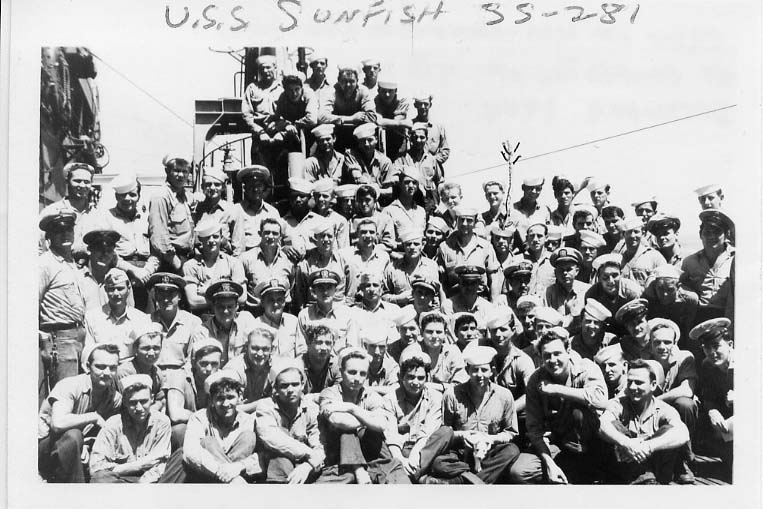
Depth charges started raining down. Eighty-six of them in total. Some close. Some far. Some so near the men swore they could feel rivets pop loose. The Sunfish dove past 450 feet, hanging on by grit and training. For hours, they were hunted, but they refused to be caught. Eventually, the sea went quiet again. Silence returned.
That night, they turned west and slipped through Diane Strait. The Kurils fell behind them, swallowed once more by fog and smoke. But the Sunfish was not done.
She was just getting started…
1 – Shinmei Maru, Passenger-Cargo 2,577 tons per post war record analysis.
2 – Postwar records analysis show no sinking in this attack
National Archives and Records Administration. USS Sunfish (SS-281) – Deck Log, July 1944. Record Group 24: Records of the Bureau of Naval Personnel. National Archives at College Park, College Park, MD. Accessed July 5, 2025. https://catalog.archives.gov/id/74852643
 Patrol Reports
Leave a comment