
The morning of 29 November 1943 opened with a sky the color of steel wool. The sea rolled slow and indifferent as Bonefish moved through the Flores Sea, stalking her patrol track with the quiet patience of a hunter. At 0525 the lookout broke the monotony with a single hard call that snapped every head around. Smoke on the horizon bearing 068 true at a distance of about twenty five thousand yards. The log placed Bonefish at latitude 06 34 south and longitude 116 47.7 east. Smoke at that distance meant a sizeable ship and the scale of the plume suggested speed and purpose.

At 0526 the boat shifted to battle stations for tracking. The officers studied the distant profile and soon identified a large transport similar to the Japanese Nozima type. She had an escort close aboard, a small subchaser type. Both vessels spewed thick black smoke as if their engineers were urging every ounce of power from boilers already pushed past their liking.
Bonefish slipped under at 0656 for the attack. The target’s range was about twenty five thousand yards and closing. The boat settled into the familiar tension of a submerged approach. At 0716 sound picked up echo ranging at sixteen thousand yards. By 0757 the JP sound operator had the screws at a count of one hundred thirty two revolutions per minute which plotted out to a speed of eight knots. The range tightened steadily.
At 0817 Bonefish reached attack position at latitude 06 22 south and longitude 116 35 east. The target moved on course 267 true at eight knots. The range was about twenty six hundred yards. Bonefish’s own ship headed on 030 true. Torpedo tracks were set with sixty degrees port and thirty degrees right gyro for the bow tubes. The firing pattern began at 0817 and fifty five seconds when tube one fired. Tube two followed at 0818 and five seconds. Tube three went at 0818 and thirteen seconds. Tube four fired at 0818 and twenty three seconds.
The first hit came at 0819 and twenty three seconds. It was heard and seen amidships. The second hit followed at 0819 and thirty two seconds directly under the mainmast. The target’s screws stopped immediately. She took a heavy list and began settling by the stern. The log noted an aircraft on her forward well deck identified as a Japanese Mary type seaplane.
By 0822 the transport’s stern was underwater. Her bow rose at an angle of about thirty degrees as the escort raced in Bonefish’s direction. At 0823 Bonefish went to deep submergence. A single depth charge detonated at a distance. Sound reported the unmistakable grinding and tearing of a large steel hull breaking apart in the direction of the target. Two more depth charges exploded at 0823 and forty five seconds. They were close enough to shake the hull. A cold temperature layer appeared at two hundred fifty feet. Bonefish dropped to three hundred fifty and then four hundred twenty feet steering evasive courses.
Between 0826 and 0827 five more depth charges went off very close. At 0829 another pair exploded nearby. The escorts continued ranging with active sonar. Bonefish rode the thermocline and silence. The violence faded and by 0917 sound reported nothing except the last faint echoes of the escort’s sweeping pings and the dying groans of the ship already on the bottom.
At 1004 the boat eased up to periscope depth. The escort was still visible at bearing 300 true, about four thousand yards distant, turning without pattern. She remained cautious and angry but she could not find her prey. Bonefish waited patiently. The day stretched on and their underwater world remained still.
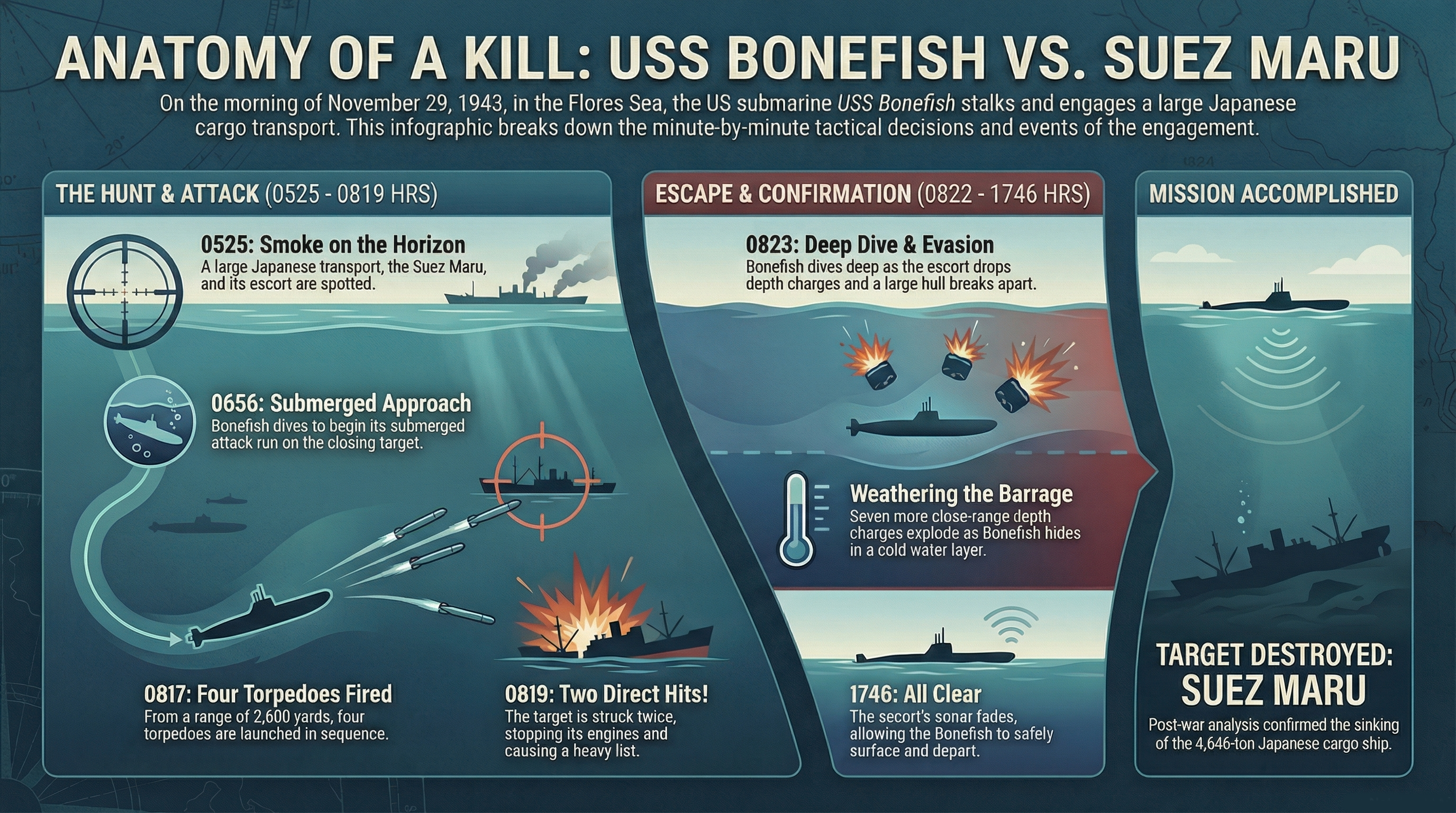
By 1746 the escorts echo ranging faded completely. Bonefish surfaced and continued north toward the Makassar Straits. The smoke of the escort hovered faintly on the horizon astern, a reminder of the fury that had failed to touch them.
The large Japanese cargo vessel was gone. Two well placed torpedoes had stopped her in minutes and the breakup sounds heard over the hydrophones confirmed her end. Bonefish pushed ahead through the evening twilight, another kill on her record and another night beneath a quiet sky in the long war of the deep.
Postwar Analysis credited the Bonefish SS-223 with sinking the SUEZ MARU, a 4,646 ton cargo ship on November 29, 1943.
Sources
U.S. Navy. USS Bonefish (SS-223) War Patrol Reports, First and Second Patrols, November 1943. Microfilm Record, Office of Naval Intelligence. Pages from SS-223_BONEFISH_Part1.pdf. U.S. Navy. Submarine Patrol Reports: USS Bonefish (SS-223). Naval District Washington, Microfilm Section, 1943. Microfilmed operational logs detailing daily positions, sightings, attacks, and damage assessments.
Roscoe, Theodore. United States Submarine Operations in World War II. Annapolis, MD: Naval Institute Press, 1949.
Blair, Clay. Silent Victory: The U.S. Submarine War Against Japan. Philadelphia: Lippincott, 1975.
Hutchinson, Robert. Silent Warriors: The Submarine Experience. London: Weidenfeld and Nicolson, 2001.
 Patrol Reports
Leave a comment