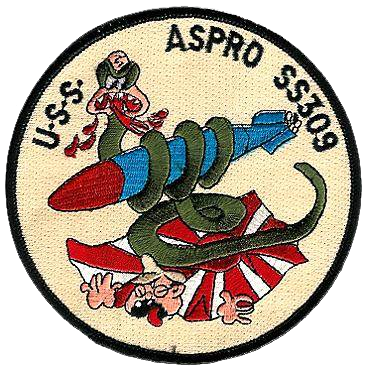
When USS Aspro (SS-309) pushed away from USS Euryale at Fremantle on September 10, 1944, she was no stranger to the deadly chess game of the Pacific submarine campaign. She had already carried out four successful patrols, sending enemy ships to the bottom, and she bore the scars and the confidence of a seasoned hunter. Her crew, lean from the tropical heat and the endless diet of Navy rations, carried the rhythm of submarine life in their bones. They had endured the long refit—tuning machinery, testing torpedoes, restowing provisions, and saying goodbye to the brief comforts of liberty. Now they were heading back into the South China Sea, where enemy shipping still plied the waters in defiance of the American blockade.
This was the fifth war patrol. Officially it lasted from September 10 to October 25, 1944. The operational area stretched from the coasts of Luzon across the shipping lanes leading into the South China Sea. Alongside Cabrilla (SS-288) and Hoe (SS-258), Aspro was assigned to form a coordinated wolf pack under the overall command of Hoe’s skipper. The assignment was clear: sink anything the Rising Sun dared to send across those lanes.

The patrol began, as all did, with drills and exercises. Shortly after departing Fremantle, Aspro carried out training attacks with the British target ship HMS Indura and then with her American companions. These were the rehearsals that sharpened reactions, making sure every man knew his station and could carry out orders under the press of combat. The gunnery exercises provided release: the thunder of deck guns shattering floating targets, the acrid smoke of spent shells drifting back across the bridge, the satisfying sight of splintered timbers disappearing beneath the waves.
By mid-September, Aspro had taken fuel and supplies at Darwin, then pushed northward into the Banda Sea, transiting Sibutu Pass on September 22. The seas were busy not only with enemy craft but with the small fishing sampans of native peoples, some friendly, some simply wary. On September 20 and again on the 23rd, Aspro’s crew came alongside sampans, handed over bread and cigarettes, and received shouts of “Victory, Victory!” from Filipino fishermen who knew that America’s silent raiders were back in their waters. These encounters, minor as they seemed, carried immense symbolic weight: the oppressed peoples of the Philippines saw in the steel shape of the submarine the promise that liberation was drawing near.
The routine of patrol settled in: daily dawn dives, periscope sweeps, endless contacts on radar and sonar that turned out to be false or fleeting. Aircraft plagued them. Every few hours the sharp ping of the SD radar reported contacts. Sometimes planes came into view, wings flashing in the sun, forcing crash dives. Other times it was interference, atmospheric noise that set nerves on edge. The men sweated in the steel tube, knowing that a single careless periscope feather or a trace of diesel exhaust might give them away.
By the end of September, the wolf pack reached its patrol station. Aspro and Cabrilla coordinated surface patrols twenty miles apart, sweeping back and forth off Luzon. Rumors of convoys thickened, and the men knew that sooner or later steel and torpedo would meet target.
The last day of September brought the first heavy action. On the morning of the 30th, Aspro heard the distant concussion of depth charges. At 0943 smoke and masts were sighted: a convoy of at least seven ships, heavily escorted. The submarine closed slowly, submerged at 150 feet, raising the periscope every twenty minutes to take bearings. Aircraft buzzed overhead. Sound reported multiple sets of screws, their propeller beats overlapping in the headphones. It was a picture-book target: columns of smoke stretching across the horizon, merchants plodding along at steady course and speed.
At 1238 Commander Gordon Abbott fired six bow torpedoes at a large freighter in the center column, range 1,700 yards. Two minutes later, an explosion rocked the sea. The escorts were quick to react. Depth charges rolled in—forty-three of them over the next half hour. The boat quivered under the pounding, bulkheads creaked, gauges trembled. Then, faint but unmistakable, came the sounds of a ship breaking up. At 1321 a secondary explosion was heard, not like any depth charge but the internal detonation of a ship’s boilers. The men grinned grimly in the half-dark: one more enemy cargo ship was on its way down. Aspro had survived, and she had killed.
But the ordeal of September 30 was only the prelude. The real test, the day that would stamp itself into the memory of every man aboard, came two days later, on October 2.
The night before had been tense. Radar contacts flickered on the SJ set, mostly interference, but one persistent echo at 11,000 yards suggested a submarine. Recognition signals were attempted but no reply came. Perhaps it was a friendly boat, perhaps not. By dawn the question was moot: at 0535, as the first gray light spread over the South China Sea, the periscope revealed a Japanese tanker.
It was steaming slowly, hugging the coast, perhaps hoping to blend into the shoreline or slip beneath the cover of land-based air patrols. Its course suggested caution, its speed a mere crawl. Soon another maru was sighted, accompanied by small sampans. The convoy was meager, but in wartime every tanker was gold. Japan was desperate for fuel; every ship destroyed tightened the noose around its war machine.
Commander Abbott ordered the approach. Aspro ran at 100 feet, coming to periscope depth at intervals, sliding closer with the patience of a stalking predator. The tanker plodded along at six and a half knots, following the curve of the shoreline. The task was to close the range without betraying the submarine’s presence. At any moment aircraft could arrive, or the enemy could zigzag and throw off the solution. The crew stood at their posts in silence broken only by the occasional orders of the captain and the rhythmic reports from sonar.
At 0846 the moment came. Four torpedoes leapt from the bow tubes, running a 2,700-yard track at a 120-degree port angle. Men in the forward torpedo room counted seconds, sweating in the stale air. Then it came: one explosion, muffled by distance but sharp enough to lift spirits. Somewhere ahead, steel had been rent open.
Almost instantly the air war began. Aircraft swooped in, their bombs splashing close. The boat went deep. At 0850 a bomb fell, the concussion rattling pipes and knocking men against bulkheads. At 0852 another was heard, then more. At periscope depth Abbott caught a glimpse of the stricken tanker, its stern sagging, heavy smoke curling upward. Hydrophones picked up the ominous sounds of tearing metal, the death rattle of a ship mortally wounded.
But jubilation was short-lived. The chase was on. Aircraft circled overhead, and depth charges began to fall. At 0900 a bomb shook the boat again. The battery was already low, and every dive meant precious power drained. Abbott considered pressing the attack on the second ship, but the conditions were worsening by the minute. Bombs fell at 0957, 0958, 1001, and 1002, several dangerously close. At 1009, as the periscope briefly broke the surface, the crew saw the tanker stern-down, sinking vertically into the sea. It was confirmation that their torpedoes had done their work. A valuable cargo of fuel would never reach Japan.
By 1012 more bombs were falling, and it was clear the Japanese air patrol had marked their position too well. The captain called off further attack runs. With batteries low and enemy eyes watching every feather, pressing the assault would have been suicide. Instead, Aspro slipped away, deeper and deeper, the hull groaning with pressure, the men silent at battle stations. They had survived another clash. One ship lay on the bottom, and Aspro was still alive.
The rest of that day was a grim endurance test. Bombs and depth charges continued until mid-afternoon. The crew listened as breaking-up noises echoed faintly through the hydrophones, the last agonized groans of the tanker they had sunk. At last, by evening, the sea grew quiet again. Aspro surfaced after dark, scarred but unbeaten.
October did not relent. Just days later, on October 5, Aspro sighted another trawler close to the beach, but the presence of aircraft kept them from pressing home an attack. On the 6th she made contact with a Japanese patrol boat conducting anti-submarine sweeps near the coast. Escorts dropped depth charges, forcing the submarine deep again. Each encounter drained batteries, strained nerves, and left scars on machinery. Yet each also built the confidence of the crew: they had faced ships and planes, had been hammered by depth charges, and had still returned fire.
The wolf pack continued to coordinate, Aspro rendezvousing at intervals with Cabrilla and Hoe, exchanging recognition signals and patches of news. One day’s orders might be for submerged patrol close to the coast, the next for surface sweeps twenty miles offshore. The men knew they were part of a larger campaign: submarines up and down the South China Sea were slicing into the lifelines of the Japanese empire.

By mid-October the patrol was drawing toward its end. The toll was significant: across September 30 and October 2 alone, Aspro had fired ten torpedoes and scored hits that sent two large tankers to the bottom. The official patrol report would credit her with sinking two large freighters, one medium tanker, and one medium oiler, with another large freighter heavily damaged. It was a record in keeping with her earlier successes and enough to secure the award of the Submarine Combat Insignia for the patrol.
On October 25, 1944, Aspro returned to port. Her fifth patrol was over. In just over six weeks she had faced convoys, aircraft, patrol boats, bombs, depth charges, and the hazards of coastal waters. She had sunk thousands of tons of enemy shipping, further tightening the grip of the U.S. submarine force on Japan’s dwindling merchant fleet. The official record spoke with military precision—dates, times, courses, ranges—but for the men aboard it was the memories that lingered: the hot reek of diesel oil and sweat, the concussions hammering their ribs during depth charge barrages, the fleeting view of a maru sliding beneath the waves, the cheer when hydrophones reported breaking-up noises. And most of all, the endless tension of October 2, when a Japanese tanker was hunted down under the eyes of enemy aircraft, and Aspro lived to tell the tale.
The submarine force would later tally its scorecards. By her fifth patrol Aspro had sunk fourteen ships, including an enemy submarine, for a total of more than 64,000 tons, and damaged eight more for nearly 60,000 tons. These were numbers with strategic weight. They were also the echoes of torpedoes launched in silence, of steel cracking open, of crews like those of Aspro who risked everything in the unseen war beneath the Pacific.
U.S. Navy, USS Aspro (SS-309) Fifth War Patrol Report, 10 September – 25 October 1944 (Declassified patrol report submitted by Commanding Officer, October 25, 1944).
Clay Blair, Silent Victory: The U.S. Submarine War Against Japan (Philadelphia: Lippincott, 1975).
Theodore Roscoe, United States Submarine Operations in World War II (Annapolis: United States Naval Institute, 1949).
Charles R. Hinman and Douglas E. Campbell, Submarine Database – On Eternal Patrol (Naval Submarine League, updated periodically).
Naval History and Heritage Command, Dictionary of American Naval Fighting Ships: USS Aspro (SS-309) (Washington, D.C.: Department of the Navy).
Norman Polmar and K.J. Moore, Cold War Submarines: The Design and Construction of U.S. and Soviet Submarines (Washington, D.C.: Potomac Books, 2003).
 Patrol Reports
Leave a comment