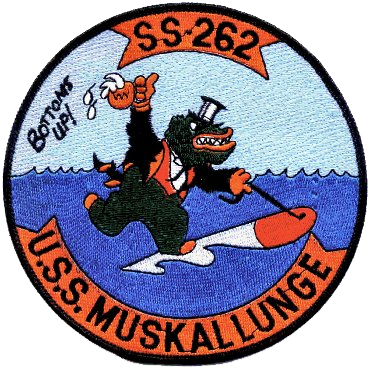
The USS Muskallunge (SS-262) was one of the U.S. Navy’s steel hunters, a Gato-class submarine that prowled the Pacific during the Second World War. Her name, chosen in honor of the fierce fish that lurks in the lakes and rivers of North America, could not have been more fitting. Fishermen know the muskie as the “fish of ten thousand casts,” a prize hard to land and nearly impossible to forget. For the crew of Muskallunge, the boat became their own elusive prize, tested in battle, hounded by escorts, and remembered today as one of the submarines that carried the Silent Service into the heart of the Pacific war.
Muskallunge was born at the Electric Boat Company in Groton, Connecticut, where so many of America’s wartime submarines were forged. Her keel was laid on April 7, 1942, in the early desperate months of the war when U-boats prowled the Atlantic and American submarines were just beginning their long campaign in the Pacific.
She slid down the ways on December 13, 1942. Mrs. Anna C. Graham, the widow of Chief Torpedoman Merritt D. Graham who had gone down in USS Grunion (SS-216), christened the boat. That personal tie, one submarine lost and another launched in its shadow, marked her from the start. On March 15, 1943, she was commissioned, and Lieutenant Commander Willard A. Saunders took command.
She was built to the specifications of the Gato class: 311 feet long, with a beam of 27 feet and a mean draft of just over 15. She displaced 1,526 tons surfaced and 2,424 submerged. Powered by four H.O.R. diesel engines and four high-speed Allis-Chalmers electric motors, she could make more than 20 knots on the surface and nearly 9 submerged. Ten torpedo tubes, six forward and four aft, gave her the bite she needed, while her deck guns and antiaircraft weapons gave her teeth above the waves. With a test depth of 300 feet, she was expected to survive the crushing weight of the ocean and the hammering of enemy depth charges. Sixty men would live and fight aboard her.

Muskallunge’s first months were not spent in combat but in testing. She carried out shakedown training in New London and Newport, firing hundreds of experimental torpedoes. By July 1943 she was ordered west, leaving New London for Pearl Harbor, where she arrived on August 7.
Before she could begin her first war patrol, she was handed a special assignment. Submariners had been fighting with torpedoes that often failed to explode, a problem that had cost lives and lost opportunities. USS Tinosa (SS-283) had returned with a dud torpedo, and Muskallunge was ordered to fire it into the cliffs of Kahoolawe. Two of three test shots exploded, but the third failed. Recovery of the unexploded weapon revealed the flaw in the contact firing mechanism. It was a discovery that finally solved one of the most frustrating problems faced by the Silent Service. Muskallunge, without firing a shot in anger, had already changed the course of the war.
Command shifted to Lieutenant Commander Michael P. Russillo, who would lead Muskallunge into more dangerous waters.
Her second patrol, beginning November 27, 1943, took her into the Western Carolines and south of Guam. There she proved her bite. She damaged a tanker, hit two freighters, and sent one of the Noroto Maru class to the bottom. It was a confidence-building patrol, showing both crew and command that Muskallunge could deliver when it mattered. She returned to Pearl Harbor in January 1944, then headed for overhaul at Mare Island.
By spring 1944 Muskallunge was back in action. After extensive work to fix chronic engine trouble, she departed Pearl Harbor on April 30. In June she joined a wolf pack of submarines ordered to intercept Japanese forces moving toward the Marianas. When the Battle of the Philippine Sea erupted, submarines like Muskallunge helped bottle up the Japanese fleet. American aircraft destroyed hundreds of enemy planes in what became known as the “Great Marianas Turkey Shoot.” Submarines USS Albacore and USS Cavalla dealt mortal blows to Japanese carriers. Muskallunge’s contribution was less dramatic, but she was part of the net that closed around Japan’s shrinking empire. By July 4 she reached Fremantle, Australia, ending her third patrol.
On August 1, 1944, Muskallunge left Fremantle on her fourth patrol, accompanied by USS Flier. Bound for the South China Sea, she moved through Mindoro Strait, where she damaged an enemy ship in a submerged attack. By August 20 she was off Cape Varella, trailing a convoy of Japanese tankers and transports. She knew they might anchor overnight in Camranh Bay, and her skipper decided to wait.
August 21, 1944: Into the Teeth
At dawn on August 21, Muskallunge lay submerged five miles from Camranh Bay. Her sound operators picked up echoes, her periscope found the convoy. Three escorts guarded transports and tankers as they cleared the harbor.
At 08:52 Muskallunge fired three torpedoes at the lead ship, identified as a transport. Seconds later three more sped toward the largest target in the group.
08:53:30 – First torpedo explosion. One hit on the AP.
08:55 – Three more torpedo explosions, about five seconds apart. Three hits on the AP.

The Durban Maru, a 7,163-ton passenger-cargo vessel, had been fatally hit. She went down, another casualty of the Silent Service.
But the victory came at a price.
08:57 – Received eight depth charges, very close.
The escorts wheeled in and dropped charges with brutal precision. Muskallunge went deep, rigged for silent running.
Subsequent attacks – two depth charges, close. Nine more, close. Three more, real close.
The boat shook with every explosion. An aircraft joined the chase, dropping charges that forced Muskallunge down to 200 feet.
Later attempt at periscope depth – three depth charges from plane, forced to 200 feet. Silent running resumed.
Charges rained through the day.
Total – forty-nine depth charges, many close aboard. Sub bottomed out with rudder scraping noise.
By evening the Japanese had given up. Muskallunge surfaced under cover of darkness and cleared the area.
On August 22 Muskallunge resumed normal patrol routine, her crew exhausted but alive. She had claimed a major prize, endured a ferocious counterattack, and lived to tell the tale. For the men aboard, the memory of that day would never fade.
Muskallunge returned to Fremantle on September 22, 1944. She sailed again in October for her fifth patrol west of Palawan, then returned to Pearl Harbor for overhaul. Her sixth patrol in spring 1945 took her off Formosa, where she doubled as a lifeguard for downed aviators. On her seventh and final patrol in August 1945, she fought a surface battle in fog against small Japanese ships.
August 8, 1945 – Enemy return fire killed one man, wounded two others.
Days later the war ended. Muskallunge received orders to proceed to Tokyo Bay, where the formal surrender would take place.
After the war she returned to New London and joined the Atlantic Reserve Fleet in January 1947. A decade later she was recommissioned briefly, then transferred to Brazil as Humaitá (S-14), where she served until 1968. Returned to the U.S., she was used as a live-fire target by USS Tench and sunk off Long Island.
In June 2021, NOAA’s Okeanos Explorer located her wreck.

Her hull was found severed near forward engine room. the bow and stern sections found resting separately.
Even in ruin, the outline of a Gato-class submarine was unmistakable.
USS Muskallunge earned five battle stars for her World War II service. She tested the torpedoes that turned the tide, carried out seven war patrols, sank enemy shipping, and endured ferocious counterattacks. Her story mirrors that of the Silent Service itself, a blend of triumph and terror, discovery and endurance.
For the men who sailed in her, Muskallunge was more than steel. She was a home, a trial, and a memory. Like the fish for which she was named, she was elusive, dangerous, and unforgettable, a true muskie of the deep.
 Patrol Reports
Leave a comment