She was not glamorous. She was not fast. She never launched a torpedo in anger. And yet, USS R-9 (SS-86) served her country with quiet persistence from the close of World War I through the climactic end of World War II. Her name is seldom heard outside the circles of Navy archives and submarine veterans, but her legacy endures in the simple, steadfast performance of her duty.
Laid down on March 6, 1918, and launched into the waters off Quincy, Massachusetts, on May 24, 1919, R-9 came into the world just a little too late for the war that had inspired her. She was part of the R-class submarines, a new breed of coastal defense boats designed to guard America’s shores in an age when undersea warfare was still finding its footing. These boats were no-frills workhorses. With four 21-inch torpedo tubes and a 3-inch deck gun, R-9 was not built to win glory. She was built to keep watch.
Following her commissioning in July 1919, R-9 settled into the rhythms of peace. She spent the next five years patrolling along the northeastern seaboard, mainly around New London and Newport. These early days were filled with training runs and routine operations. Then came the call to head west. In 1924, she was ordered to the Pacific and stationed at Pearl Harbor. For more than six years, she participated in fleet exercises and independent drills, contributing quietly to the Navy’s readiness. When her time came, she passed back through the Panama Canal and arrived in Philadelphia in early 1931, where she was decommissioned and placed into reserve. She stayed there through the lean years of isolationism, berthed like a sleeping sentinel.
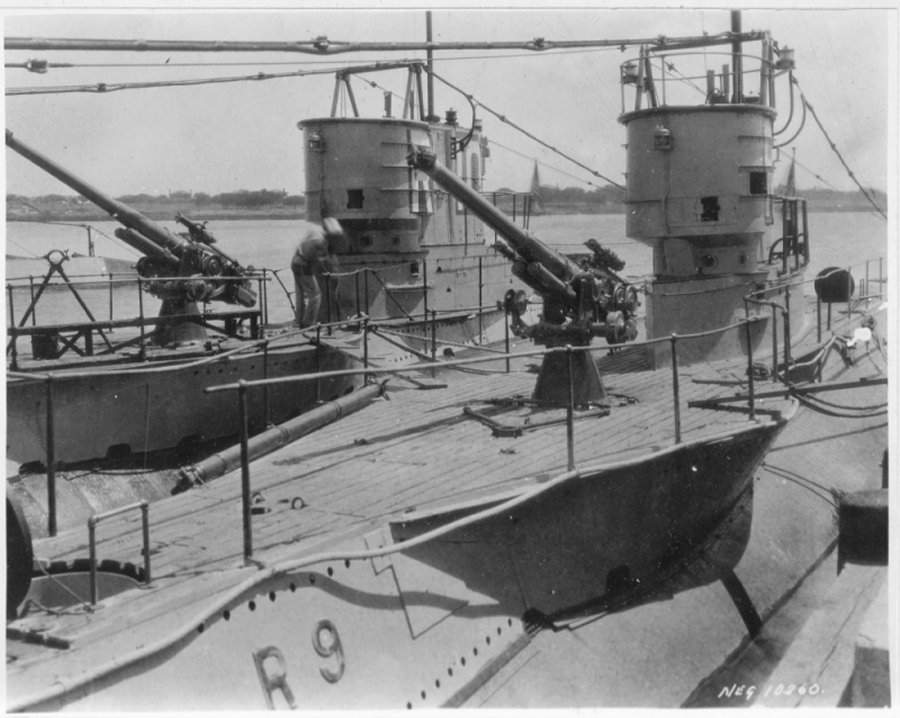
R-10 (SS-87) and R-9 (SS-86) are tied up at dock, most likely at New London, CT., or Portsmouth, ME (NAVSOURCE)
USN photo # 19-N-10260, from the National Archives and Records Administration (NARA), courtesy of Daniel Dunham
The world began to darken again by the late 1930s. As war clouds gathered over Europe, the United States Navy began to stir. In September 1940, R-9 was placed in reduced commission, and by March of 1941, she was back in full service. She might have been older, but she was still reliable. She was sent to the Caribbean, to Coco Solo, to help defend the Panama Canal, that vital artery connecting two oceans. She patrolled those warm waters with SubRon 3 until the fall of that year, then returned north to New London for overhaul.
When the war came to American shores in December 1941, R-9 was back at work. She was assigned to the Submarine School, then sent to Casco Bay, Maine, for operational training. From there, she began rotating between New London and Bermuda. These patrols were part of the broader Atlantic defense during the terrifying height of the U-boat offensive. German submarines were taking a heavy toll on Allied shipping. The Eastern Sea Frontier and Bermuda Patrol Areas became critical zones. R-9 did not engage enemy vessels, but she was there. And that mattered.
One of the most telling episodes in R-9’s wartime career came in July 1942, during her fifth war patrol. The mission was, by all accounts, profoundly uneventful. She left Bermuda on July 12 and headed 350 miles northeast to a designated patrol box. Every morning, she submerged before dawn. Every evening, she surfaced after nightfall. She patrolled a tight 40-mile radius, north to south, for four days. She saw nothing. She heard nothing. And then she came home.
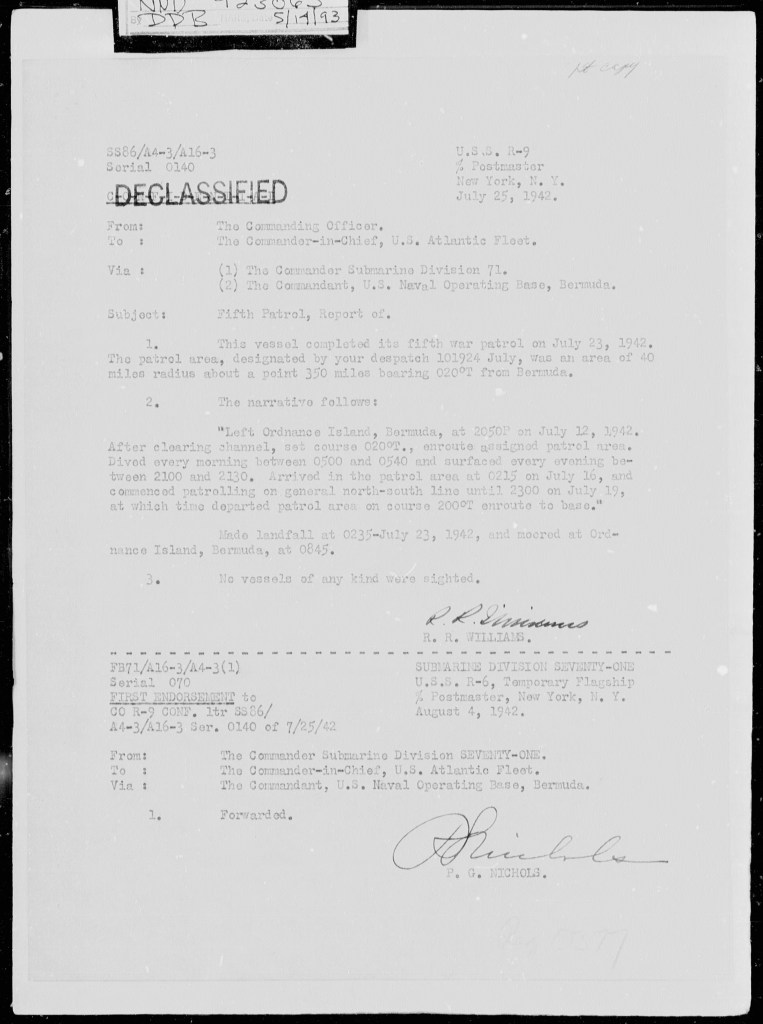
To many, that might sound dull. To a sailor, especially a submariner, it sounds like success. No encounters meant no ambushes. No distress signals. No funeral pennants flying. Patrol 5 was quiet because R-9 was where she was supposed to be, doing exactly what was asked. Her presence made sure the enemy did not find an opening. In that stillness, she protected convoys and commerce. It was the kind of duty that never made headlines but kept the war effort alive.
As the war evolved, so did R-9’s role. By the spring of 1943, she was reassigned to anti-submarine warfare training. She became a teacher, a target, and a test platform for newer ships and sonar crews. She trained with destroyers, destroyer escorts, and escort carriers. In 1945, she worked those same waters off Cuba and Florida, helping bring green crews up to speed in a theater that demanded seasoned skill. Then, in May of that year, she returned once more to New London.
On September 25, 1945, she was decommissioned at Portsmouth, New Hampshire. The war was over. Her part in it had been played. She was struck from the Navy list on October 11 and scrapped the following February. There was no ceremony. No grand farewell. But there was a legacy.
R-9 served without fanfare. She did not chase headlines or sink enemy fleets. She showed up. She stood her watch. And in doing so, she helped secure America’s coasts, its convoys, and its confidence in a time of darkness. For the men who served aboard her, and the families who never had to grieve because a boat like R-9 was on patrol, that was more than enough. That was victory, silent and steady, beneath the waves.
 Patrol Reports
Leave a comment