
The Cold War was a strange kind of war. It was fought with maps, speeches, and shadows more than bullets and blood. Yet in those years the world balanced on the edge of nuclear fire. Every night the thought lingered that sirens could wail, missiles could launch, and millions could die in minutes. Against that backdrop the United States built a fleet of forty-one submarines designed to keep the peace by threatening catastrophe. They were called the “41 for Freedom,” a phrase that sounded noble but in reality described one of the most terrifying arsenals ever to slide into the sea. Among them was USS John Marshall (SSBN-611). She was an Ethan Allen-class boat, one of the first submarines built from the keel up to carry ballistic missiles. Her story is unusual even among her sisters. She began life as a Polaris missile boat, prowling the Atlantic and Arctic with a belly full of nuclear warheads. She ended her career not as a missile carrier at all, but as a hybrid, an attack submarine fitted with Dry Deck Shelters to support Navy SEALs and special operations. In her thirty years she served as both deterrent and covert support, a boat that mirrored the changing priorities of the Cold War.

John Marshall was born in on September 24, 1755 in rural Virginia, the eldest of fifteen children. He fought as a young officer in the Revolutionary War, studied law afterward, and quickly rose as a Federalist statesman. In 1801 President John Adams appointed him Chief Justice of the Supreme Court, a position he held for thirty-four years. Marshall established the Court as an equal branch of government and famously declared in Marbury v. Madison that the judiciary had the power of judicial review. His decisions shaped the Constitution into a living framework of national authority, strengthened the federal government, and set precedents that still govern the law today. By the time of his death in 1835, he had become the most influential jurist in American history. To name a ballistic missile submarine after him was no accident. It linked the nation’s nuclear might with the rule of law, a reminder that America’s strength rested on both power and principle.
The submarine that bore his name was laid down at Newport News Shipbuilding on April 4, 1960, as the second boat of the Ethan Allen class. These were larger, more refined successors to the earlier George Washington-class submarines. They carried sixteen vertical missile tubes behind the sail, purpose-built to launch Polaris nuclear missiles. John Marshall was launched on July 15, 1961, and commissioned into service on May 21, 1962. From that moment she became part of the invisible fleet, the most survivable leg of America’s nuclear deterrent.
Her early years were defined by Polaris patrols. She carried A-2 and later A-3 missiles, each capable of destroying a city. The mission was simple but heavy with consequence. Disappear into the ocean, patrol silently for two to three months, and wait for an order that hopefully would never come. Crews rotated on Blue and Gold teams to maximize time at sea. A sailor who served during those patrols remembered the atmosphere vividly. “We were ghosts,” he said. “Nobody knew where we were. Our families had no idea. The Soviets could only guess.” Life aboard was claustrophobic. Fresh food lasted a week or two, then came canned and powdered rations. The air was recycled and scrubbed by chemicals. The mess deck echoed with the clatter of trays and the endless brewing of coffee. Days blurred into nights until sailors marked time by the menu cycle. One crewman joked that when powdered milk showed up, you knew the patrol was half over.
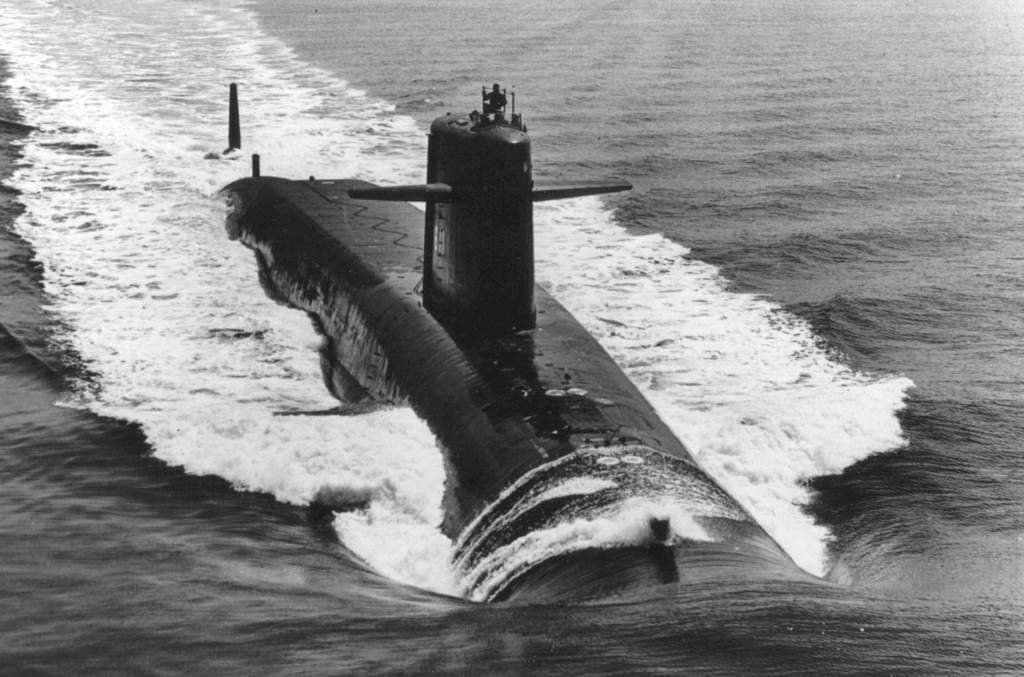
The Ethan Allen class was a stepping stone. They were the first submarines designed entirely for the ballistic missile mission, but by the late 1960s they were already being outclassed by the Lafayette and James Madison boats, which were bigger and designed for the next generation of missiles. The Navy began converting its SSBNs to carry Poseidon C-3s in the early 1970s, but the Ethan Allens were too small. They were left with Polaris. Arms control treaties like SALT I limited the number of strategic missile submarines, and the Navy had to decide how to use its aging Ethan Allens. Scrapping them was one option. Another was to convert them into something new.

That decision came in 1981. John Marshall was reclassified as an attack submarine, SSN-611. Her missile tubes were deactivated and sealed. She could no longer launch ballistic missiles, but she was far from useless. Along with her sister Sam Houston, she was modified to carry Dry Deck Shelters. These were large, pressurized compartments bolted to her deck, each capable of holding SEAL delivery vehicles. With these shelters, she became a platform for special warfare, able to deploy Navy SEALs covertly anywhere in the world.
The change gave her a second career. Through the 1980s she supported exercises and missions that never made headlines. She surfaced quietly at night, shelters opening as SEALs slipped into black water to stage simulated beach raids or reconnaissance. Her new role was not glamorous. She was not fast compared to other attack boats, and her long hull made her less maneuverable. Sailors joked she was a “slow attack” submarine. But she was invaluable to the SEAL community. She and her crew pioneered the art of launching special operations from the depths.
Veterans remember those years with wry humor. One officer said, “We were the only SSN with a garage on the back.” Another laughed that with the shelters attached, the boat looked like she was hauling luggage. The SEALs, however, took her seriously. She offered something no other submarine could provide at the time: a covert delivery system for men and equipment that extended the reach of American power. Exercises off foreign coasts tested infiltration scenarios that would be vital if the Cold War turned hot.
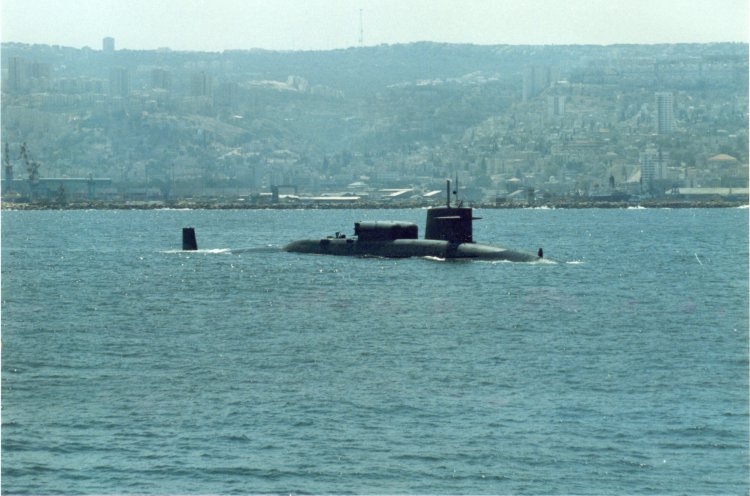
Even in this new role, John Marshall still carried the weight of deterrence. She was a reminder that the United States could adapt and use old platforms for new missions. Through the late 1980s she continued her quiet work while newer Los Angeles-class attack boats took on the high-speed hunts against Soviet submarines.
By the early 1990s the Cold War had ended. The Soviet Union collapsed, arms treaties reduced the nuclear arsenal, and the Ethan Allens had long outlived their design life. On July 22, 1992, John Marshall was decommissioned and stricken from the Naval Vessel Register. The ceremony was simple, as most submarine decommissionings are, attended by crew past and present. Less than a year later, on March 29, 1993, she was recycled at Puget Sound Naval Shipyard. Her reactor compartment was cut out and sealed, her steel melted down for reuse. It was an unceremonious end but fitting for a ship that had always lived in the shadows.
Her bell was preserved and placed at Marshall University, where students pass by it without always realizing the long and complex history it represents. For veterans, it is a reminder of patrols beneath the sea, of the endless drills, the close quarters, and the quiet pride of knowing they had stood the watch. One man summed it up simply: “We never fired a shot. That was the point. We were there so nobody else would either.”
The USS John Marshall was never meant to be famous. She did not fight great battles or fire weapons in anger. Yet her legacy is important. She shows how the Navy adapted in the Cold War, repurposing old ships for new missions, keeping pressure on adversaries, and supporting allies in ways that never made the papers. She carried the name of a man who defined the rule of law, and she embodied the paradox of nuclear weapons: built for destruction, but used to keep the peace.
Her story is a reminder that sometimes history is made not by what happens, but by what does not. She patrolled the oceans so the missiles stayed silent, trained SEALs so raids never needed to be carried out, and stood ready so wars did not have to be fought. The USS John Marshall was a guardian in steel, and though she is gone, her service remains part of the long twilight struggle that defined the second half of the twentieth century.
Crewmember Resources:
Facebook (not available)
References
Cold War Boats. (n.d.). USS John Marshall (SSBN/SSN-611) history pages. Retrieved September 2025, from https://coldwarboats.org/ssbn/ssbn611
Federation of American Scientists. (n.d.). Dry Deck Shelter (DDS). Retrieved September 2025, from https://fas.org/man/dod-101/sys/ship/dds.htm
GlobalSecurity.org. (n.d.). Dry Deck Shelter (DDS). Retrieved September 2025, from https://www.globalsecurity.org/military/systems/ship/dds.htm
Naval Encyclopedia. (n.d.). Ethan Allen-class FBM submarines. Retrieved September 2025, from https://naval-encyclopedia.com/cold-war/us/ethan-allen-class-ssbn.php
Naval History and Heritage Command. (n.d.). Dictionary of American Naval Fighting Ships: John Marshall (SSBN-611). Retrieved September 2025, from https://www.history.navy.mil/research/histories/ship-histories/danfs/j/john-marshall-ssbn-611.html
Naval History and Heritage Command. (n.d.). Photographs of USS John Marshall (SSBN/SSN-611). Retrieved September 2025, from https://www.history.navy.mil/content/history/nhhc/our-collections/photography/ships/ssbn/j/john-marshall-ssbn-611.html
NavSource Naval History. (n.d.). USS John Marshall (SSBN/SSN-611) photo archive. Retrieved September 2025, from http://www.navsource.org/archives/08/08611.htm
NavySite.de. (n.d.). USS John Marshall (SSBN/SSN-611). Retrieved September 2025, from https://www.navysite.de/ssbn/ssbn611.htm
Nuclear Companion. (n.d.). Ethan Allen-class submarines. Retrieved September 2025, from https://nuclearcompanion.com/data/ethan-allen-class/
The Herald-Dispatch. (n.d.). Marshall crew honored with ship’s bell. Huntington, WV.
U.S. Naval Institute. (1987, August). SOF — The Navy’s perspective. Proceedings.
USS John Marshall Association. (n.d.). USS John Marshall (SSBN/SSN-611) association website. Retrieved September 2025, from http://www.ssbn611.org
Wikipedia. (n.d.). Ethan Allen-class submarine. In Wikipedia. Retrieved September 2025, from https://en.wikipedia.org/wiki/Ethan_Allen-class_submarine


John Marshall’s anchor ended up being donated to Hidden Creek elementary school in Port Orchard WA.
You can find it located next to their flag pole, in front of their entrance and can be seen in a photograph on their website: https://hiddencreek.skschools.org/
LikeLike