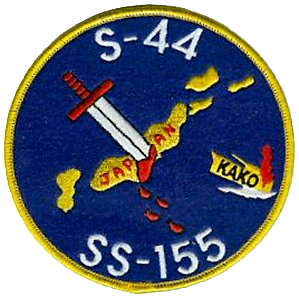
In the gray dawn of August 10, 1942, the crew of USS S‑44 settled into battle stations with a strange mix of nerves and purpose. They’d been pushing through the maze of New Britain and New Ireland for weeks, a tangle of islands in the Coral Sea where every rip of current hides a ship or a mine. The day before had passed quietly, submerged, covering New Hanover’s approach. Now, North of Simberi Island, at periscope depth in glassy seas, something unusual appeared.
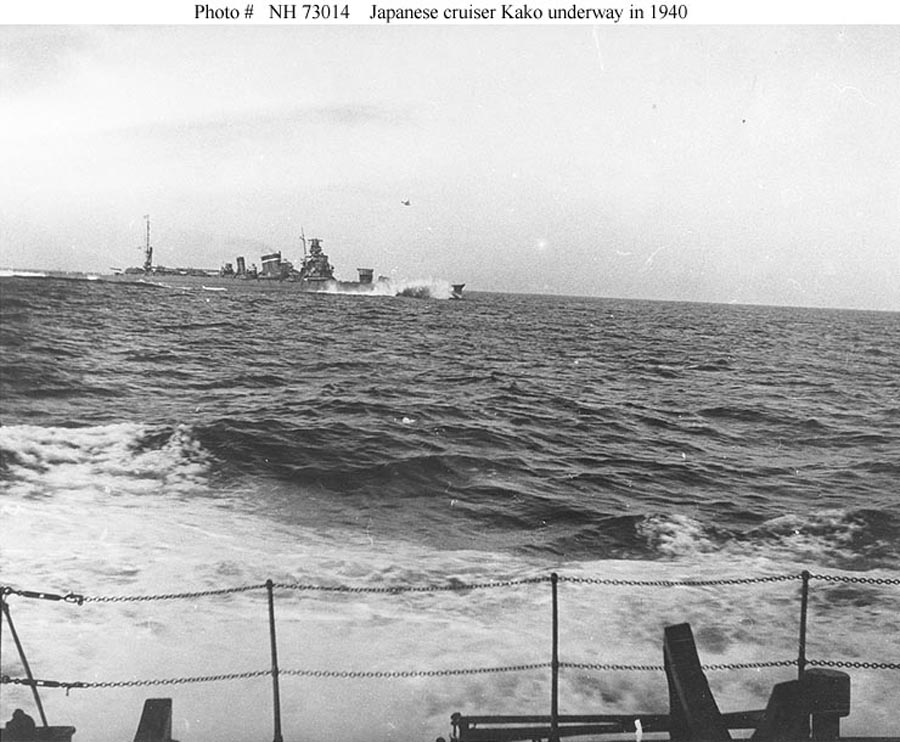
Through the scope came that moment of frozen disbelief. “Four heavy cruisers,” Moore announced quietly. They sat in two neat columns, cutting across the horizon. The conning crew recognized them from reference photos—tripod masts like spears, slab-sided funnels, sharpened bows. It was Cruiser Division Six of the Imperial Japanese Navy, steaming home after the carnage at Savo Island. Just hours earlier they’d stalked Allied ships under darkness, sinking four heavy cruisers and killing over 1,000 men with one-sided precision. Now, by all rights, they should have felt invincible. Instead, fate dropped an aging American S‑class submarine in their path.
Lieutenant Commander John R. “Dinty” Moore peered through the periscope, steady and intent. He’d inherited S‑44 earlier in the war—a submarine built in the 1920s with cramped quarters, ancient systems, and no air conditioning when the tropics sweat you into every seam. She wasn’t much on paper, but she carried Mark 10 torpedoes, and Moore believed in timing and determination more than tech.
The Japanese formation was under 900 yards off. Close enough that every shot had to count. Moore made his call: target the last ship in the rear column—Kako, a Furutaka‑class heavy cruiser of around 7,100 tons. She had served at Pearl Harbor, the Java Sea, and Coral Sea. Captain Takahashi Ban, her commander, would have been proud of her record—usually coming home intact. Today, he never saw the danger coming.
The log told it plainly: “0750 — high point of Simberi Island bears 240° (T), distant 8 miles. Sighted four heavy cruisers.” The boat stilled into an attack posture: torpedoes loaded, men braced, air tight with tension.
On the bridge of Kako, dawn routines still held—men scrubbed decks, officers consult orders, steam hissed from funnels. Captain Takahashi believed they’d be home soon, the ocean was safe… until the water erupted.
“0806‑45 — fired first torpedo,” says the log. One by one, four torpedoes launched in controlled fury. Seconds stretched. Crews counted inside their minds—one thousand, one thousand one… “0807‑45 — fired last one.”
Below decks in S‑44, hands gripped valves, eyes roamed gauges—every nerve strained. Then: “By 0808 had heard four torpedo detonations.” Three explosions rocked Kako. Through the scope, Moore saw confusion bloom—smoke, flames, sailors scattering. The bow pitched, the ship groaned. Captain Takahashi’s orders never got out fully. Steam and smoke roared as seawater hit the boilers. Kako began rolling. Minutes later she went under, her stern breaking the horizon and then vanishing forever.
S‑44’s order came: “Take her deep.” The boat dropped into silence. Inside, hearts thudded. Minutes dragged until they dared breach periscope depth again. The horizon stayed empty.
Aboard Kako, chaos. Fire surged belowdecks, twisted steel hissed, men scrambled into life rafts in shock. A Kawanishi floatplane assigned to scout overhead had failed to spot the danger in time. It was too late to warn the crew. The ship listed hard to starboard, rolled over in minutes, and sank bow-first around 0715‑0715 local time — the Japanese floatplane patrol was in the air but couldn’t change the outcome. In total, 68 crew were lost. But Aoba, Furutaka, and Kinugasa plucked 649 survivors from the water, including Captain Takahashi himself.
For S‑44’s crew, that sinking felt like a moment torn from a film—revenge for Savo Island, a proof that even an aging sub can land a deadly blow. They’d turned the ocean’s edge into a narrow stage where courage mattered most. When they returned to Brisbane on August 23, word spread fast: S‑44 had done what no other S‑boat had, sinking a heavy cruiser. Moore earned the Navy Cross.
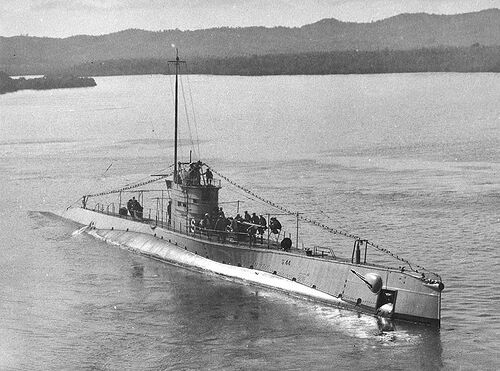
Captain Takahashi died later—an era’s tradition held that commanders go down with their ship. But this time, he and many of his crew were rescued. Still, the loss of Kako sent ripples through the Japanese Navy—Cruiser Division Six had lost one of its few heavy hitters, and lived under a new unease: American submarines were lethal, capable, and shaping the sea.
The sinking of Kako by S-44 is textbook submarine warfare—no grand fleets, just nerve and timing in a narrow envelope. It wasn’t elegant, but it was real, messy, human. It carried the weight of loss at Savo, of daring and risk, of cold reality in warm water. For S-44’s crew, it was the moment they knew they could fight back. For the Japanese, it was a reminder that confidence could vanish in less than a minute, under calm skies.
USS S-44 Deck Log, August 8–13, 1942, Record Group 38, Records of the Office of the Chief of Naval Operations, National Archives and Records Administration.
Narrative by David Ray Bowman FTBN1(SS) 08.09.2025
Blair, Clay, Jr. Silent Victory: The U.S. Submarine War Against Japan. 2nd printing. Annapolis, MD: United States Naval Institute, 1975. ISBN 0-397-00753-1
Roscoe, Theodore. United States Submarine Operations in World War II. Annapolis, MD: United States Naval Institute, 1949. ISBN 0-87021-731-3.
Naval History and Heritage Command, United States Submarine Losses – World War II: USS S-44 (SS-155) (Washington, D.C.: Department of the Navy, 1963; updated online edition), https://www.history.navy.mil/research/library/online-reading-room/title-list-alphabetically/u/united-states-submarine-losses/s-44-ss-155.html.
“USS S-44,” Wikipedia, last modified 2024, accessed August 2025, https://en.wikipedia.org/wiki/USS_S-44.
“USS S-44 (SS-155),” PigBoats.com: U.S. Submarines in World War II, accessed August 2025, http://www.pigboats.com/ww2/s44.html.
“Kako, sunk by S-44,” Last Stand on Zombie Island, accessed August 2025, https://laststandonzombieisland.com/category/submarines/page/15.
 Patrol Reports
Leave a comment