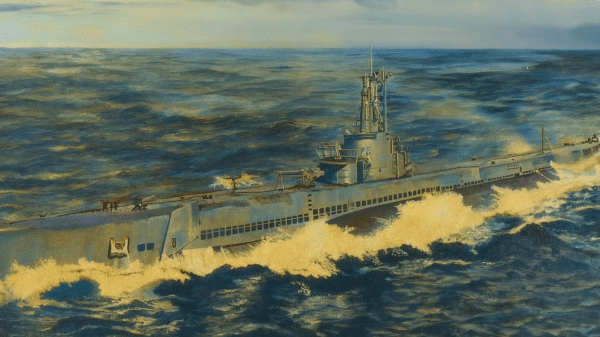
At just sixteen years old, Timothy A. Boone of Muskegon, Wisconsin, returned home a wounded veteran of the Pacific submarine war. With three broken ribs, burns, and a cast on his arm, Boone limped off the front lines of World War II not with fanfare, but with the quiet resolve of someone who had seen too much, too soon. The Navy had tried to say he was too young. He insisted otherwise. After slipping past the red tape, training hard, and deploying into the teeth of the Pacific theater, Boone found himself on the wrong end of a Japanese depth charge attack during a tense submarine patrol between Saipan and the Philippines. His actions—gunning topside and surviving the brutal concussion of an underwater barrage—earned him an honorable discharge and a quiet seat at the table of submarine legends, though he wasn’t done yet. Not by a long shot.
Continue reading “Sixteen Year Old Sub Vet”Post Holiday Action in the Kuriles

In the early morning fog of July 5, 1944, the USS Sunfish broke free from a curtain of gray and found herself staring at a rare, eerie clarity over the northern Kuril Islands. Aradio To rose sharply in front of her like a black tooth jutting from the sea, and for the first time in days, the crew could see clearly. Paramushiru, Shimushu, even Kamchatka were all laid out under a hazy sun that had barely burned through the mist. The weather gave them a moment of visual advantage, but it also left them exposed. There was no Japanese shipping in sight, but that didn’t mean it wasn’t out there. In these waters, silence could kill.
Continue reading “Post Holiday Action in the Kuriles”Contact Off Kiska: USS Growler, July 5, 1942

In the cold gray dawn of July 5, 1942, the crew of USS Growler (SS-215) was deep in the fight. She was five miles northeast of Kiska Harbor, patrolling the rough waters of the Aleutians as part of the silent service’s early wartime thrust into the North Pacific. The island, then held by Japanese forces, was a linchpin in the enemy’s bold move to stretch their Empire’s grip eastward across the Aleutian chain.
For the men aboard Growler, the day began as it often did on patrol. Visibility had improved since the previous night, and the morning hours were spent submerged, listening. At 0413 hours, at a quiet periscope depth, the boat’s sonar picked up a formation of enemy ships. The contact was sharp and clear—three vessels bearing 240 degrees true, estimated at 8000 yards and closing. The estimated course of the targets was 090 to 110 degrees true. Their size and profile suggested something more serious than patrol boats. It looked like cruisers leaving Kiska.
Continue reading “Contact Off Kiska: USS Growler, July 5, 1942”
