
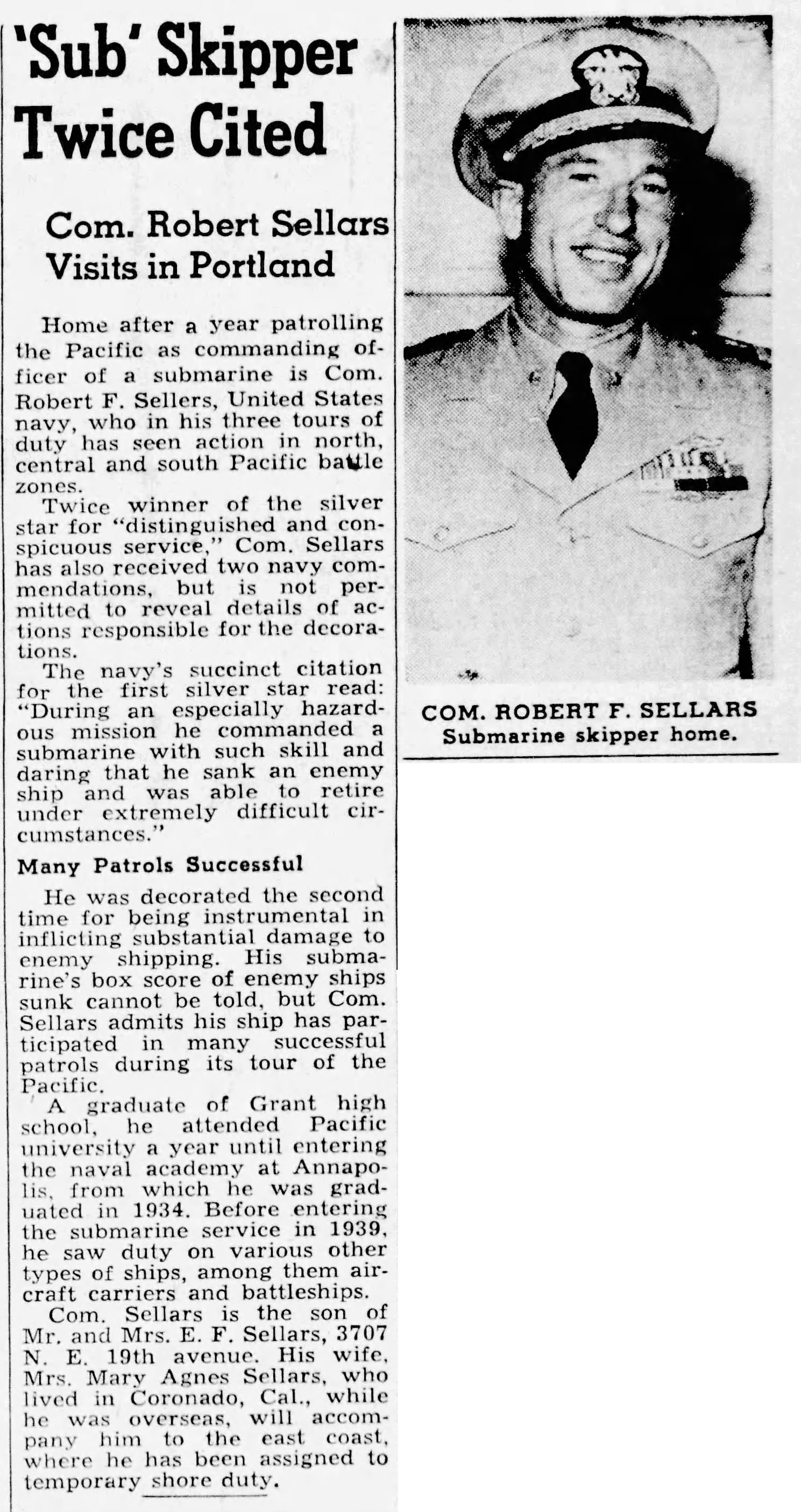
On July 29, 1946, Portland’s Sunday Oregonian ran a proud headline: “Portland Submarine Officer Home from Pacific”. The article spotlighted Commander Robert F. Sellars, fresh from his command of USS Blackfish, returning to Oregon on a brief leave. He had completed four Pacific patrols after earlier duty in the Aleutians and the Atlantic. The piece offered readers a clean, clipped summary of Sellars’ wartime service. What it could not capture was the depth of experience behind his quiet return.
Sellars had been in the thick of the fight since the early days. A 1934 graduate of the Naval Academy, he had taken the helm of USS S-31 (SS-136) during the lean, anxious months of 1942. At a time when the Navy was scrambling to plug gaps with World War I-era boats, Sellars and his crew pushed their S-boat into dangerous waters around the northern Kuril Islands.
On October 26, 1942, during S-31’s fifth war patrol, Sellars spotted a Japanese freighter at anchor in Otomae Wan, off Paramushiro. Despite poor visibility, unreliable navigation instruments, and shallow reefs all around, he pressed in. At 0922, S-31 launched two torpedoes. Both struck their target. The ship—later identified as the Keizan Maru, a 2,864-ton cargo vessel—sank stern-first, billowing smoke. Moments later, S-31 grounded hard. Then again. And again. For the next half hour, the submarine scraped, backed, and clawed her way across underwater hazards, finally slipping into deeper water by 1000 hours.
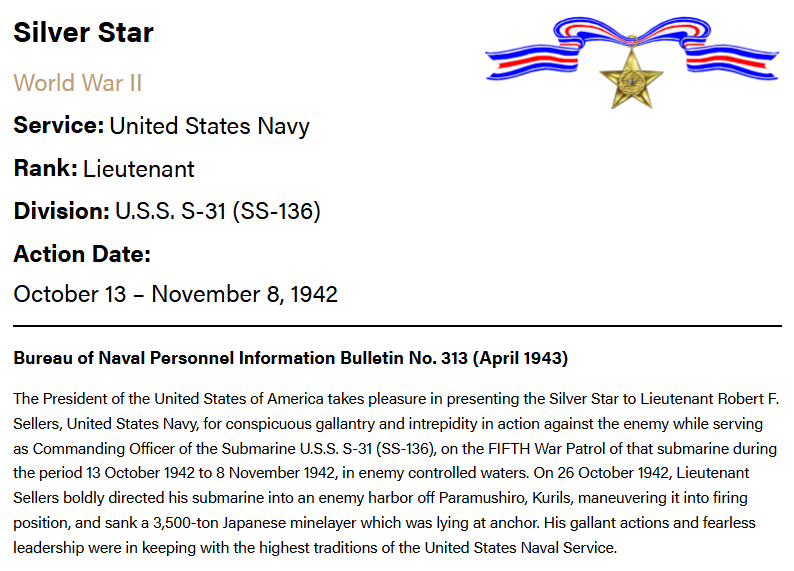
There was no depth charging. No immediate enemy response. But the danger had been real, and the attack effective. For this action, Sellars was awarded the Silver Star, cited for “outstanding courage, coolness and skill” in penetrating enemy waters, sinking a ship, and escaping destruction.
His reward was more duty. Sellars transferred to USS Blackfish (SS-221) in early 1944, assuming command in the midst of the boat’s eighth patrol. By then, Blackfish had shifted from the Atlantic to the Pacific and was running hard against Japanese shipping. Under his leadership, Blackfish completed four more patrols, operating in waters ranging from the Solomons to the East China Sea.
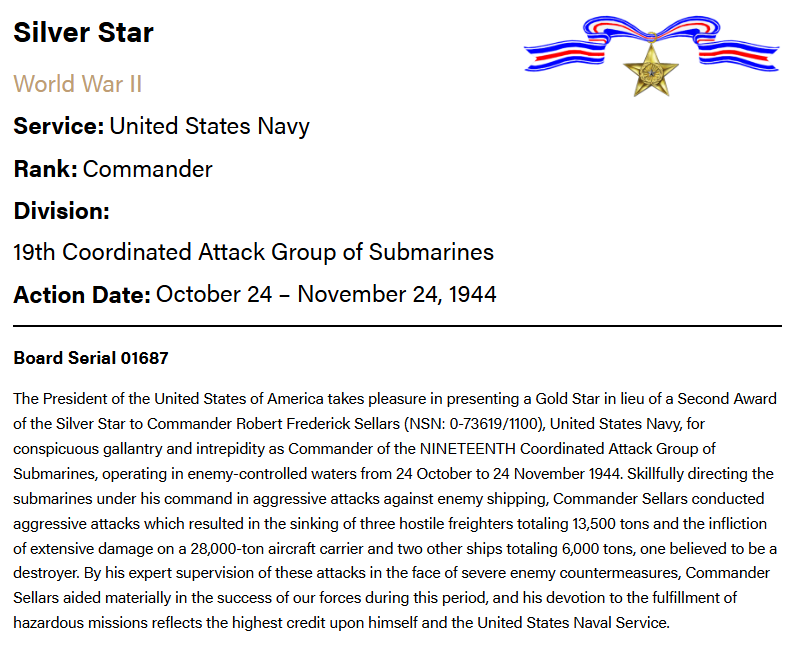
During her eleventh war patrol, Blackfish joined a coordinated attack group with USS Shark II (SS-314) and USS Seadragon (SS-194). The group, formed on October 24, 1944, included submarines assigned overlapping patrol areas, supporting each other by message traffic and joint tracking. But almost immediately, Shark II vanished. She sent one final transmission on the 24th, reporting a contact. Then silence. Sellars, now the senior officer, took charge of the group. Despite the loss of Shark, he pressed on with the mission, keeping the boats focused and active. That decision—leading during uncertainty and loss—earned him a second Silver Star.
By war’s end, he had made 13 patrols aboard submarines and had earned the respect of both his men and his peers. His July 1945 trip to Portland was not just a homecoming. It was a moment of pause before the final chapter of wartime service.
Sellars continued serving in uniform after the war. He moved into missile development work at Cape Canaveral, where submarines were entering the nuclear age. He retired as a Captain and settled in Orlando, Florida. Civilian life did not slow him. He worked with Martin Marietta, volunteered at Orlando Regional Medical Center, and stayed active with the Naval Academy Alumni Association and the Submarine Veterans of WWII.

On November 4, 1996, Robert F. Sellars passed away at the age of 86. His obituary in Florida Today described a man who had served his country, loved his family, and stayed involved with his community. His wife of 60 years, Mary Agnes, survived him, along with a daughter and two sons.
But here, among those who understand the tension of silent approaches and the weight of long patrols, we remember something more. Sellars led by presence, not posture. He fought in one of the most unforgiving theaters, aboard a boat that creaked and bucked in the ice, and later commanded modern subs across two oceans. He didn’t seek the spotlight, but he never shirked the hard job.
For submariners, that’s the kind of legacy that matters. He got the boat back. He got the job done. And he brought his men home.

The Sunday Oregonian, “Portland Submarine Officer Home from Pacific,” July 29, 1945, page 46.
Source: [Image File: The_Sunday_Oregonian_1945_07_29_46.png]
USS S-31 Fifth War Patrol Report, October–November 1942.
Source: U.S. Navy Patrol Report; National Archives Catalog, ID 134025954. Also referenced in attached file: USS_S-31.pdf. Narrative by David Ray Bowman FTB1(SS) 07.28.2025
National Archives and Records Administration. USS Blackfish (SS-221) War Patrol Report – Eleventh Patrol. Record Group 38: Records of the Office of the Chief of Naval Operations. National Archives Catalog, ID 74805961. Retrieved from https://catalog.archives.gov/id/74805961 Narrative by David Ray Bowman FTB1(SS) 07.28.2025
Florida Today, Obituary for Robert F. Sellars, November 13, 1996, Page 53.
Source: Image scan from Florida_Today_1996_11_13_Page_53.pdf.
Naval History and Heritage Command. “Keizan Maru – Japanese Merchant Ship Sunk, 26 October 1942.”
Reference: Ship loss database and corroborating Japanese records.
United States Submarine Veterans of World War II.
Source: Membership records and postwar activities as noted in obituary and community accounts.
 Patrol Reports
Leave a comment