
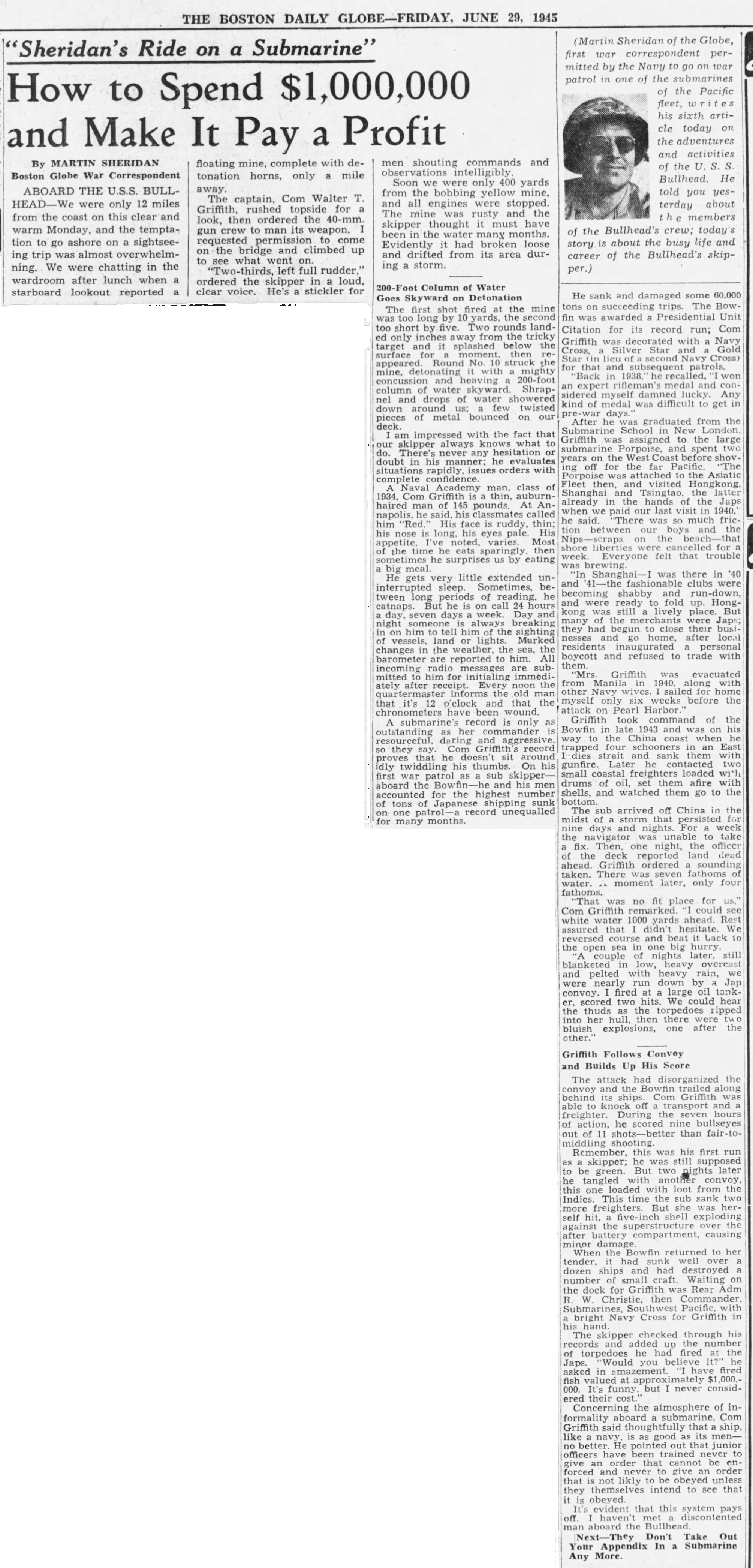
In the summer of 1945, Martin Sheridan was no stranger to the silent, steel corridors of a submarine. As a war correspondent, he’d seen more than most. But aboard the USS Bullhead, he’d seen it all: the crack of deck guns, the eerie shimmer of a drifting mine, the close-call scrape with a Japanese convoy, and the pale dawns when a depth charge’s echo still rang in the ears. His Boston Globe article, published June 29, 1945, reads like a love letter to that boat and her men; a mosaic of danger, camaraderie, and cool defiance beneath the Pacific sun.
What Sheridan could not have known, what would have hollowed out the heart of any man who’s ever stood on a steel deck and called it home, was that the Bullhead would vanish just weeks later. No mayday. No final flash. Only silence. The last American submarine lost in World War II. Overdue. And presumed lost.
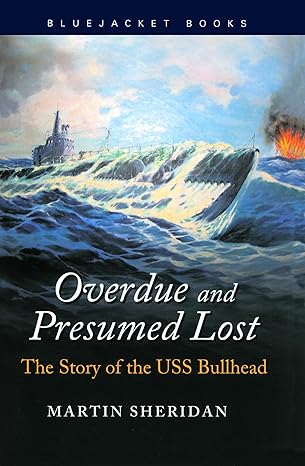
That phrase, so clinical, so final. would come to title his book.
For Sheridan, the loss must have felt like a betrayal by time itself. To have been there, to have watched Griffith’s cool command and heard the laughs in the wardroom, and then to receive the news that they were gone… it would have struck like a torpedo to the soul. His article had been a celebration of courage, of survival, of a crew that knew their odds and ran the table anyway. And then, the ocean swallowed them whole.

Bullhead was one of 52 American submarines lost during World War II. The Silent Service bore a crushing burden—less than two percent of Navy personnel, but over fifteen percent of its combat losses. There are no headlines for those who vanish beneath the waves. No crowds wave from the pier. No funerals with folded flags. Only names etched in stone, and memories that flicker in the words of those lucky enough to have come home.
Sheridan came home. He came back with a story. But the men of the Bullhead—Griffith, the cautious yet daring skipper; the watchstanders Sheridan called “cheerfully fatalistic”; the young sailors who passed their time eating spam and scanning horizons for shadows—they came back only in Sheridan’s prose, and in the hearts of those who read it.
The cost of war is often measured in blood. But for the Silent Service, it was measured in silence. In telegrams that never arrived. In dives that never surfaced.
Sheridan knew that. He wrote their story so the rest of us wouldn’t forget.
And we won’t.
In July 1945, the USS Bullhead departed Fremantle, Australia, for her third war patrol. Her mission was to operate in the Java Sea, perform lifeguard duty for B-24 raids on Japanese-held territories, and sink any remaining enemy shipping. She was one of three American submarines dispatched to the area. The other two, Capitaine and Puffer, would return. Bullhead would not.
On August 6, 1945, the same day the atomic bomb was dropped on Hiroshima, a Japanese Army aircraft reportedly dropped depth charges near Balinese waters, claiming a hit on a submerged submarine. No response to radio calls to Bullhead were received after that date. She was never heard from again.
She was declared “overdue and presumed lost” on September 5, 1945.
The most likely scenario: Bullhead was surprised on the surface by a Japanese plane as she charged batteries or prepared for lifeguard duty. The Java Sea was shallow, leaving no escape room below.
Eighty-four men were aboard. None survived.
She was the last U.S. Navy submarine lost in World War II, bringing to a close the deadliest chapter in the history of American undersea warfare.
 Patrol Reports
Leave a comment