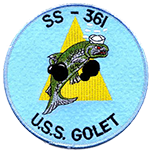
She slipped away from Midway on May 28, 1944, her steel hull slicing through the Pacific with quiet determination. Her crew, 82 strong, knew their mission and accepted the risks. They had trained, bonded, and believed in the purpose that had brought them to this point. The boat was USS Golet, SS-361, a Gato-class submarine barely six months into her career. No one who waved her off that day could know they were saying goodbye forever.
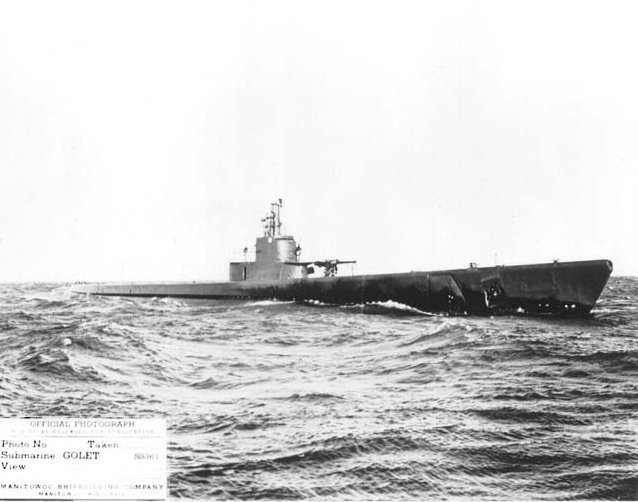
Golet wasn’t supposed to be a Gato-class. She had originally been ordered as a Balao-class boat, but the blueprints for that newer design arrived too late at the Manitowoc Shipbuilding Company in Wisconsin. So Golet, and a handful of her sisters, ended up being built to Gato specifications. She was still a warship of remarkable power, nearly 312 feet long, with ten torpedo tubes, a 3-inch deck gun, machine guns, and a range that let her roam the vast Pacific without support. What set her apart, like all Gato boats, wasn’t the hardware. It was the men inside. The quiet resolve. The grit. The belief in duty.
Construction on Golet began in the heartland. Her keel was laid in January 1943 and she slid into the waters of Lake Michigan that August, sponsored by the wife of Senator Alexander Wiley. The people of Shreveport and Caddo Parish, Louisiana, had raised the money for her construction through war bonds, putting their own hopes and pride into her hull. Commissioned on November 30, 1943, Golet was commanded by Lt. Cmdr. James M. Clement and joined the fight like many Manitowoc boats—after a trip down the Mississippi River to New Orleans, then through Panama and finally to Pearl Harbor.
By March 1944, she was ready. Her first patrol would take her to the cold and treacherous waters off the Kurile Islands, Southern Hokkaido, and Eastern Honshu. It was no tropical cruise. The weather was merciless. Fog, sleet, and ice made the sea a white tomb. She spotted only one ship that entire patrol, and that one steamed away too fast for a firing solution. Golet came back to Midway on May 3 without firing a torpedo. She hadn’t failed—sometimes the ocean simply refuses to offer targets. War is rarely tidy.
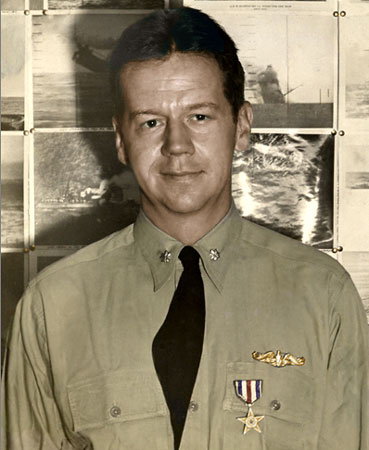
What happened next reads like the beginning of a ghost story. After her return, Lt. Cmdr. James S. Clark took over command. He had already served with distinction and was trusted to lead the boat on her second mission, back to the waters off northern Honshu. Golet set out again on May 28, 1944. And that’s when the silence began.
She was scheduled to check in by July 5 and return to Midway by the 12th or 13th. On July 9, a message was sent that required acknowledgement. Nothing came back. Maybe her radios were out. Maybe she was running silent. But as the days passed and no periscope pierced the waters near Midway, the tension grew. By July 26, hope gave way to dread. The Navy declared her lost.
It would take years before anyone knew what likely happened. After the war, U.S. intelligence pored over captured Japanese records. On June 14, 1944, Japanese antisubmarine forces recorded a contact. They dropped depth charges on a suspected submarine near 41 degrees North, 14 degrees 30 minutes East. After the explosions, the ocean coughed up cork, a raft, debris, and a slick of oil that stretched across the surface like a death shroud. There were no survivors. No doubt remained. Golet had been found by the enemy, and she had not escaped.
Eighty-two men died that day. Submariners. Sailors. Sons. Husbands. They are not forgotten. Their names are etched into the records at the Wisconsin Maritime Museum in Manitowoc. They’re honored on a memorial in Metairie, Louisiana, not far from the community that built their boat. Their sacrifice is part of the legacy of the U.S. Silent Service, a legacy built on courage, silence, and steel.
Golet’s story is not one of flashy battles or dramatic victories. It’s a story of preparation, sacrifice, and sudden loss. Her death was quiet, almost invisible, like most submarine stories. That’s why they must be told. We must remind ourselves that freedom didn’t come easy or cheap. Every Gato-class boat, every patrol, every name on a plaque represents a promise kept by men who knew the odds and went anyway.
Today, as Submarine Veterans, we walk in the shadow of giants. Men who served not for glory, but for country. Golet’s brief but valiant history is a piece of our shared heritage. She rests now in the cold waters off Japan, on Eternal Patrol. And while we may never see her again, we carry her memory every time we raise a glass, tell a sea story, or whisper a silent salute to the deep.
Fair winds and following seas, USS Golet. You are not forgotten.
 Patrol Reports
Leave a comment