
By mid-1944, American submarines were extending their patrols into the northern Pacific, including the Kurile Islands chain, to interdict Japanese shipping and isolate enemy garrisons. Following the Aleutian Islands campaign (1942–43), Japan’s remaining bases in the Kuriles (stretching from Hokkaido to Kamchatka) were targets for periodic U.S. air raids and naval harassment. Older S-class submarines had prowled these cold northern waters early in the war, and notably the USS S-44 was sunk off Paramushiro by a Japanese escort in October 1943. By 1944, fleet submarines from Pearl Harbor and Midway took up patrols in the area. The USS Barb (SS-220) and USS Herring (SS-233) were among the U.S. subs assigned to the Sea of Okhotsk and Kuriles, hunting convoys that supplied isolated outposts. Barb was now under the command of Commander Eugene B. “Lucky” Fluckey (who had taken command in May 1944), while Herring was on her eighth war patrol under Lieutenant Commander David Zabriskie, Jr.. These two submarines would rendezvous in late May 1944 to coordinate their efforts against Japanese shipping in the region.
Rendezvous of USS Barb and USS Herring – May 31, 1944
On May 31, 1944, USS Barb and USS Herring met in the Sea of Okhotsk approximately 150 miles west of Matsuwa (Matua) Island. Both submarines surfaced and held a conference via megaphone to plan a joint operation. According to Barb’s war patrol report, the two captains agreed to split the patrol area: “Barb would cover [the area] south and west of [the shipping] lane, Herring to [the] north and east to Matsuwa”. At 1120 hours, the meeting adjourned – “secured conference and headed south for roving patrol along [the] lane” – and the submarines separated to begin their coordinated hunt. This would be Herring’s final communication; unbeknownst to Barb’s crew, Herring would not be heard from again after this point.
Despite the ominous fate awaiting Herring, morale was surely high as the subs parted company. Both boats were experienced and had scored victories on previous patrols. Herring in particular had just come off a successful attack: Japanese records later revealed that Herring had sunk two enemy vessels the night before May 31, including the escort ship Ishigaki. (In a twist of fate, Ishigaki – a 870-ton Kaibōkan-class escort – had been responsible for sinking the U.S. submarine S-44 in 1943, so Herring’s victory served as a measure of vengeance.) Now, with Barb and Herring operating as an informal wolfpack in the Kuriles, the stage was set for a major combined assault on Japanese shipping off Matsuwa Island.
Attack on a Japanese Convoy (May 31, 1944)
By the afternoon of May 31, 1944, USS Barb and USS Herring were stalking a Japanese convoy in the vicinity of Matsuwa. Barb, cruising to the southwest of the rendezvous point, made contact with multiple enemy ships and began maneuvering into attack position. At roughly the same time, distant explosions and depth-charge rumbles were heard – Barb’s crew noted the telltale sounds of another submarine under attack in the distance. Commander Fluckey surmised that Herring must be engaging part of the convoy on a parallel course. In fact, that is exactly what was happening: USS Herring had intercepted the convoy’s escort and leading ships, while Barb targeted the trailing vessels.
According to postwar analysis of both U.S. and Japanese reports, the coordinated attack unfolded as follows:
- Escort Ishigaki – a new Type C escort destroyer (DE) – was torpedoed and sunk by USS Herring. Herring scored a single hit that blew up Ishigaki, killing most of its crew. (This escort was the very ship that had sunk USS S-44 months earlier.) The loss of the escort threw the enemy formation into disarray.
- Hokuyo Maru – a Japanese Army cargo ship in the convoy – was also torpedoed and sunk by USS Herring, according to Japanese records. (This ship was later identified by name after the war; Herring’s crew initially could only report exploding a “merchantman.”)
- Koto Maru – a Japanese cargo/transport – was engaged by USS Barb. Fluckey fired a spread of torpedoes that hit Koto Maru, sending the freighter to the bottom.
- Madras Maru – another merchant ship from the convoy – was immediately targeted next. Barb fired three torpedoes at Madras Maru, scoring hits and sinking that vessel as well.
In the space of a short period, the two submarines had devastated the convoy. Barb’s crew even managed to capture a Japanese survivor from the wreckage later that evening. The prisoner, pulled from the cold Sea of Okhotsk, confirmed what the Americans suspected: Herring had sunk the convoy’s escort vessel (Ishigaki) during the attack. He also indicated that one of the convoy’s merchant ships had been hit by Herring as well, before the remaining ships fled. Indeed, post-war examination of Japanese records verified that Herring sank the third merchantman of that convoy, while Barb got the other two.

Type C Escort by Takeshi Yuki scanned from “Color Paintings of Japanese Warships.” Photo courtesy of combinedfleet.com
When the action of May 31 was over, a total of four Japanese ships had been sunk as a result of the joint operation: one warship and three cargo vessels. This was an exceptionally successful day’s work for the two submarines. Barb and Herring effectively wiped out an entire convoy west of Matsuwa Island. Barb reported her two kills (later identified as Koto Maru and Madras Maru) in her patrol log, and inferred Herring’s victories from the evidence at hand. Herring, however, maintained radio silence after the attack – standard practice to avoid revealing her position. Unfortunately, it meant that Herring’s own triumphs on May 31 went unconfirmed by U.S. Navy authorities at the time; only later would Allied intelligence learn of Herring’s feat from captured Japanese records.
Herring’s Final Attack and Loss (June 1, 1944)
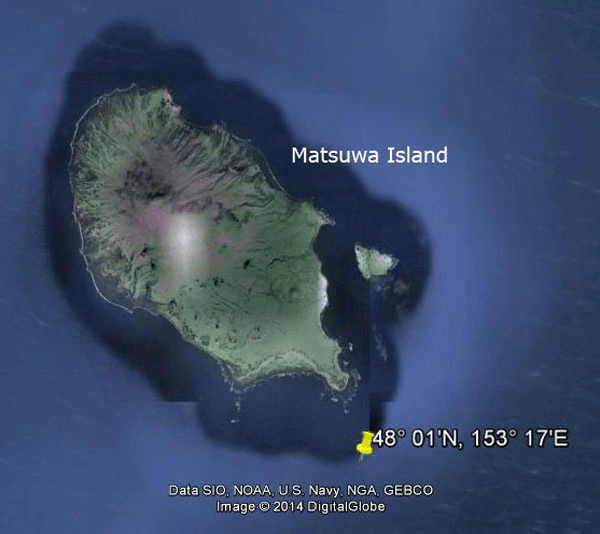
Following the convoy battle, USS Herring proceeded toward Matsuwa (Matua) Island itself. By the early hours of June 1, 1944, Herring had arrived near Matsuwa’s harbor area, where she found additional targets at anchor. Moored off the island’s Tagan Cape were two Japanese vessels – likely transports or cargo ships delivering supplies to the garrison. Herring moved in to attack these sitting targets at dawn on June 1.
Under cover of darkness and early morning fog, USS Herring fired torpedoes into the harbor anchorage. Both torpedoes struck their marks, resulting in two direct hits on two anchored ships. The targets were later identified as:
- Hiburi Maru – a 4,366-ton freighter being used as a troop transport. Herring’s torpedo hit caused a massive explosion, and Hiburi Maru sank at anchor with heavy loss of life (dozens of crew and nearly a hundred Japanese Army troops on board were lost).
- Iwaki Maru – a 3,124-ton transport/cargo ship (also carrying troops). It too was struck by a torpedo from Herring and went down in the harbor waters. Postwar records indicate about 50 personnel (crew and soldiers) were killed on Iwaki Maru.
This successful strike raised Herring’s tally to four ships sunk in 24 hours. However, Herring’s proximity to the shore had not gone unnoticed. As the second ship exploded, Japanese coastal defense batteries on Matsuwa Island reacted swiftly. The Matsuwa garrison – the “Matsuwa Detachment” of the Imperial Japanese Army’s 52nd Guards Division – manned several coastal artillery sites and anti-aircraft guns on the island. Using optical sights and fire-control radar, a shore battery at Tagan Point targeted the submarine’s conning tower silhouette in the dawn light.
Moments after Herring’s torpedoes hit the anchored ships, Japanese gunners opened fire. At least two shells struck Herring squarely in the conning tower area, resulting in a violent secondary blast – likely the detonation of the sub’s own armaments or battery cells. Observers on the island reported that “bubbles [soon] covered an area about 5 meters wide, and heavy oil covered an area of approximately 15 miles” on the sea’s surface. These grim signs – a massive oil slick and debris – marked the quick death of USS Herring. The submarine sank in shallow waters just off Matsuwa’s coast, taking her entire crew of 83 men to the bottom. Herring was the only U.S. submarine confirmed lost to enemy shore battery fire in World War II. There were no survivors; Herring’s daring morning attack had turned into a fatal trap once the coastal guns found their range.
Meanwhile, USS Barb was not present to witness Herring’s demise. After the previous day’s convoy action, Barb had moved off to continue her patrol per the plan. Barb did not attack any ships at Matsuwa on June 1, so the destruction of Hiburi Maru and Iwaki Maru could only have been Herring’s handiwork. In fact, Barb was unaware of Herring’s fate until much later. On June 3, 1944, Pacific Fleet command sent orders to both subs to avoid a certain area (due to upcoming U.S. surface operations for the Mariana Islands campaign) and requested an acknowledgment. Herring never replied. Barb also tried repeatedly to hail Herring by radio after June 1 and received no answer. By late June, when Herring failed to return to Midway, the Navy grimly listed the submarine as overdue and presumed lost.
Aftermath and Broader Context
The joint Barb–Herring foray into the Kuriles proved costly but impactful. USS Barb survived the patrol and went on to a highly decorated career (earning the Medal of Honor on a later patrol under Cdr. Fluckey). Barb’s eighth war patrol (May–June 1944) was credited with sinking five ships and two small craft, including the two freighters on May 31. USS Herring, by contrast, did not return, but her final patrol was simultaneously her most successful and her last. Herring was officially credited with four Japanese ships sunk on that 8th patrol, totaling about 13,200 tons. These included the escort Ishigaki and freight Hokuyo Maru from the convoy, and the Hiburi and Iwaki Maru at Matsuwa. (Additional research after the war brought Herring’s overall tally to as many as seven enemy vessels sunk in her career.) For their actions in this period, both submarines received Navy Unit Commendations and battle stars. Herring’s crew, sadly, were all lost in action and are commemorated on the On Eternal Patrol honor roll.
Strategically, the May 31–June 1, 1944 engagements highlighted the role of U.S. submarines in the Northern Pacific theater. While the majority of submarine successes in World War II occurred in warmer waters (Southwest Pacific and South China Sea), boats like Herring and Barb demonstrated that the far north was also an active battleground. Japanese convoys in the Sea of Okhotsk and along the Kurile Islands were vulnerable, and U.S. submarines took advantage whenever possible to disrupt Japan’s logistic chain to its remote bases. The loss of Hiburi Maru and Iwaki Maru at Matsuwa, for example, would have directly impeded Japanese efforts to reinforce or resupply their garrison there. However, operating in these waters was perilous – not only because of enemy escorts, but also due to shore-based defenses, extreme weather, and tricky navigation around isolated islands. Herring’s fate was a stark reminder that even a surfaced submarine was never safe within range of coastal artillery.
In the broader context, the coordinated patrol of Barb and Herring off Matsuwa was an early example of “wolfpack” tactics that the U.S. Navy increasingly employed in 1944. Shortly after this, Barb joined a formal three-submarine wolfpack (code-named “Ben’s Busters”) in Asian waters, and other groups carried out similar operations (including penetrations of the Sea of Japan in 1945). The Northern Pacific remained a secondary theater, but U.S. submarines kept pressure on the Kuriles through intermittent patrols and even surface bombardments of coastal targets. For instance, earlier in February 1944, U.S. surface ships bombarded Paramushiro, and submarines like USS Narwhal delivered raids and recon in the Kuriles. Each encounter provided intelligence and helped contain the Japanese northern flank.
USS Herring’s wreck remained lost for decades, lying somewhere off the rocky coast of Matua. In 2016, a joint U.S.-Russian expedition finally discovered the wreck of USS Herring near Matsuwa (Matua) Island in approximately 100 meters of water. This discovery confirmed the exact location of Herring’s demise, close to the coordinates recorded in Japanese reports. Today, the sacrifice of Herring’s 83 submariners is remembered with memorials in the United States and even at a marker on Matua’s Cape Tagan, placed by researchers to honor both the American crew and the Japanese victims of the battle. The story of USS Herring and USS Barb’s joint operation off Matsuwa Island remains a dramatic chapter of undersea warfare – one that encapsulates both the lethal effectiveness of U.S. submarines and the grave risks they faced in the pursuit of victory in World War II.
 Patrol Reports