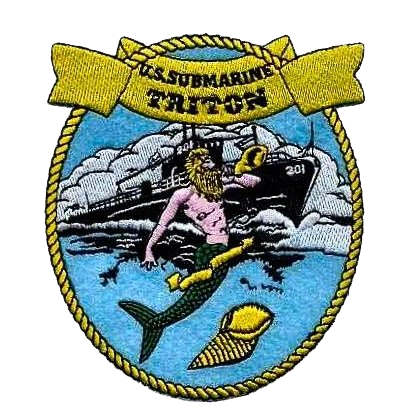
In March of 1943, the Pacific War had reached a fever pitch. The U.S. Navy’s submarine force, already proving itself to be one of the most effective weapons in America’s arsenal, was actively hunting Japanese shipping in the vast, contested waters of the South Pacific. Submarines, operating in deadly cat-and-mouse games with Japanese destroyers, were crucial in strangling enemy supply lines. However, with every daring success, there was an equal measure of peril. It was in these waters, north of the Admiralty Islands, that USS Triton (SS-201) embarked on her sixth and final war patrol, never to return.
USS Triton was a Tambor-class submarine, commissioned in August of 1940. Over the course of her wartime career, she had proven herself to be a formidable predator. Her first patrol took place in the early, chaotic days following the attack on Pearl Harbor, making her one of the first American submarines to strike back against the Japanese. Subsequent patrols saw her exacting a heavy toll on enemy shipping, sinking numerous cargo vessels, a destroyer, and even another submarine. By the time she departed from Brisbane, Australia, in February of 1943, Triton had become one of the most battle-tested submarines in the fleet, commanded by Lieutenant Commander George K. MacKenzie, Jr.
On February 16, 1943, Triton left Brisbane on what would be her final mission. Assigned to patrol the sea lanes between Rabaul and Shortland Basin, she quickly found herself in the thick of enemy activity. On March 6, she attacked a Japanese convoy, reporting the sinking of two ships and damage to a third. But success did not come without risk—one of her torpedoes made a circular run, forcing Triton to dive deep to avoid her own weapon. The next few days saw a relentless hunt, with Triton making multiple attacks on enemy convoys, some successful, others repelled by defensive escorts.
The last message received from Triton came on March 11, 1943. “Two groups of smokes, five or more ships each, plus escorts… Am chasing,” she reported. This was the last definitive communication from the submarine. On March 13, she was warned of three enemy destroyers sighted in her vicinity, possibly on a submarine hunt. What followed on March 15 remains one of the enduring mysteries of the war.
Postwar records from Japanese sources indicate that three destroyers—most likely from a convoy escort force—engaged and depth-charged a submarine at approximately 0°09’N, 144°55’E, north of the Admiralty Islands. The attack was described as prolonged and vicious. Japanese accounts state that a significant oil slick, pieces of wood, cork, and debris marked the location, including manufactured goods with American markings—strong evidence that the victim was indeed USS Triton. Further corroboration came from USS Trigger (SS-237), operating nearby, which reported hearing heavy depth charge explosions in the distance for over an hour.
Yet, despite this seemingly conclusive evidence, there have been alternative theories regarding Triton’s fate. Some reports suggest the possibility of friendly fire. Speculation emerged that she might have been mistakenly attacked near Brisbane upon her return, potentially by an Allied aircraft or coastal defenses. The lack of definitive wreckage leaves open the faintest of doubts, but the weight of evidence strongly favors the engagement with Japanese destroyers on March 15 as the true cause of her loss.
For the families of the 74 men aboard, the loss of USS Triton was a wound that time could not fully heal. One story, in particular, stands out—that of Jeanine McKenzie Allen, the daughter of Torpedoman’s Mate First Class Lloyd McKenzie. As a child, she barely knew her father before he departed for war. As an adult, she spent over a decade searching for answers about his fate, pouring over records, attending submarine veterans’ conventions, and finally arranging for a memorial stone at Arlington National Cemetery to honor him and his shipmates. Her search brought her face to face with the legacy of the silent service, connecting her with those who had known her father and ensuring that the sacrifice of the men of USS Triton would not be forgotten.
Attempts to locate Triton’s wreckage have, so far, been unsuccessful. Unlike some other lost submarines whose final resting places have been discovered through modern deep-sea exploration, Triton remains on eternal patrol, her exact location still hidden beneath the waves. However, her legacy endures. She is remembered through naval history, by submarine veterans, and in the solemn tolling of the bells each year for the 52 boats lost in World War II.
The story of USS Triton is one of valor, sacrifice, and mystery. She fought bravely in the perilous waters of the Pacific, striking hard at the enemy, before vanishing into the deep. Her fate serves as a solemn reminder of the dangers faced by the silent service and of the unbreakable bond among those who serve beneath the waves. Though her exact final moments may never be fully known, her legacy is written in the annals of naval history—and in the hearts of those who still remember her.
 Patrol Reports
Leave a comment