 The USS Barbel (SS-316) was one of the many steel sharks that prowled the depths of the Pacific during World War II, silently hunting Japanese shipping in the vast, contested waters. She was a Balao-class submarine, designed for endurance, stealth, and lethality. At 311 feet long, armed with ten 21-inch torpedo tubes and a 5-inch deck gun, she was built to strike hard and slip away unnoticed. Commissioned in April 1944, Barbel quickly proved her worth, sinking multiple enemy vessels in her first three war patrols. But the Pacific was a dangerous hunting ground, and by early 1945, the tide of war was shifting, bringing new dangers to the Silent Service.
By February 1945, the war was in its final, brutal phase. The United States had pushed deep into the Pacific, taking the Philippines and drawing ever closer to the Japanese home islands. The South China Sea, where Barbel operated, remained a critical battleground. Japan’s merchant fleet had been decimated, but what little remained was fiercely protected by aircraft and warships. American submarines were tasked with sealing the noose, cutting off Japan’s last supply lines, but the enemy was relentless in its counterattacks.
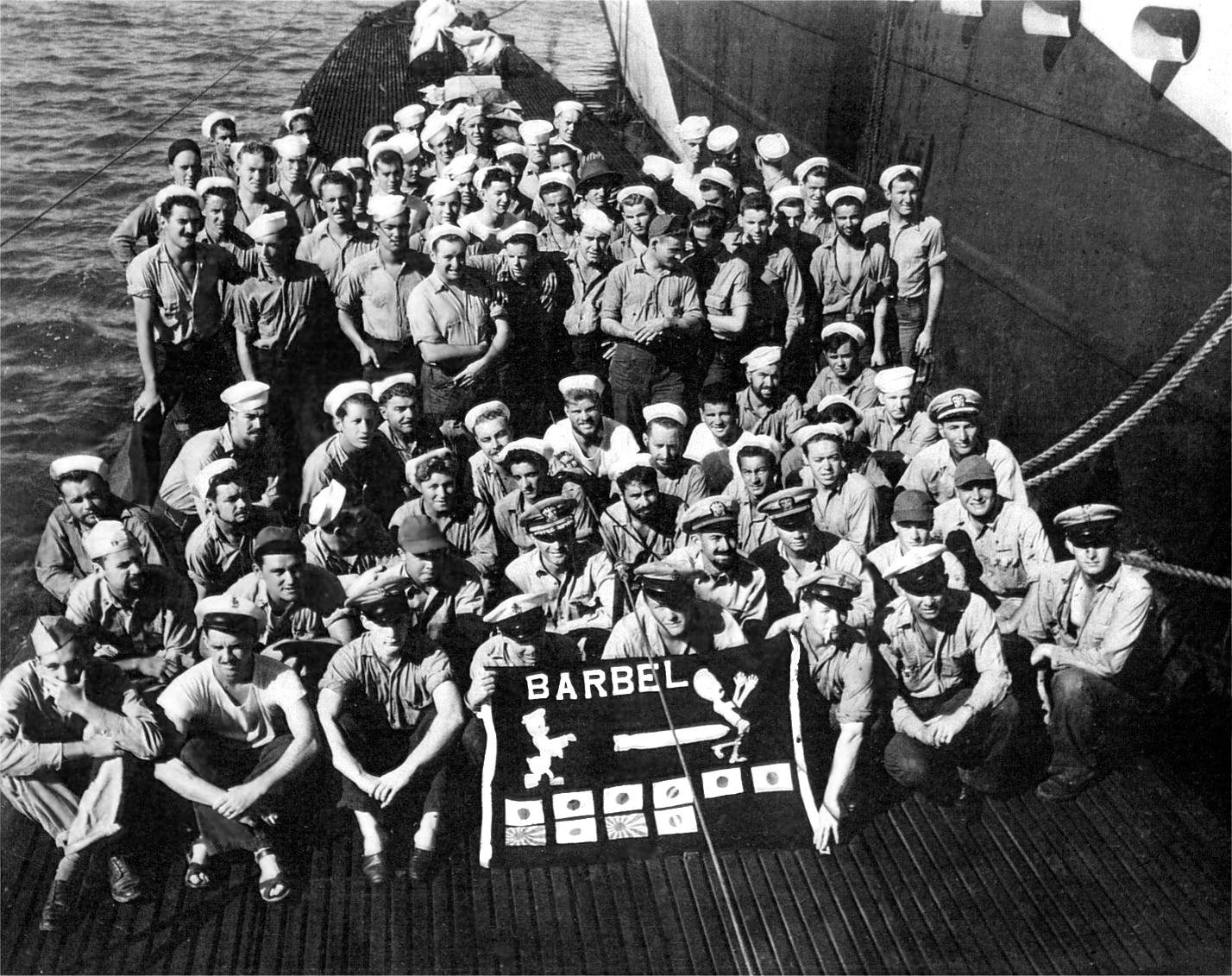
On January 5, 1945, Barbel left Fremantle, Australia, under the command of Lieutenant Commander Condé L. Raguet for her fourth war patrol. She refueled at Exmouth Gulf before heading into enemy-controlled waters, navigating the Lombok Strait, Java Sea, and Karimata Strait to take up station in the South China Sea. Initially, she was tasked with patrolling the western approaches to Balabac Strait alongside USS Bluegill and USS Bream. By January 27, she was reassigned to a wolfpack with USS Perch and USS Gabilan, covering the western approaches to Balabac and the southern entrance to Palawan Passage.
The area was swarming with enemy activity. Japanese aircraft prowled the skies, sweeping the waters for submarines, and Barbel found herself increasingly harassed. On February 3, she sent what would be her final message to the submarines Tuna, Blackfin, and Gabilan. She reported heavy aircraft presence and that she had already endured three separate depth charge attacks. She promised to send another update the following night.
That next message never came.
On February 4, Japanese records indicate that a naval aircraft spotted a submarine near Palawan Island, in the Philippines. At coordinates 7°49.5’N, 116°47.5’E, the plane attacked, dropping two bombs. One struck near the bridge—a catastrophic hit for a submarine. If the blast didn’t kill the command crew outright, it would have instantly flooded key compartments, crippling the vessel’s ability to dive or fight back. The Barbel, wounded and likely taking on water, slipped beneath the waves and disappeared.
For days, nearby submarines tried to reach her. USS Tuna, expecting Barbel at a scheduled rendezvous on February 7, reported no contact for 48 hours. She searched the area but found nothing—no oil slick, no debris, no survivors. On February 16, the Navy officially declared her lost.
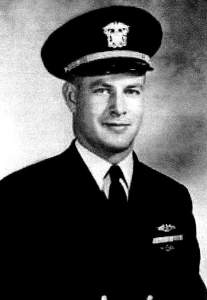
Seventy-seven men went down with Barbel that day. They were sons, brothers, husbands—ordinary men performing extraordinary duties in one of the most hazardous assignments of the war. Lieutenant Commander Raguet, who had taken command only weeks before, was among them, along with a seasoned crew that had already survived three combat patrols. In the silent world of submarines, where every man relied completely on his shipmates, their loss was felt deeply by the tight-knit submarine force.
Submarine duty was a high-stakes gamble. Surface ships could take damage and still fight on, but submarines operated with a razor-thin margin for error. A single bomb, a lucky depth charge, or an electrical failure at the wrong moment could seal their fate. Unlike destroyers or cruisers, when a submarine was lost, it was almost always lost with all hands. The men of Barbel knew the risks but took them anyway, trusting in their boat, their skill, and each other.
Their sacrifice was not in vain. By the war’s end, American submarines had all but annihilated Japan’s merchant fleet, cutting off its war industries and hastening its defeat. Though they made up less than two percent of the Navy’s personnel, submariners accounted for over half of all Japanese ships sunk. It was a victory paid for in blood—fifty-two U.S. submarines were lost in the war, along with more than 3,500 men.
The USS Barbel remains on eternal patrol, but her name and legacy endure. She received three battle stars for her service, a testament to her effectiveness in combat. Her story is remembered in memorials, history books, and in the hearts of those who have followed in the footsteps of the Silent Service.
As we reflect on Barbel’s fate, we remember those seventy-seven men. Their final moments are lost to history—did they have time to realize their fate? Did some fight to save the boat, hoping for a miracle? Or did she go down so fast that they never knew what hit them? The sea keeps her secrets well. But what we do know is this: they stood their watch, performed their duty, and met their fate with the quiet resolve of those who sail into the deep, knowing they may never return.
For that, they will never be forgotten.
 Patrol Reports
Leave a comment