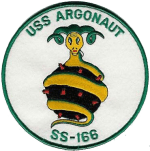
 The USS Argonaut was more than a submarine; she was a bold experiment in the U.S. Navy’s quest to master long-range undersea warfare. Commissioned in 1928, she was the largest non-nuclear submarine ever built by the United States at that time, with a displacement exceeding 4,000 tons and an imposing length of 381 feet. Designed primarily as a minelayer, Argonaut was a product of an evolving strategy that prioritized endurance and strategic versatility over speed. Her construction embodied innovation, featuring complex minelaying capabilities and pioneering use of welding techniques. While her early career was marked by mechanical issues and limited success, she remained a testament to the Navy’s ambition and adaptability.

As the threat of war loomed, Argonaut transitioned from a peacetime vessel to a vital wartime asset. In 1942, she was overhauled at Mare Island Naval Shipyard, her minelaying equipment removed to make room for additional torpedo tubes and troop transport modifications. These changes allowed her to carry Marine Raiders for special operations, a critical role during the Pacific campaign. This transformation was most evident during the Makin Island raid in August 1942, where Argonaut and her sister ship, USS Nautilus, transported 252 Marine Raiders to the Gilbert Islands. Despite logistical challenges and fierce Japanese resistance, the operation demonstrated Argonaut’s newfound versatility and the determination of her crew. The mission concluded with the destruction of enemy installations and a hard-fought return to Pearl Harbor.
Argonaut’s final mission began in December 1942 under the command of Lieutenant Commander John R. Pierce. Operating in the treacherous waters near New Britain, her mission was to disrupt Japanese shipping routes critical to the enemy’s war effort. On January 10, 1943, she encountered a heavily escorted Japanese convoy returning to Rabaul from Lae. This convoy was a lifeline for Japanese operations in the region, making it a high-value target. Argonaut’s attack was daring; she launched torpedoes, reportedly damaging a Japanese destroyer. But her success came at a price. Depth charges from the escorting destroyers battered her relentlessly, forcing her to surface.
As Argonaut’s bow broke the surface at a sharp angle, a U.S. Army reconnaissance plane, observing the battle from above, saw her surrounded by enemy destroyers. The Japanese ships poured gunfire into her exposed hull, sealing her fate. Witnesses reported her shattered conning tower and the slow descent of her broken hull beneath the waves. She disappeared at coordinates 5°40′S, 152°02′E, taking with her 102 brave men. Japanese records corroborated the devastating attack, describing the obliteration of Argonaut’s upper structure before she sank.
The loss of Argonaut was a profound tragedy for the U.S. Navy, marking the deadliest wartime loss for an American submarine. Her sinking was a stark reminder of the immense dangers faced by submariners during World War II. These men operated in a hostile environment, where silence and stealth were their only defenses against a relentless enemy. Among the lost was Lieutenant Commander Pierce, a leader known for his calm under pressure and unwavering dedication to his crew. The sailors of Argonaut embodied the spirit of the Silent Service, ordinary Americans performing extraordinary acts in the face of unimaginable peril.

Even in her absence, Argonaut’s legacy endures. Before their final patrol, her crew donated the ship’s bell, which now hangs in the Submarine Memorial Chapel at Pearl Harbor. This bell serves as a lasting tribute to the men who gave their lives beneath the waves. Argonaut’s story highlights the evolution of submarine warfare, from experimental designs to essential tools of modern naval strategy. Her contributions during the Makin Island raid and her final, valiant stand against overwhelming odds cement her place in the annals of naval history.
Argonaut’s sacrifice is a poignant chapter in the story of the Silent Service, whose courage and resilience played a crucial role in turning the tide of the Pacific War. The names of her 102 lost crew members are etched into history, a solemn reminder of the cost of freedom and the bravery of those who protect it. In life, she was a leviathan of the deep, and in death, she became a symbol of the enduring spirit of those who serve beneath the waves.
 Patrol Reports
Leave a comment