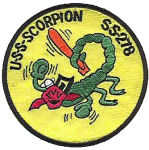
 The story of the USS Scorpion (SS-278) begins with her launch on July 20, 1942, at the Portsmouth Naval Shipyard in Kittery, Maine. A sleek Gato-class submarine, she was part of a formidable fleet that would define the U.S. Navy’s undersea warfare in World War II. Named after the scorpion, a creature known for its stealth and sting, she embodied these qualities in her missions across the Pacific theater.
Commissioned on October 1, 1942, under the command of Lieutenant Commander William N. Wylie, Scorpion spent her early months preparing for war. After shakedown operations off New England, she headed to the Panama Canal and then on to Pearl Harbor, arriving in March 1943. Her early voyages were not without danger; at one point, an Allied merchant ship mistook her for an enemy submarine and opened fire. The shells landed harmlessly, but the encounter underscored the risks of her mission.

Her first war patrol took her to the waters off Honshū, Japan, where she quickly made her presence known. She laid mines, sank two freighters, and destroyed several smaller vessels. Her second patrol in the Yellow Sea continued this streak, with Scorpion sinking two additional freighters and surviving intense depth charge attacks from Japanese escorts.

On her third patrol, now under the command of LtCDR Maximilian Gmelich Schmidt near the Mariana Islands, she damaged an oil tanker and navigated treacherous seas, escaping uncharted pinnacles and relentless enemy pursuit. By the time she departed for her fourth patrol in December 1943, Scorpion had already earned three battle stars, sinking ten ships and damaging two more, totaling nearly 40,000 tons.
The fourth patrol began with a departure from Pearl Harbor on December 29, 1943. After refueling at Midway, she headed to the northern East China and Yellow Seas, an area notorious for its dangers. On January 5, 1944, while conducting operations in rough seas, one of her crewmembers fractured his arm, prompting Scorpion to request a rendezvous with the USS Herring (SS-233). Despite heavy seas making a transfer impossible, Herring reported back that Scorpion had the situation “under control.” This would be the last communication from Scorpion. She was never seen or heard from again.
The disappearance of Scorpion remains one of the enduring mysteries of the Silent Service. When she failed to return by February 24, the Navy launched an exhaustive search, but no trace of her was found. By March 6, 1944, she was presumed lost. Postwar analysis pointed to Japanese minefields recently laid across the entrances to the Yellow Sea. While many submarines had navigated these minefields safely, the timing of Scorpion‘s disappearance suggested she may have struck one of the mines when they were most effective. Other theories include operational mishap or catastrophic failure, though Japanese records from the time contain no mention of anti-submarine engagements in the area. The presumed loss date was listed as on of after January 5, 1944.
The waters where Scorpion operated were among the most dangerous in the Pacific. Japanese forces had fortified these regions with mines, patrols, and air support to protect vital shipping routes. Submarines like Scorpion played a critical role in disrupting these routes, often operating alone in hostile territory. The bravery of her crew, patrolling in the face of such overwhelming odds, highlights the dedication and resolve of U.S. submariners during the war. At the height of the conflict, submarines accounted for only 2% of Navy personnel but were responsible for sinking over 30% of Japan’s merchant fleet. These successes came at a heavy price—fifty-two U.S. submarines, including Scorpion, were lost during World War II.
The loss of Scorpion was a devastating blow to her crew’s families and the Navy as a whole. Her commander, Maximilian Schmidt, was a seasoned leader respected by his men. The crew, a mix of young officers and enlisted sailors, shared a camaraderie forged in the high-pressure environment of submarine warfare. Letters and personal accounts from similar crews describe the mix of tension and humor that sustained these men during their long, silent patrols.
Though Scorpion now rests somewhere beneath the waves, her legacy endures. She is a testament to the valor of the submariners who fought in World War II and a reminder of the unseen battles waged beneath the ocean’s surface. As we honor her memory, we also honor the spirit of all those who serve in the depths, running silent and running deep.
 Patrol Reports
Leave a comment