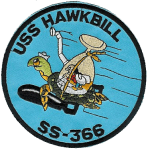
 The USS Hawkbill (SS-366) prowled the waters of the South China Sea on December 15, 1944, ready to strike another blow in the relentless submarine campaign against Japan. Commanded by Lieutenant Commander Francis Worth Scanland Jr., the Hawkbill was a stealthy predator of the Pacific, a Balao-class submarine with cutting-edge technology and a seasoned crew. This day would bring her into contact with one of Japan’s desperate attempts to maintain maritime supply lines: the Matsu-class destroyer IJN Momo.
The Hawkbills log for December 15 recounts a day of meticulous planning and daring execution. Early that afternoon, at 1341 hours, the submarine surfaced to establish radio contact with a B-24 bomber flying overhead. This reconnaissance plane confirmed the presence of a convoy containing two transports and their destroyer escorts, moving at seven knots on a course of 330 degrees. The B-24 also warned that the convoy might include as many as six destroyers. With this vital intelligence in hand, Scanland’s crew began their pursuit.
By 1820 hours, under cover of darkness, the Hawkbill changed course to converge with the convoy. Her radar made contact twenty minutes later, pinpointing two ships—both identified as Matsu-class destroyers—within range. The crew prepared for an attack.
At 1927 hours, positioned just 2,500 yards from the targets, the Hawkbill fired three torpedoes at each destroyer. The nearest destroyer, later confirmed to be the IJN Momo, bore the brunt of the assault. Three of the six torpedoes struck home, detonating with catastrophic force. Witnesses on the Hawkbill heard and saw the explosions that tore through the Momo, which sank almost immediately. The second destroyer, though spared, was left immobilized.
The attack was a textbook demonstration of U.S. submarine warfare, combining intelligence, stealth, and precision. For the crew of the Hawkbill, the success was a testament to their training and readiness. However, it was also a stark reminder of the stakes: the waters around Luzon were heavily patrolled, and the risk of retaliation was ever-present. After the Momo sank, the Hawkbill prudently withdrew, observing the convoy’s remaining escorts from a safe distance.
The Momo, launched just months earlier in 1944, was part of Japan’s Matsu-class of escort destroyers. These ships were hastily built as the Imperial Navy struggled to defend its supply routes from relentless Allied attacks. The Momo had already seen action, including in the Battle of Ormoc Bay, but her limited capabilities left her ill-suited for the increasingly hostile waters of the South China Sea. Her mission on December 15 was critical but ultimately fatal.
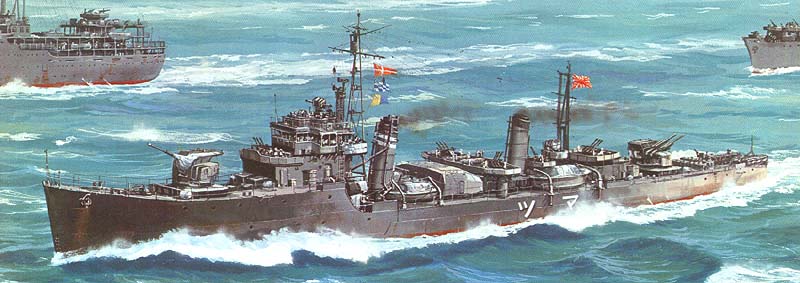
The sinking of the Momo highlighted the dominance of U.S. submarines in the Pacific. By 1944, these silent hunters had become a decisive force, targeting Japanese convoys with devastating effect. The Hawkbill’s attack exemplified the effectiveness of coordinated air and submarine operations, as the reconnaissance provided by the B-24 bomber was instrumental in locating the convoy.
The loss of the Momo and her crew of 210—including the deaths of 92 sailors—further underscored the human cost of Japan’s faltering defense. For the Hawkbill, it was another victory in a war of attrition that would see the U.S. Silent Service account for more than half of Japan’s maritime losses.
The broader significance of this encounter lies in its strategic and symbolic implications. The destruction of IJN Momo was not just the elimination of a single vessel but also a demonstration of how the Allied forces were systematically dismantling Japan’s ability to wage war. The U.S. submarine campaign, bolstered by advanced technology and tactics, turned the vast Pacific into a battlefield where even Japan’s most guarded convoys were vulnerable.
For the men of the Hawkbill, the events of December 15 were both a validation of their efforts and a sobering reminder of the perilous waters they navigated. The memory of their precision and courage that day lives on, a testament to the skill and resilience of the U.S. Navy’s Silent Service during World War II.
 Patrol Reports
Leave a comment