
They were never built to stare at the sky. Fleet submarines were hunters, creatures of the deep that stalked their prey in silence. Yet, in the uneasy years after the Second World War, the U.S. Navy found itself short on eyes. The kamikaze had taught a brutal lesson—that fleets needed early warning, and surface radar picket ships were sitting ducks. The answer, paradoxically, was to turn the predators of the deep into guardians of the air.
The improbable story of the radar picket submarine, officially designated SSR, was born from desperation and innovation in equal measure. Through three major conversion phases under a program called Project MIGRAINE, these former war patrol boats became part of a strange and short-lived fraternity that bridged the last gasps of the analog Navy and the dawn of the nuclear age.
It began in the dying months of World War II. The U.S. Navy’s destroyers, positioned in lonely rings around Okinawa, became magnets for suicide planes. Between April and June of 1945, more than 100 radar picket destroyers were sunk or damaged. The Navy’s planners realized that a submerged picket could survive what a surface ship could not. A submarine equipped with powerful air-search radar could detect attackers, coordinate intercepting fighters, and then dive for cover. The war ended before any were finished, but the seed had been planted.
Two fleet boats, USS Requin (SS-481) and USS Spinax (SS-489), were completed after V-J Day and became the first prototypes. Their conversions were improvised, cramming radar consoles and communications gear into spaces once used for torpedoes. Their radar antennas sat low on the deck, where seawater routinely shorted them out. The cramped conditions made the submariners curse, but the concept worked. By 1946, both had proved that submarines could perform as mobile, submersible early-warning posts.
This led to a more systematic approach. The Navy’s Bureau of Ships christened the development effort Project MIGRAINE, a fitting name for a program plagued by tight budgets, complex electronics, and chronic space constraints.
The first official conversions came in 1948. Two boats, USS Tigrone (SS-419) and USS Burrfish (SS-312), were selected. Both had been conventional Balao or Tench-class fleet submarines, built to carry 24 torpedoes, now gutted to hold radar equipment. Their crew’s mess and galley were torn out and replaced with a Combat Information Center, or CIC. Stern torpedo tubes were removed entirely, their spaces turned into bunks. Two forward tubes were sealed for storage.
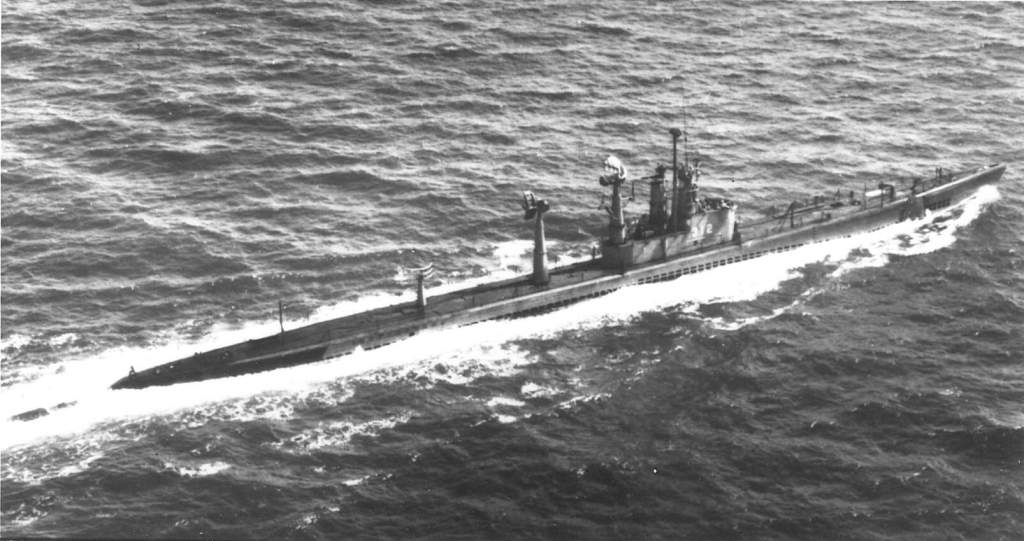
The new configuration elevated the radars onto tall masts above the fairwater, solving the visibility problem that had plagued Requin and Spinax. They carried air-search, surface-search, and fighter-controller radars that could detect planes over 100 miles away. Snorkels were added so they could operate diesels while submerged. Both were redesignated “SSR” in early 1949, marking the first time that code had been assigned to a submarine.
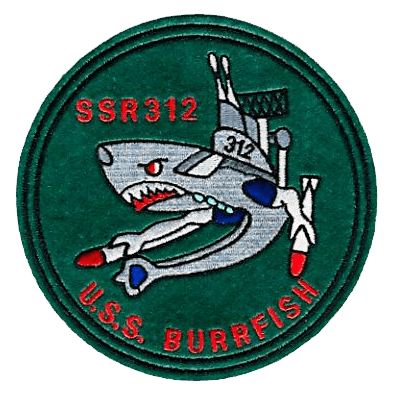
For Burrfish, the new role was a second life. After six Pacific war patrols and the sinking of the German tanker Rossbach, she was recommissioned and returned to service in 1950 as a radar picket boat with Submarine Squadron Six out of Norfolk. For six years she ranged the Atlantic, taking her turn on lonely patrols in the Mediterranean and North Atlantic, sending radar tracks of Soviet aircraft to the fleet below her horizon.
Experience quickly exposed the limitations of the first conversions. The radars were still bulky, the wiring complex, and the cramped CICs left little space for operators. So, in 1948, Requin and Spinax were brought back to the yards for new work. Their stern torpedo rooms were gutted entirely and turned into living quarters and an enlarged CIC. Two forward tubes were sealed off to make room for new electronics. The air-search and surface radars were moved to masts atop the fairwater, while a fighter-controller beacon, the YE-3, was added aft.
The changes worked. For the first time, these boats could detect high-flying targets and direct friendly fighters with relative efficiency. Requin, redesignated SSR-481, became the lead example. She operated along the Atlantic coast, conducted Arctic tests, and deployed repeatedly to the Mediterranean as part of the Sixth Fleet. Her crews joked that they spent more time on the surface than underwater, but in truth, the radar picket mission kept her busier than almost any other conventional sub in the postwar Navy.
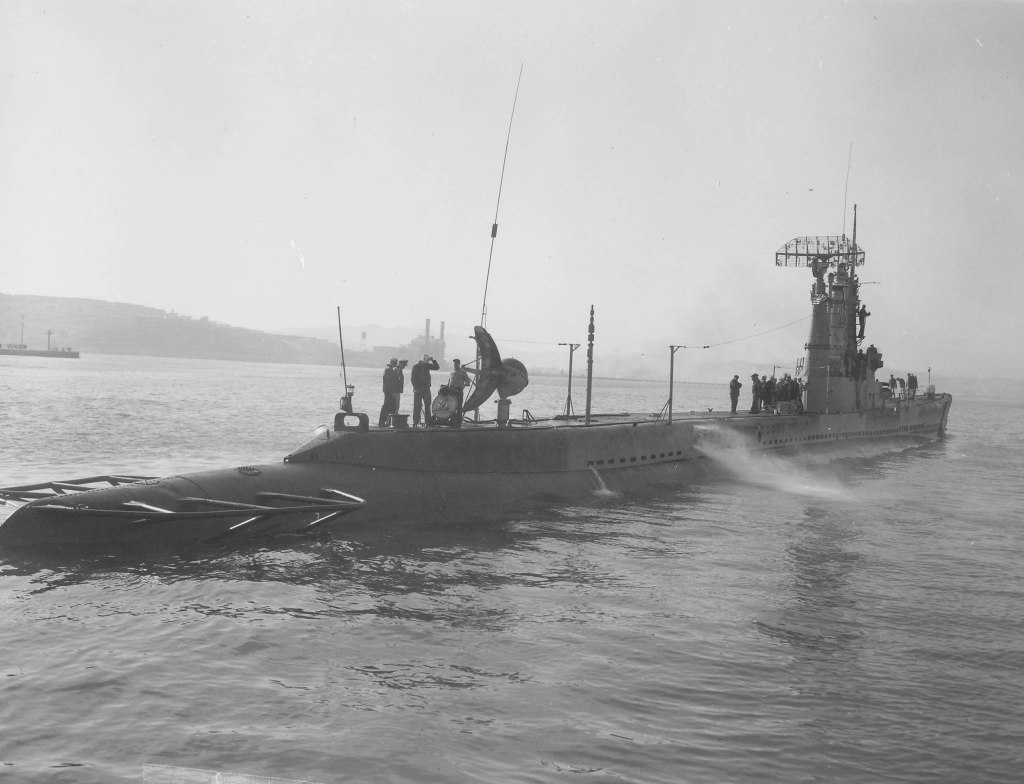
By the early 1950s, the Cold War had fully replaced the kamikaze as the existential threat. The Navy needed a radar network to spot Soviet bombers before they could reach the fleet or the American coast. Six Gato-class submarines, Pompon, Rasher, Ray, Redfin, and Rock, were pulled from reserve and cut in half. A 24-foot section was inserted amidships to create space for a full-sized CIC and more radar electronics. These “stretched” subs were the MIGRAINE III conversions.
Externally, they were nearly unrecognizable from their wartime origins. Gone were the open conning towers and gun mounts. In their place rose a massive, enclosed sail housing multiple radar antennas. The long, graceful lines made them look more like futuristic research craft than war machines. Internally, they were better balanced, retaining their six forward torpedo tubes while losing the aft battery compartment to crew quarters. Between 1951 and 1953, all six boats rejoined the fleet, bringing the total number of operational SSRs to ten.
The Navy now had enough radar pickets to provide barrier coverage for carrier groups in both oceans. A typical formation paired two SSRs on opposite ends of the threat axis, ensuring one could stay on the surface while the other submerged to evade. Each boat carried a CIC team of four, a controller, height-finder, plotter, and bridge communicator, who operated in shifts around the clock.
But life aboard these boats was anything but glamorous. The constant noise of radar sets and ventilation made sleep nearly impossible. Salt corrosion plagued the antennas. The submarines were rarely submerged, and when they did dive, the radar masts had to be locked straight ahead, reducing underwater maneuverability to a crawl. The picket crews became known in the fleet as “sky-lookers,” a somewhat mocking nickname from traditional submariners who considered the duty dull and surface-bound.
The radar picket subs were one strand in a vast defensive web. In the Arctic and across Canada stretched the Distant Early Warning (DEW) Line, a chain of radar stations meant to detect Soviet bombers. Offshore, destroyers and converted merchantmen formed radar barriers. The submarines filled the gaps, operating where fixed stations couldn’t reach and where surface ships were too vulnerable.
In the Atlantic, boats like Requin, Burrfish, and Tigrone stood watch along approaches to the East Coast, feeding data to the Aerospace Defense Command and later NORAD. In the Pacific, Spinax, Rasher, and Raton patrolled near Japanese and Aleutian waters, forming an invisible shield around carrier groups. The concept worked, at least on paper. But it came at the cost of the submarines’ offensive capability. With most torpedo tubes removed and much of the weight devoted to electronics, the SSRs were neither fish nor fowl: too slow to keep up with the fleet, too conspicuous to hide from aircraft, and too expensive to maintain.
By 1958, the Navy recognized that airborne early warning aircraft could do the job better. The radar picket destroyers and submarines were gradually withdrawn, replaced by the E-1 Tracer and EC-121 Warning Star aircraft that could cover vast areas at high altitude. Requin’s radar gear was removed at the Charleston Navy Yard in 1959, and she was reclassified as a standard attack submarine once more.
Burrfish was placed in reserve three years earlier, later loaned to the Royal Canadian Navy as HMCS Grilse (SS-71). The Canadians used her as a training boat until 1969, when she was returned and sunk as a target off California. Requin, luckier than most, served another decade, even joining the search for the lost Scorpion (SSN-589) in 1968. Decommissioned later that year, she was saved from scrapping through the efforts of Senator John Heinz and today rests proudly in Pittsburgh as a museum ship.
The others met quieter ends. Spinax was struck from the Navy list in 1960, Rasher and Raton followed soon after. The Navy’s final attempt to modernize the concept produced two new diesel boats, the Sailfish class (SSR-572 and SSR-573), and one nuclear giant, Triton (SSRN-586), a 447-foot colossus with twin reactors and a radar suite that could track targets hundreds of miles away. Yet even Triton’s impressive performance couldn’t save the mission. By the early 1960s, satellites and airborne systems had rendered the radar picket obsolete.
The radar picket submarines were, in hindsight, an evolutionary dead end, but a necessary one. They bridged the gap between the fleet boats of World War II and the guided-missile and nuclear patrol submarines that followed. The lessons learned in integrating complex electronics into a submarine hull directly influenced later projects, including the Regulus missile subs and early ballistic-missile conversions.
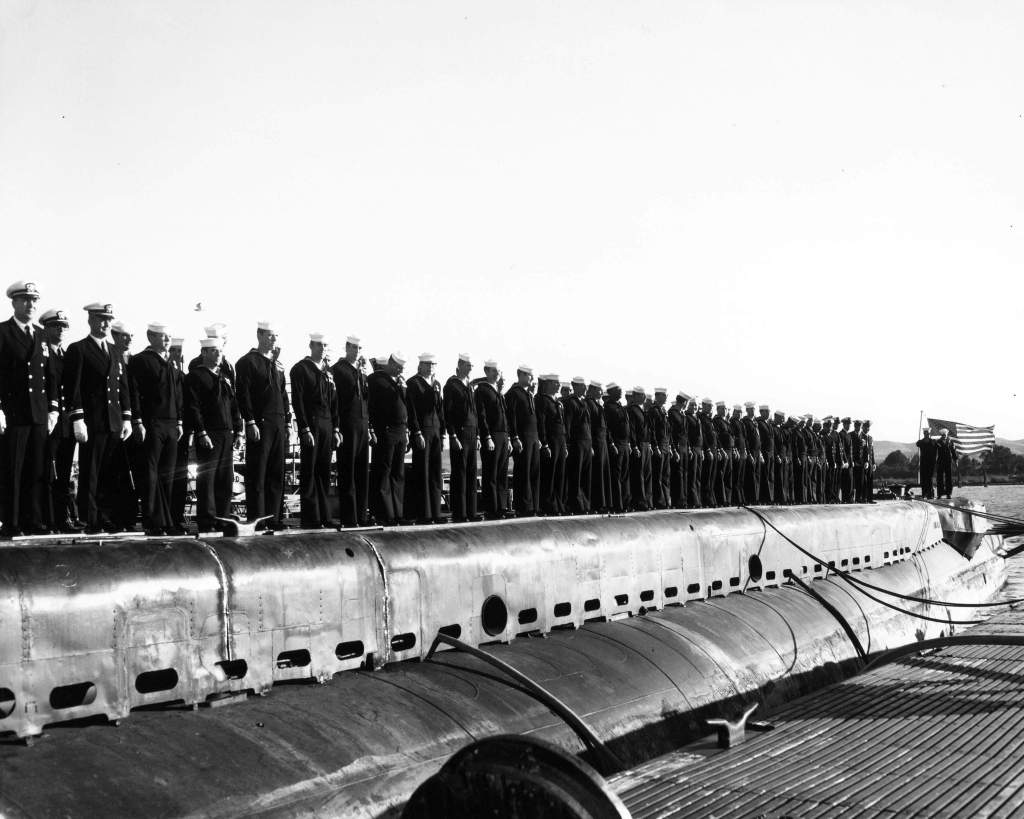
More importantly, they kept alive a generation of boats and sailors in a time of transition. While others were scrapped, the MIGRAINE conversions proved that ingenuity could stretch both steel and doctrine. The sight of Requin’s bulbous radar sail rising from the Atlantic was a symbol of adaptability, a reminder that even instruments of war can be reinvented for vigilance rather than violence.
Their story closes not with a battle, but with the quiet hum of radar sets sweeping the sky. For a brief window of history, America’s submarines looked upward, not for enemies beneath the waves, but for shadows on the horizon. And in doing so, they became sentinels of a new age, standing watch at the threshold of the Cold War.
- “Briefing Document: The Service and Evolution of the USS Requin (SS-481).” Internal U.S. Navy historical memorandum, compiled 1968; reproduced in user-provided file Briefing Document.docx, pp. 1–9.
- “Article Outline: Project MIGRAINE and the Birth of the Radar Picket Submarine (SSR).” U.S. Navy Bureau of Ships Research Compilation, 1953; reproduced in user-provided file Outline.docx, pp. 1–6.
- “Radar Picket.” Wikipedia: The Free Encyclopedia. Last modified October 2025. https://en.wikipedia.org/wiki/Radar_picket.
- “USS Burrfish (SS/SSR-312).” Wikipedia: The Free Encyclopedia. Last modified October 2025. https://en.wikipedia.org/wiki/USS_Burrfish.
- “USS Requin (SS/SSR/AGSS/IXSS-481).” Wikipedia: The Free Encyclopedia. Last modified October 2025. https://en.wikipedia.org/wiki/USS_Requin.
- U.S. Navy Bureau of Ships. Project MIGRAINE: Radar Picket Conversion Program Technical Summary. Naval Ship Systems Command Archives, 1948–1953.
- Naval History and Heritage Command. “USS Spinax (SSR-489) and the Evolution of the Submarine Radar Picket Role.” NHHC Research Division Report, Washington, D.C., 1959.
- Department of the Navy. Cold War Naval Electronics and Early Warning Systems, 1945–1960. Office of Naval Research Technical Monograph No. 122 (Washington, D.C.: Government Printing Office, 1961).
- Heinz, John. “Preserving the USS Requin.” Congressional Record, April 1990, S4721–S4723.
 Patrol Reports
Leave a comment