
In the silent world beneath the waves, few names carry the weight of history and transformation quite like USS James K. Polk. Bearing the name of the 11th President of the United States, the boat served as both a sentinel of deterrence and a pioneer of adaptation, evolving from a nuclear-armed ballistic missile submarine into a stealthy platform supporting special operations. Its story spans from the tense days of the Cold War through the uncertain calm of its end, a reflection of the shifting tides of American power and naval innovation.

James Knox Polk, the 11th President of the United States, was born on November 2, 1795, in Mecklenburg County, North Carolina, and raised on the Tennessee frontier. A protégé of Andrew Jackson, he rose from the Tennessee legislature to become Speaker of the House of Representatives and later Governor of Tennessee. Elected president in 1844 as a “dark horse” candidate, Polk pledged to serve only one term and achieved a sweeping agenda: he reduced tariffs, restored the independent treasury, settled the Oregon boundary with Britain at the 49th parallel, and led the nation to victory in the Mexican-American War, acquiring vast territories that extended U.S. sovereignty to the Pacific. Though his expansionist policies fulfilled the dream of Manifest Destiny, they also deepened the national debate over slavery. True to his word, he declined to seek reelection, retiring in 1849 and dying just three months after leaving office.
The keel of James K. Polk was laid down on November 23, 1963, at the Electric Boat Division of General Dynamics in Groton, Connecticut. It was one of the 12 Benjamin Franklin-class submarines, the final iteration of the George Washington lineage that began America’s fleet of ballistic missile submarines. The Benjamin Franklins were an evolution of the Lafayette and Ethan Allen classes, slightly quieter and designed to carry the Polaris A3 ballistic missile, later upgraded to the Poseidon C3. From the beginning, Polk represented the cutting edge of Cold War strategy. To understand her significance, one must understand the time in which she was built. The United States and the Soviet Union were locked in an ideological and military standoff that relied on one ultimate equation: deterrence. Submarines like James K. Polk were designed to vanish into the deep ocean, unseen and unreachable, capable of striking back with nuclear precision should deterrence ever fail. They were not offensive weapons in the usual sense. Their mission was to make war unthinkable.

Launched on May 22, 1965, and commissioned on April 16, 1966, USS James K. Polk entered service during a period of high technological confidence. Her twin crews, Blue and Gold, trained to operate the vessel continuously, ensuring she could remain on deterrent patrols for months at a time. These patrols were not glamorous. They were monotonous, often psychologically taxing, and cloaked in total secrecy. Yet they were among the most vital operations of the Cold War. Each patrol meant that, somewhere beneath the sea, an American submarine was ready to respond to a nuclear strike within minutes. Crews rotated on and off the boat at forward bases such as Holy Loch, Scotland, or Rota, Spain. Few details of Polk’s patrols were ever publicized, but what is known tells the story of discipline and endurance. She completed sixty-six strategic deterrent patrols between 1966 and 1991, a record that places her among the most active submarines of her generation.
The life of a ballistic missile submarine in those years followed a familiar rhythm. The crew embarked, submerged, and disappeared for months at a time. They maintained absolute radio silence except for occasional encrypted bursts to verify readiness. Daily life revolved around maintenance, drills, and the constant vigilance required of nuclear sailors. There were no port calls, no news, and no sunlight. But there was purpose. The men aboard James K. Polk knew they were the hidden cornerstone of national security.
By the mid-1970s, the submarine force had already begun to evolve. New classes, such as the Ohio-class SSBNs, were being designed with greater missile capacity, longer range, and advanced stealth. For the older Benjamin Franklin-class boats, time was running short in their strategic role. Yet the Navy, ever practical, saw a new use for these seasoned vessels. The Cold War was entering a phase where unconventional warfare, special operations, and undersea intelligence-gathering became as important as nuclear deterrence. When the United States began to withdraw older missile submarines from strategic duty, several—including James K. Polk—were slated for conversion to support these missions.
Polk’s transformation began in the early 1990s. Her final deterrent patrol was completed in August 1991, just months before the formal dissolution of the Soviet Union. With the geopolitical landscape shifting, the Navy decided to convert Polk from an SSBN to an attack submarine, redesignated SSN-645. The conversion took place between 1992 and 1994, when her missile compartment was removed or modified to accommodate two Dry Deck Shelters. These shelters, attached externally to the hull, allowed the deployment of SEAL Delivery Vehicles and special warfare teams. What had once carried intercontinental ballistic missiles now carried commandos. The conversion process also included upgrades to sonar, communications, and habitability systems, transforming Polk into one of the most versatile platforms of its kind.
This reimagined role reflected the broader reorientation of the submarine force in the post–Cold War era. No longer was the sole mission to deter nuclear war. The new missions emphasized intelligence collection, surveillance, and precision strike support for special operations. The submarines that had once been silent warriors of deterrence now became instruments of shadow warfare and reconnaissance.
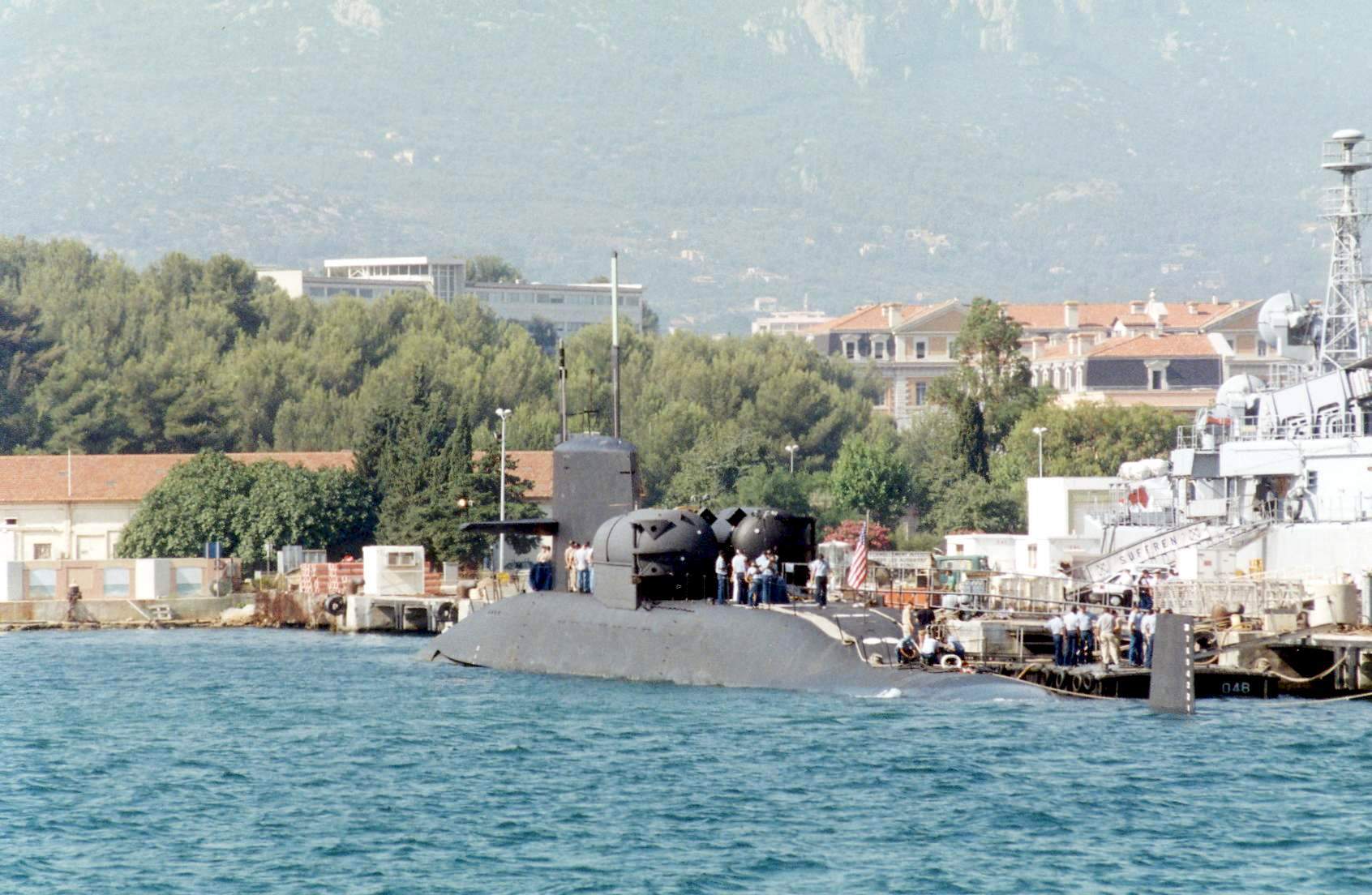
James K. Polk’s service as an SSN took her to different waters and different purposes. She trained with SEAL teams, tested new deployment methods, and continued to operate under the secrecy that had always defined her service. The very name that once represented a shield against nuclear destruction now symbolized a flexible, hidden blade of American power. For the men who served aboard her, this period was both a rebirth and a farewell. The old missile tubes were gone, but the spirit of quiet professionalism remained the same.
By the late 1990s, however, age and budget realities caught up with her. The Ohio-class boats had fully taken over the nuclear deterrent mission, and newer attack submarines were entering service. On January 9, 1999, USS James K. Polk was deactivated while still in commission. She was formally decommissioned and stricken from the Naval Vessel Register on July 8, 1999. The ship entered the Nuclear-Powered Ship and Submarine Recycling Program at Puget Sound Naval Shipyard, where she was dismantled and recycled by April 26, 2000.
Yet even in dismantling, Polk left a legacy. Her sail was preserved and now stands proudly at the National Museum of Nuclear Science & History in Albuquerque, New Mexico. It is a monument both to her service and to the era she represents. Visitors can walk beneath that steel fin, run their hands across the weathered metal, and imagine the invisible power that once moved silently beneath the sea. The rest of the submarine, like so many of her class, was returned to the elements, her steel and reactor fuel recycled into new forms of energy and industry.
The name James K. Polk itself carries historical resonance that mirrors the submarine’s own journey. President Polk served from 1845 to 1849, a one-term leader whose tenure expanded the United States dramatically through the annexation of Texas, the Oregon boundary settlement, and the Mexican-American War, which brought California and the Southwest into the Union. His presidency defined an era of ambition and decisive action, much like the boat that bore his name. It is fitting that a vessel designed to extend American influence and security across the globe carried his name into the depths.
Throughout its life, James K. Polk was manned by generations of sailors who embodied the quiet professionalism of the Submarine Force. Many of them belonged to what submariners fondly call “the Silent Service,” a community bound by secrecy and shared sacrifice. Crew reunions and veterans’ associations continue to honor their service, collecting photographs, patrol patches, and stories that can now be told after decades of silence. These men lived in tight quarters, trusted one another completely, and carried responsibilities few civilians could imagine. In that sense, they were the heirs to both the pioneering submariners of the early twentieth century and the explorers of old.
There was a rhythm to their lives that outsiders rarely see. A man would leave home for months, vanish into classified waters, and return to port weeks later, older, quieter, but with the quiet satisfaction of having done his duty. Families adjusted to this routine, as did the sailors themselves. Submariners on Polk spoke of the strange comfort of the constant hum of machinery, the smell of hydraulic oil, and the dim red light that marked night aboard the boat. They remembered small celebrations on patrol: Thanksgiving dinners in the North Atlantic, birthdays marked with makeshift cakes, the occasional movie night when the reel didn’t jam. They also remembered the tension of drills, the endless training that ensured they could handle any crisis from fire to flooding to reactor scram.
When the conversion to SSN came, some veterans expressed mixed emotions. The removal of the missile tubes symbolized the end of an era. But many took pride in the new mission, seeing it as a continuation of service in a world that no longer depended on massive nuclear arsenals. The Dry Deck Shelter operations were difficult and dangerous, demanding the same precision and discipline that had defined the missile patrols. James K. Polk, even in her twilight years, continued to embody adaptability and resilience.
Her story also serves as a reminder of the ingenuity of American shipbuilding and the foresight of naval planners. Instead of scrapping the older SSBNs outright, the Navy repurposed several for new missions, extending their usefulness while developing the tactics and technologies that modern special operations now take for granted. The Navy’s ability to reimagine a Cold War deterrent platform into a 1990s reconnaissance and special warfare asset speaks to the flexibility that has long characterized the U.S. Submarine Force.
Today, the name USS James K. Polk lives on through the memories of her crew and the organizations that preserve her history. The USS James K. Polk Veterans Association maintains records, photographs, and stories that capture both the grandeur and the grind of submarine life. Their gatherings are filled with laughter, sea stories, and the quiet respect of men who once trusted their lives to one another in the deep. They recall the constant readiness drills, the satisfaction of a quiet patrol successfully completed, and the bittersweet day when the boat’s final reactor was shut down for good.
The history of James K. Polk is not merely the history of a single ship. It is a microcosm of the evolution of undersea warfare in the latter half of the twentieth century. From her keel-laying during the height of the Cold War to her final recycling in a new century, she embodied the changing face of deterrence, the expansion of naval capability, and the adaptability that keeps the United States Navy at the forefront of maritime power. Her dual identity, first as a guardian of nuclear peace and later as a tool of precision and stealth, reflects the nation she served: capable of transformation without surrendering purpose.

If one were to stand today before her preserved sail in New Mexico, one might feel the weight of history pressing through the steel. That piece of submarine once sliced through the cold Atlantic depths, carrying the hopes and fears of an entire nation. It was part of a machine built not to fight, but to prevent the need to fight. And when its purpose changed, it did not fade into obsolescence but found new life in service. That adaptability, that quiet endurance, is the real legacy of USS James K. Polk.
For those who served aboard her, and for those who study her now, she remains more than a name on a hull. She is a symbol of vigilance, innovation, and duty performed far from the light of public acclaim. The ocean keeps her secrets, but her story still rises, like a periscope breaking the surface, reminding us that even in silence, history speaks.
Are you a former crewmember of the USS James K. Polk?
USS James K. Polk Association Web Site
USS James K. Polk association Facebook Page
Notes
- James K. Polk (SSB[N]-645), Dictionary of American Naval Fighting Ships, Naval History and Heritage Command, https://www.history.navy.mil/research/histories/ship-histories/danfs/j/james-k-polk-ssb-n-645.html.
- Gary P. Priolo, “USS James K. Polk (SSBN-645/SSN-645) Submarine Photo Archive,” NavSource Naval History, https://www.navsource.org/archives/08/08645.htm.
- “History of the USS James K. Polk,” USS James K. Polk Veterans Association, https://www.ssn645.org/history.htm.
- “USS James K. Polk (SSBN-645 / SSN-645),” NavySite.de, https://www.navysite.de/ssbn/ssbn645.htm.
- “USS James K. Polk (SSBN-645 / SSN-645) – Quarterdeck Entry,” Cold War Boats Association, https://coldwarboats.org/index.php/boats/ssbn645.
- “USS James K. Polk Sail,” National Museum of Nuclear Science & History, Albuquerque, NM, https://www.nuclearmuseum.org/see/exhibits/outdoor-exhibits/uss-james-k-polk-sail.
- “Dry Deck Shelter (DDS),” Federation of American Scientists, https://fas.org/man/dod-101/sys/ship/dds.htm.
- “USS James K. Polk (SSN-645),” Naval Vessel Register, U.S. Navy, https://www.nvr.navy.mil/SHIPDETAILS/SHIPSDETAIL_SSBN_645.HTML.
- Wikipedia contributors, “USS James K. Polk (SSBN-645),” Wikipedia: The Free Encyclopedia, https://en.wikipedia.org/wiki/USS_James_K._Polk_(SSBN-645).
- Electric Boat Division, General Dynamics, Launch Records, USS James K. Polk (SSBN-645), May 22, 1965, Groton, Connecticut, cited in NavSource Naval History and NHHC archives.

 Patrol Reports
Leave a comment