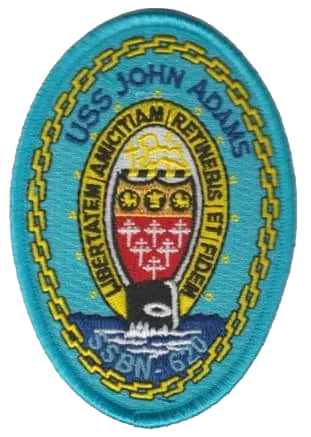
USS John Adams (SSBN-620) belonged to a class of submarines built in a time when the world’s stability depended upon quiet patrols beneath the sea. She was a Lafayette-class ballistic missile submarine, one of the Navy’s workhorses of deterrence during the Cold War. Named for the nation’s second president and a man whose voice helped declare American independence, the boat carried his name across decades of silent service in defense of the same principles.
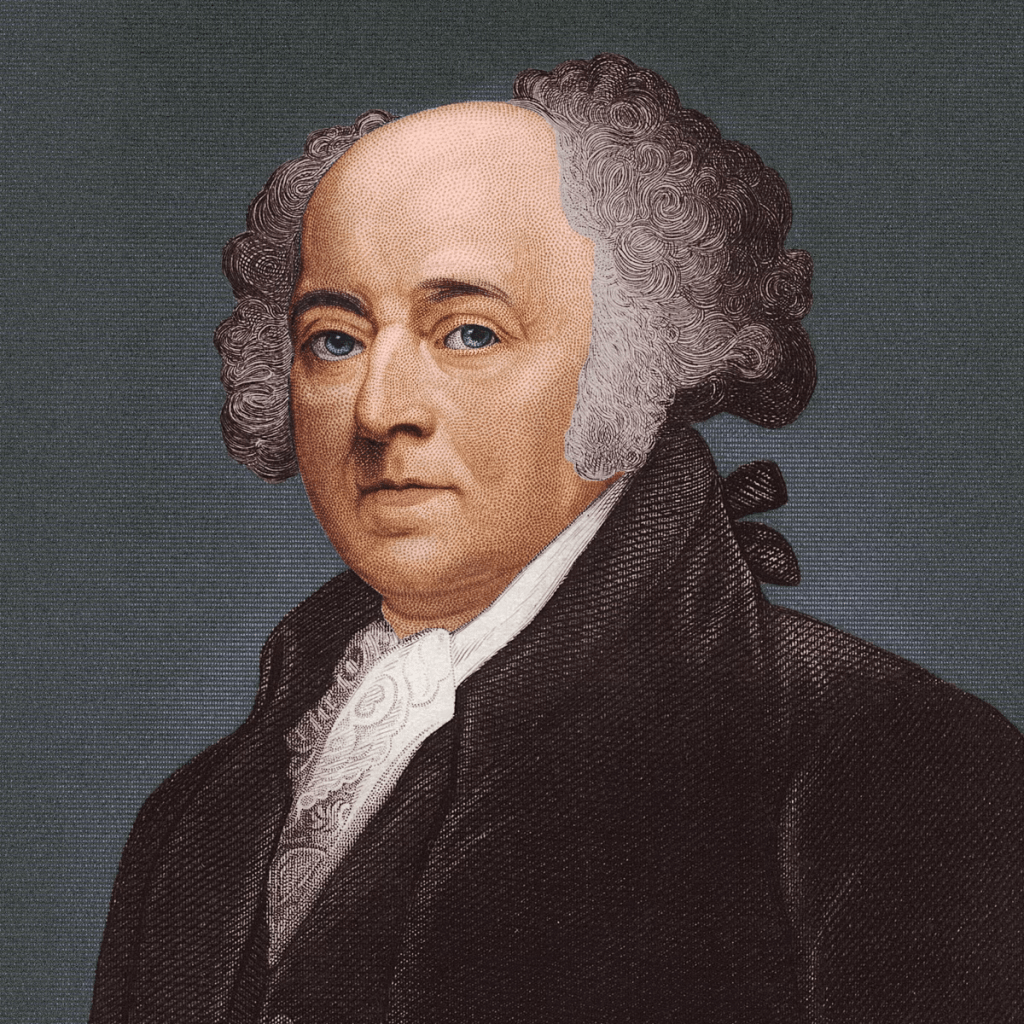
The namesake was President John Adams, born on October 30, 1735, in Braintree, Massachusetts. A lawyer by trade and a man of fierce conviction, Adams was among the earliest and most vocal advocates for independence from Britain. He served as a delegate to the Continental Congress, nominated George Washington to command the Continental Army, and helped draft the Declaration of Independence. Later, he became America’s first vice president and its second president. Though often considered irritable and proud, he was a devoted patriot and thinker who valued the rule of law and the balance between liberty and order. His correspondence with his wife Abigail remains one of the great literary and historical treasures of early America. It is fitting that a submarine meant to preserve peace through strength bore his name.
The keel of USS John Adams was laid down on May 17, 1962, at Portsmouth Naval Shipyard in Kittery, Maine. The yard was already steeped in submarine tradition, and Adams would continue that legacy as one of the new generation of nuclear-powered Fleet Ballistic Missile submarines. She was launched on January 12, 1963, sponsored by Mrs. Maryon Pittman Allen, and commissioned on May 12, 1964, with two alternating crews, Blue and Gold, following the Navy’s dual-crew system that maximized patrol time. Commander Lawrence E. Grayson took charge of the Blue Crew, while Commander Robert F. Sellars commanded the Gold Crew.

From the beginning, the mission of the John Adams was deterrence. She carried the Polaris A-2 missile system, which allowed the United States to maintain a credible second-strike capability even if its land-based missile fields or bomber bases were attacked. The Adams joined Submarine Squadron 14, homeported at Holy Loch, Scotland, which served as a forward base for America’s undersea nuclear fleet. The squadron’s tender, USS Proteus, and later USS Canopus, provided maintenance and refit services while crews rotated for rest and training.
The life of a ballistic missile submarine crew was built on secrecy and routine. Patrols typically lasted around seventy days, during which the submarine remained submerged almost continuously, avoiding detection by staying deep and quiet. The crew drilled constantly, tested systems, and maintained a strict schedule designed to keep both the ship and the men ready for any contingency. Few people outside the service ever knew where John Adams patrolled, only that somewhere in the depths of the Atlantic, she waited, an unseen guardian of peace.
By 1965, John Adams had completed her initial shakedown and begun deterrent patrols out of Holy Loch. Throughout the late 1960s, her two crews alternated control, one at sea while the other trained ashore or rested with families. The boat’s performance earned high marks for reliability and readiness. Like other submarines of her class, she represented a technological leap forward in quieting, endurance, and missile range compared to the earlier George Washington and Ethan Allen classes.
In 1968, John Adams entered the Puget Sound Naval Shipyard in Bremerton, Washington, for an overhaul and refueling. She was the first Fleet Ballistic Missile submarine to undergo this work at that yard, which marked a milestone in expanding the Navy’s capacity to maintain its strategic deterrent fleet. During the overhaul, she received upgrades to her systems, improved sonar and navigation equipment, and most notably the new Poseidon C-3 missile system, which replaced the earlier Polaris weapons. The Poseidon carried multiple independently targeted warheads and significantly increased the deterrent potential of each submarine.
Returning to duty after refit, John Adams resumed her patrols, this time operating from Rota, Spain, as part of Submarine Squadron 16. Like Holy Loch, Rota was one of the Navy’s forward bases that kept its deterrent fleet close to potential flashpoints. Through the 1970s, John Adams continued to make patrols without fanfare, part of the invisible backbone of American nuclear strategy. Crews rotated through the boat’s control and missile compartments, performing their work with precision and quiet pride.
In the late 1970s, the submarine community began to transition toward the larger Ohio-class boats that would replace the earlier generations. John Adams remained in service into the early 1980s, continuing deterrent patrols as she approached two decades of operation. By then, she had completed dozens of patrols and logged thousands of submerged hours.
The decommissioning process began as the Navy consolidated its strategic submarine fleet. USS John Adams was decommissioned and struck from the Naval Vessel Register on March 24, 1989. She entered the Nuclear-Powered Ship and Submarine Recycling Program at Puget Sound Naval Shipyard, where she had once been the first FBM to undergo overhaul. Her dismantlement was completed on February 12, 1996.
While her hull was cut apart and her reactor safely disposed of, the name and spirit of John Adams lived on. The service of her officers and crew had helped sustain the balance of deterrence that kept the Cold War from turning hot. Unlike ships that fought in open battles, her mission was to prevent them, to serve as a silent guarantee that any attack on the United States would invite immediate and overwhelming retaliation. This paradox of peace through potential destruction was the foundation of deterrence, and John Adams was a part of it for twenty-five years.
Life aboard the submarine was often monotonous and claustrophobic. The men shared small spaces, recycled air, and long stretches of silence broken only by the hum of machinery. Yet many who served aboard remembered it as one of the proudest experiences of their lives. They were entrusted with responsibility of enormous gravity and carried out their duties with calm professionalism. Each patrol, though uneventful to the outside world, represented another successful contribution to global stability.
In historical retrospect, USS John Adams represents a vital phase of American naval evolution. She bridged the era between the early ballistic missile boats and the modern Ohio-class fleet. Her service spanned the Cuban Missile Crisis aftermath, the Vietnam era, détente, and the final decade of the Cold War. Through those years, her presence beneath the Atlantic helped maintain the uneasy peace that defined the second half of the twentieth century.
The ship’s legacy also includes the technological and human progress made through her service. Her crewmen refined the systems and operational habits that became standard for later submarines. Her overhauls at Puget Sound expanded the Navy’s industrial base for supporting nuclear-powered vessels. Her deployment to Holy Loch and Rota strengthened alliances and ensured that the United States could project secure deterrence across the globe.

For many veterans, John Adams was more than steel and circuitry. She was a home, a challenge, and a source of pride. The camaraderie formed in her narrow passageways and cramped mess decks lasted long after the ship was gone. Reunions and online groups continue to gather former crewmembers, trading stories that few outside the submarine service can fully understand. They remember the endless drills, the smell of hydraulic fluid, the sound of the diving alarm, and the steady reassurance of knowing that their mission mattered, even if it was never publicly celebrated.
When viewed alongside her namesake, the submarine’s service takes on an almost poetic symmetry. John Adams the man fought for a new nation’s independence through words, law, and diplomacy. USS John Adams preserved that same nation’s independence through vigilance, technology, and deterrence. Both embodied a belief that peace must be secured through preparation and that freedom demands responsibility.
The story of USS John Adams is not one of battles won or ports captured. It is the story of a long, quiet vigil under the sea, maintained by generations of sailors whose names rarely appear in headlines. Their contribution was measured not in victories, but in the absence of war. When she was finally retired and dismantled, her mission had already been accomplished. The Cold War had ended without the nuclear conflict she was built to prevent.
Today, the name John Adams remains on the rolls of the Navy, reserved for future use. The legacy of SSBN-620 endures in the traditions of the submarine service and the continuing role of strategic deterrence. The boat’s story reminds us that history is often shaped as much by what does not happen as by what does.
From her launch in 1963 to her recycling in 1996, USS John Adams carried forward the ideals of her namesake: steadfast duty, belief in peace through strength, and devotion to the cause of liberty. She served without fanfare, patrolled without acclaim, and stood as a silent sentinel during some of the most uncertain years of modern history. Her steel may be gone, but her spirit remains anchored in the deep, among the quiet watchmen who guarded the free world.
Primary and Authoritative Sources
- Naval History and Heritage Command. “John Adams II (SSBN-620).” Dictionary of American Naval Fighting Ships (DANFS). U.S. Navy, updated 2024.
- Naval History and Heritage Command. “Photographic Archive: USS John Adams (SSBN-620).” Washington, DC: NHHC, 1963–1989.
- Naval Vessel Register. “USS John Adams (SSBN-620) – Naval Vessel Register Entry.” U.S. Department of the Navy, 1989.
- Puget Sound Naval Shipyard & Intermediate Maintenance Facility. Salute Newsletter: “First FBM Overhaul Completed – USS John Adams.” August 1968.
- U.S. Department of Energy. Nuclear-Powered Ship and Submarine Recycling Program Green Book, Appendix A: “Submarines Recycled at Puget Sound Naval Shipyard.” DOE, 1996.
- Commander Submarine Squadron 14. Command History 1964–1970. U.S. Navy Archives, Holy Loch, Scotland.
- Commander Submarine Squadron 16. Command History 1970–1980. U.S. Navy Archives, Rota, Spain.
- Central Intelligence Agency (FOIA Release). Biographical Data of Naval Commanding Officers, 1967–1968: “CDR Robert F. Sellars – USS John Adams (SSBN-620) Gold Crew.”
Secondary and Technical Sources
- NavSource Online: Submarine Photo Archive. “USS John Adams (SSBN-620).” Accessed 2025. https://www.navsource.org/archives/08/08620.htm
- NavySite.de. “USS John Adams (SSBN-620).” Ship Information and Crew List. Accessed 2025. https://www.navysite.de/ssbn/ssbn620.htm
- HullNumber.com. “Crew Roster and Timeline: USS John Adams (SSBN-620).” Accessed 2025.
- Wikipedia Contributors. “USS John Adams (SSBN-620).” Wikipedia, The Free Encyclopedia. Updated October 2025.
- Military Wiki Contributors. “USS John Adams (SSBN-620).” Accessed 2025.
- Naval Encyclopedia. “Lafayette-Class Fleet Ballistic Missile Submarines.” Accessed 2025.
- HistoryLink.org. “Puget Sound Naval Shipyard and Its Role in the Cold War Submarine Program.” Accessed 2025.
Tertiary and Veterans’ Accounts
- USS John Adams Veterans Association. “Crew Reunion Announcements and Remembrances.” Facebook Group and Association Website, Accessed 2025.
- St. Marys Submarine Museum. “Commissioning Day Photographs of USS John Adams (SSBN-620).” Exhibit Notes, St. Marys, GA.
- The Lean Submariner Blog. “Recollections from the Polaris Patrols of USS John Adams.” Posted 2018.
- Navy Emporium. “Ship Histories and Patch Gallery: USS John Adams (SSBN-620).” Accessed 2025.
 Patrol Reports
Leave a comment