
The year 1928 was not kind to submariners. It began with the aftermath of the USS S-4 tragedy, a disaster that left all forty men aboard entombed just a few hundred yards from Provincetown, Massachusetts. The submarine had been rammed by the Coast Guard destroyer Paulding and went down in less than a minute, settling at about a hundred feet. Six men trapped in the torpedo room signaled by tapping out messages on the hull, asking the haunting question: “Is there any hope?” Weather and sea combined to make the answer no. Despite the efforts of Rear Admiral Brumby, Captain Ernest J. King, Lieutenant Henry Hartley, and Commander Edward Ellsberg, the men suffocated before help could reach them. The tragedy became a defining moment for the submarine force, not just for the lives lost, but for the realization that rescue methods were woefully inadequate.
The salvage of S-4 became a herculean effort. Captain King oversaw the raising of the boat in March of 1928, a feat that combined skill, brute strength, and sheer determination. Divers like Thomas Eadie and Frank Crilley showed courage that bordered on reckless, risking their own lives in icy, treacherous water. Eadie received the Medal of Honor for saving fellow diver Fred Michels, whose air line had become entangled. Others received the Navy Cross, including men who commanded the tugboats that wrestled against storm and tide. Once raised, the S-4 was recommissioned later that year, not for combat but as a laboratory for submarine rescue. Out of the wreckage came determination, and out of the tragedy came progress.

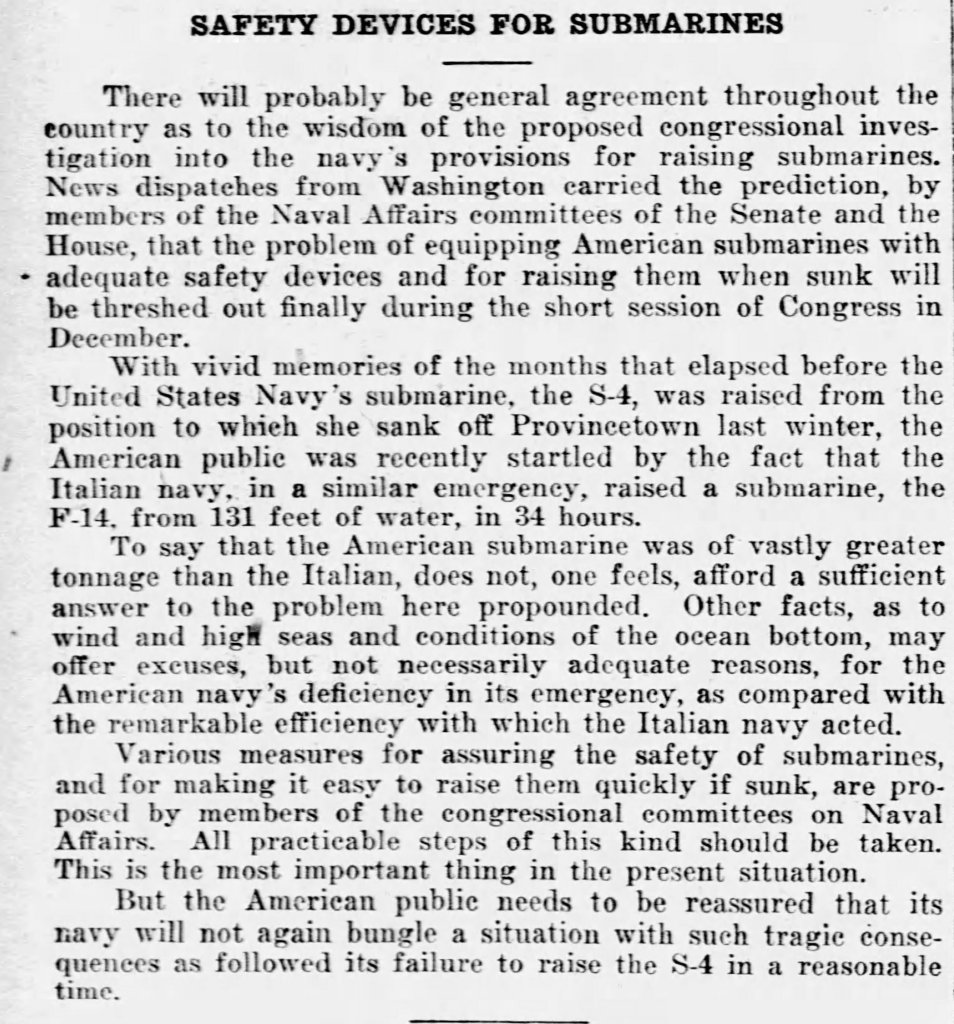
Across the Atlantic, Italy suffered its own submarine catastrophe in August 1928. The F-14 collided in the Adriatic and went down quickly. Italian salvors raised the boat within thirty-four hours, faster than anything attempted with S-4, but the crew was already gone. Poisonous chlorine gas had filled the hull when seawater mixed with the submarine’s batteries. The men’s last message, telegraphed as they gathered at the prow, was as stark as it was heartbreaking: “We are all gathered at the prow. Gas is advancing inexorably. We are dying. Long live—”. Death by suffocation, death by drowning, death by gas—it seemed that every path led the submariner to the same grim destination.
By 1928, submarines had earned the nickname “iron coffins.” Newspaper writers and even naval men muttered that perhaps the submarine itself was cursed, nothing more than an “eternal hoodoo.” Commander Ellsberg, who had overseen the salvage of S-51 just a few years before, had prophetically warned that another disaster was inevitable within three years. His warning came true with the S-4, and his recommendations for safety equipment had largely been ignored. The pontoons he insisted upon were scattered among commands, unavailable when needed most. Ironically, some of his very suggestions seemed to be put into practice by the Italians.
But the Navy was not deaf to the lessons of 1928. A new device was being tested, an ungainly but practical contraption that looked more like a circus trick than a life-saving tool. Called a “lung,” it was essentially an inflated life preserver with an oxygen bag and mouthpiece attached. It was meant to allow a man to escape from a sunken submarine and rise slowly enough to avoid the bends. Tests to sixty feet were promising, and the Navy planned to issue one to every man on every submarine. Lieutenant C. B. Momsen, a name that would later become legend, was at the center of its development, along with Chief Gunner C. L. Tibbals and engineers from the Bureau of Construction and Repair.
The debates of the day reached beyond technology. Should submarines even exist? Critics argued that they were deathtraps in peace and assassins in war, and the world would be safer if every last one were abolished. Admirers pointed out their effectiveness and the impossibility of convincing rival nations to give them up. So the work went on. New devices were tested, new procedures debated, and young men continued to volunteer for service aboard the “boats.”
In the end, 1928 was a year of hard lessons. The loss of the S-4 and the F-14 underscored the peril of collision and the insidious threat of toxic gas. Salvage successes proved that recovery was possible, but only if the crew lived long enough. The inventions and experiments that followed showed that the Navy was serious about finding answers. Yet the larger truth remained: the ocean is vast, merciless, and quick to claim the careless. For those who rode beneath its surface, safety was not guaranteed. It was fought for, tested, and too often bought with blood.
 Patrol Reports
Leave a comment