She started life as a workhorse, not a wonder. USS O-12 was never meant to make history, only to do her duty. Built in Bridgeport, Connecticut in 1916, this O-class submarine served briefly in the Panama Canal Zone after World War I. She was solid, if not spectacular. Compared to her Electric Boat sisters, she had her flaws. But for a few short years, she stood watch where it mattered. Then, in 1924, the Navy pulled her from service and parked her at the Philadelphia Navy Yard. She was supposed to be scrapped. That would have been the end of it.

But then along came Sir Hubert Wilkins. He wasn’t American. He wasn’t military. He wasn’t anything the brass would normally pay attention to. He was an adventurer. Australian by birth, forged by hardship, and driven by an obsession with polar exploration. He had flown across the Arctic and survived World War I as a battlefield correspondent. Now, in the waning 1920s, he had a new idea. He wanted to go under the Arctic ice. Not fly over it, not walk across it, but take a submarine beneath the frozen sea. And for that, he needed a boat. Preferably one cheap, and still floating.
The O-12 fit the bill. With backing from Lincoln Ellsworth, Hearst newspapers, and some high-profile scientific institutions, Wilkins made a deal. Since he wasn’t a U.S. citizen, the Navy couldn’t lease the sub directly to him. Instead, they handed it over to Lake and Danenhower Inc. for one dollar a year, with the promise it would be used only for scientific exploration and scuttled at the end of the journey. The old sub would get a second chance. She’d be renamed Nautilus.
Refits began in Philadelphia, then shifted across the river to the Mathis Shipyard in Camden. Simon Lake, the original designer of the boat, was brought in to install modifications he claimed were essential for under-ice navigation. Wilkins wasn’t thrilled with all of them, but Lake had the final say. The boat was outfitted with ice drills, a moon pool in the old torpedo room, a retractable conning tower, and bizarre-looking sled runners bolted to her deck. It looked more like a Jules Verne fever dream than a proper naval vessel.
She was rechristened Nautilus in March 1931 by Lady Wilkins, who smashed a bucket of ice cubes on her bow. Prohibition had taken the champagne off the table. Jules Verne’s grandson stood by, watching. The symbolism was thick. This wasn’t just an expedition. It was a challenge to the very limits of what was possible with early 20th-century technology.

Nautilus left New York on June 4, 1931. The Atlantic wasn’t kind. By June 14, both engines had failed in a brutal storm. Nautilus drifted helplessly until the battleship USS Wyoming, carrying hundreds of Naval Academy midshipmen, found her and hauled her to Cork, Ireland. From there, she was towed to England for repairs. The expedition had barely begun, and already it was months behind schedule and leaking credibility.

The delays stacked up. In Bergen, Norway, she took on more equipment and more scientists. By the time she departed for the Arctic ice, it was August, dangerously late in the polar calendar. As she crept north, the ice thickened. Inside the hull, conditions were miserable. The boat was damp, freezing, and hard to heat. The crew drank little water. Food was scarce. Spirits dropped.
Then came the real blow. Just as Nautilus prepared to dive under the ice, Captain Sloan Danenhower made a shocking discovery. The aft diving planes were gone. Simply missing. Without them, controlled submersion was impossible. Some whispered sabotage. Others blamed oversight or damage from storms. Either way, the dive was scrubbed. They had come thousands of miles to crawl under the Arctic, and now they couldn’t submerge.
Wilkins, ever the showman, wasn’t ready to admit defeat. Under pressure from Hearst to continue or lose funding, he gave the order to ram the ice. Danenhower flooded the forward trim tanks and drove Nautilus under the edge of a floe. It worked. Briefly. The boat slid beneath the pack and surfaced through a polynya. She became the first submarine to operate under polar ice, though the achievement was more stunt than science.
Radio silence for days led to fears of disaster. Rescue plans were drawn up. Back in Norway, no one knew if the boat or her crew were alive. But Nautilus emerged, battered and bleeding, and limped back to Spitsbergen. She had gathered scientific data along the way. Woods Hole would later publish the results. But the mission’s grand promise had collapsed into barely-contained chaos. Hearst, unimpressed, refused to pay. Wilkins had won the moment, but lost the war.
There was no going home. The submarine couldn’t survive another Atlantic crossing. The U.S. Navy agreed to let her be scuttled. On November 20, 1931, she was towed three miles into the Bergen Fjord. A valve was opened. Water rushed in. The Nautilus slipped beneath the surface, where she remains to this day. Right side up, quietly intact in 1,138 feet of cold Norwegian water.
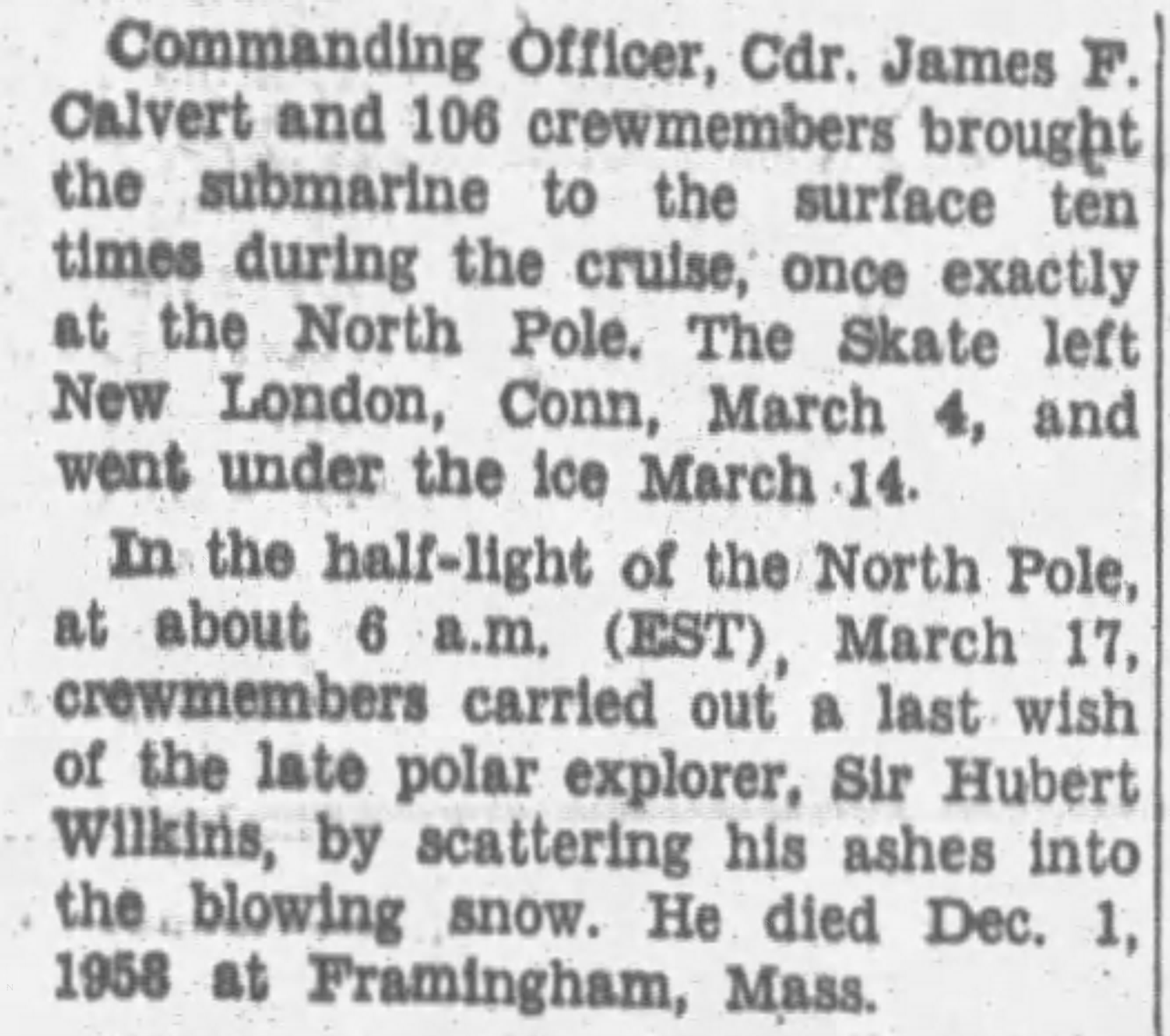
For decades, the story faded. Then, in the 1980s, Norwegian sonar picked up something strange in the fjord. The wreck was identified, photographed, and preserved in memory if not in museum. Wilkins, once mocked, was vindicated in death. In 1958, USS Nautilus SSN-571 succeeded where he had failed, crossing under the North Pole with nuclear power and silent grace. A year later, USS Skate surfaced at the Pole and scattered Wilkins’ ashes on the ice. His dream had finally come true.
The original Nautilus never fired a torpedo in anger. She won no battle stars. But she carried the weight of an impossible dream, borne on cold steel and stubborn will. For submariners, she is a relic worth remembering. Not for her victories, but for her audacity.
 Patrol Reports
Leave a comment