In June of 1963, at Dealey Plaza in Groton, Connecticut, Lt. Cmdr. Richard E. Munly stood before the 278th graduating class of the Navy’s Submarine School. Before him sat 310 sailors—one of the largest classes in the school’s distinguished history—eager and untested. Munly, then serving as the engineering and repair officer at the Submarine Base, offered measured words, seasoned with experience:
“You have successfully completed a hard schooling which is the first step toward one of the most coveted awards in the armed services—qualification in submarines.”
He reminded the graduates that the Submarine Force was undergoing tremendous changes—technologically, strategically, and culturally. Opportunity, he warned them, would not be handed to them, but it was there. “Take advantage of them,” he urged, as only someone who had.
From Portland to the Patrol

Richard Edmund Munly was born August 8, 1924, in Portland, Oregon, a first-generation submariner with old-world grit. He worked graveyard shifts in the Portland shipyards during WWII before being appointed to the U.S. Naval Academy. He graduated in 1948 and married his sweetheart Joanne later that same year. By 1951, he had earned his Dolphins and was posted aboard USS Piper and later USS Rock out of San Diego.
His early submarine career blossomed into a prestigious technical path: postgraduate study in mechanical engineering, a critical assignment to Admiral Rickover’s nuclear propulsion program at Oak Ridge, and hands-on engineering in one of the most transformative periods of naval history.
Captain of the Quillback


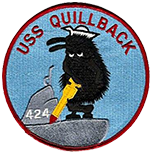
In 1961, Munly assumed command of USS Quillback (SS-424), a sleek Guppy II-class submarine fresh out of an extensive Charleston Shipyard overhaul. Under his leadership, Quillback deployed to the Mediterranean during the Cold War’s uneasy calm. More notably, in October 1962, she was stationed at Guantanamo Bay when the Cuban Quarantine—America’s sternest submarine chess move—was activated. For the first ten days of that nuclear standoff, Quillback stood ready.
During 1963, Munly’s command helped sharpen the Fleet Training Group at Guantanamo. He trained the men who would soon follow him beneath the surface. His own time undersea concluded with distinction, but his leadership echoed through the next generation of sailors who learned what it meant to serve below the waves.
Quiet Valor
Commander Munly retired from the Navy in 1973 and continued to serve in the defense industry until 1989. He passed away peacefully in Arlington, Virginia, on August 12, 2013, at the age of 89. He left behind his beloved wife of 64 years, four children, twelve grandchildren, six great-grandchildren, and a legacy rich with quiet valor.
Those of us in the USSVI and the Submarine Veterans of Bremerton remember him not only as the commanding officer of Quillback, but as a man who embodied the spirit of the Dolphin pin: competence, courage, and camaraderie. His stories—told with a punster’s flair—entertained his grandchildren. But it was his steady hand during uncertain waters that earned him our deepest salute.

 Patrol Reports
Leave a comment