
In the fog of the Atlantic and beneath the waves, a quiet revolution was underway. As the United States entered World War I in 1917, its submarine force was still in its infancy—limited in number, rudimentary in design, and scattered in command. The boats were short-ranged, poorly coordinated, and used mostly for coastal defense. But at the helm of its transformation stood a man few have heard of, yet whose legacy shaped the very heart of the Silent Service: Admiral Samuel Shelburne Robison.
A graduate of the U.S. Naval Academy in 1888 and a technical expert in wireless telegraphy, Robison entered World War I with a solid foundation in the very technologies that would make submarine warfare viable. In July 1917, he was appointed Commander of the Atlantic Submarine Force. Simultaneously, he became the General Supervisor of Submarines in Commission—a dual role that positioned him to centralize and redefine undersea operations.
At a time when submarine warfare was largely reactive and uncoordinated—with decentralized commands and minimal integration with surface fleet tactics—Robison brought structure. He reorganized the command hierarchy, implemented consistent training standards, and imposed accountability measures that laid the foundation for a modern submarine fleet. He didn’t merely command submarines—he engineered their future.
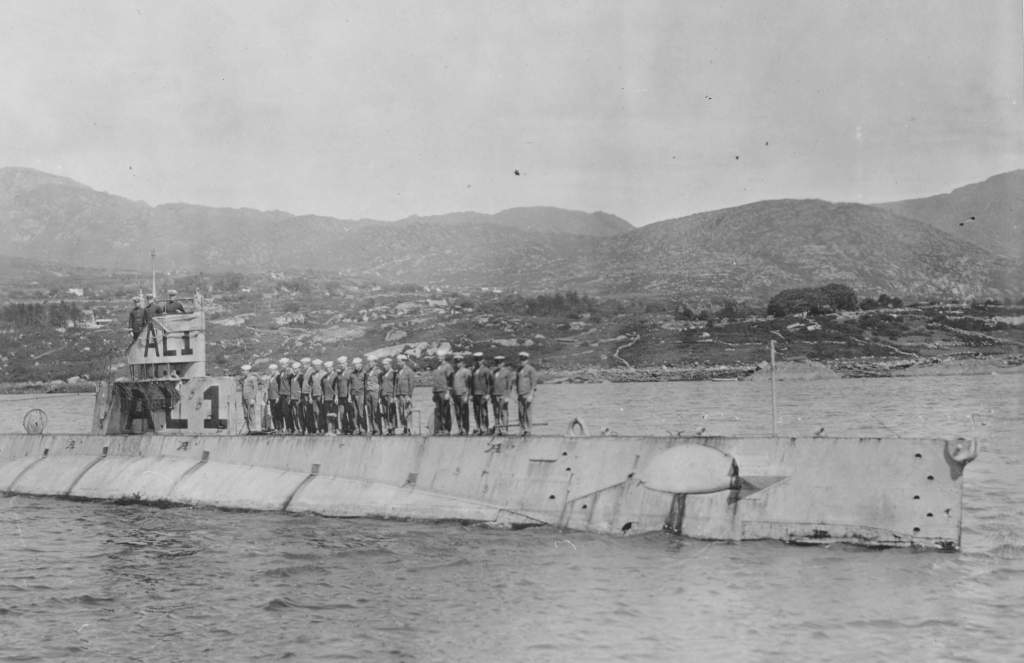
National Archives Identifier: 45513709 Local Identifier: 165-WW-338B-009
Photo courtesy of catalog.archives.gov
Under Robison’s leadership, the U.S. submarine force shifted from experimental operations to frontline relevance. He introduced tactical doctrines that emphasized coordinated patrol zones, systematic escort strategies for convoys, and offensive maneuvers into enemy-dominated waters. His vision extended beyond tactical orders—he saw submarines not just as hunters, but as part of a larger operational ecosystem.
Key Dates in Robison’s Submarine Career
May 10, 1867 – Born in Juniata County, Pennsylvania
1888 – Graduated from U.S. Naval Academy
July 1917 – Appointed Commander, Atlantic Submarine Force
Oct 1918 – Assumed command of Squadron 3, Patrol Force (France)
Mar 1919 – Returned to U.S. as Commandant of Boston Navy Yard
1928-1931 – Superintendent, U.S. Naval Academy
Nov 20, 1952 – Passed away in Chevy Chase, Maryland
He collaborated closely with British naval authorities, particularly Vice Admiral William Sims, who commanded U.S. naval forces in European waters. Together, they coordinated patrol schedules, adopted similar convoy protection schemes, and shared intelligence on German U-boat activity. Through this cooperation, Robison helped align American and Allied strategies, particularly in the North Sea and Atlantic theaters. His influence was evident in the deployment patterns that disrupted U-boat dominance and contributed to securing vital supply lines.
Robison’s technical background in wireless telegraphy proved instrumental. Author of the widely used Manual of Wireless Telegraphy for the Use of Naval Electricians, he understood that undersea warfare demanded not just stealth, but real-time communication. He implemented wireless protocols that enhanced situational awareness and responsiveness, bridging the isolation that plagued early submarine missions.
His wartime cablegrams, particularly those from September to November 1918, reveal a commander focused on detail, documentation, and discipline. In reports to Chief of Naval Operations Admiral William S. Benson, Robison outlined the operational status of submarines, personnel readiness, maintenance backlogs, and enemy contact data. These communications became the blueprint for postwar evaluations and improvements, including revised crew training protocols, sonar experimentation, and standardization of maintenance reporting.

When the war ended, Robison didn’t fade into obscurity. In 1919, he became Commandant of the Boston Navy Yard, where he directly oversaw refits and maintenance of the postwar submarine fleet. He later served on the Navy’s General Board and, from 1928 to 1931, as Superintendent of the U.S. Naval Academy—positions that allowed him to shape the next generation of submarine officers.
His critical evaluations of wartime submarine designs led to tangible improvements. The evolution from the O-class to the more robust S-class boats bore his strategic imprint. The S-class featured enhanced range, improved internal layout, and more reliable diesel engines. Robison advocated for longer-range capabilities, improved communication systems, and sturdier hull construction—all of which laid groundwork for the submarine force that would prove essential in World War II.
For his wartime service, Robison was awarded the Navy Cross and named an Honorary Companion of the Order of the Bath by the British government. In 1942, he was promoted to full admiral on the retired list, a final salute to a man whose vision had reshaped the undersea fleet.
Though his name is seldom listed among the more famous admirals of the 20th century, Samuel S. Robison’s influence runs deep—quiet as a submerged boat, and just as powerful. His fusion of technical mastery, operational foresight, and leadership below the headlines made him a true architect of the modern Silent Service. The systems he helped build still echo in the doctrine and discipline of today’s submarine force.
 Patrol Reports
Leave a comment