It was a moment unlike any the Pacific Northwest had seen before. On June 15, 1957, the USS Nautilus (SSN-571), the world’s first operational nuclear-powered submarine, paid a brief and unforgettable visit to Puget Sound. At the time, she was already a marvel of American engineering and naval ingenuity, a technological leviathan swimming in waters more accustomed to diesel haze and surface wakes. When she surfaced in Seattle later that day like “an unleashed whale,” the future had officially arrived.
But let’s rewind to where the day began, at the mouth of the Strait of Juan de Fuca. That morning, Nautilus glided silently beneath the waves along the coast, having departed New London, Connecticut, a month earlier on May 15 for an extended exercise and publicity tour in the Pacific. After transiting the Panama Canal and conducting maneuvers with the Pacific Fleet, the submarine’s voyage brought her northward to Washington state. The Evergreen State was no stranger to submarines, but this was no ordinary boat.
Her first and briefest stop was Everett, Washington.
Everett’s Brushed Glimpse
Anchored in Everett harbor for just two hours, Nautilus made no docking, no public tours, and extended no gangway. But her mere presence in Port Gardner Bay was enough to draw hundreds of onlookers. Local radio station KRKO had hyped the visit beforehand, and residents from all over Snohomish County flocked to the shoreline to catch a glimpse.
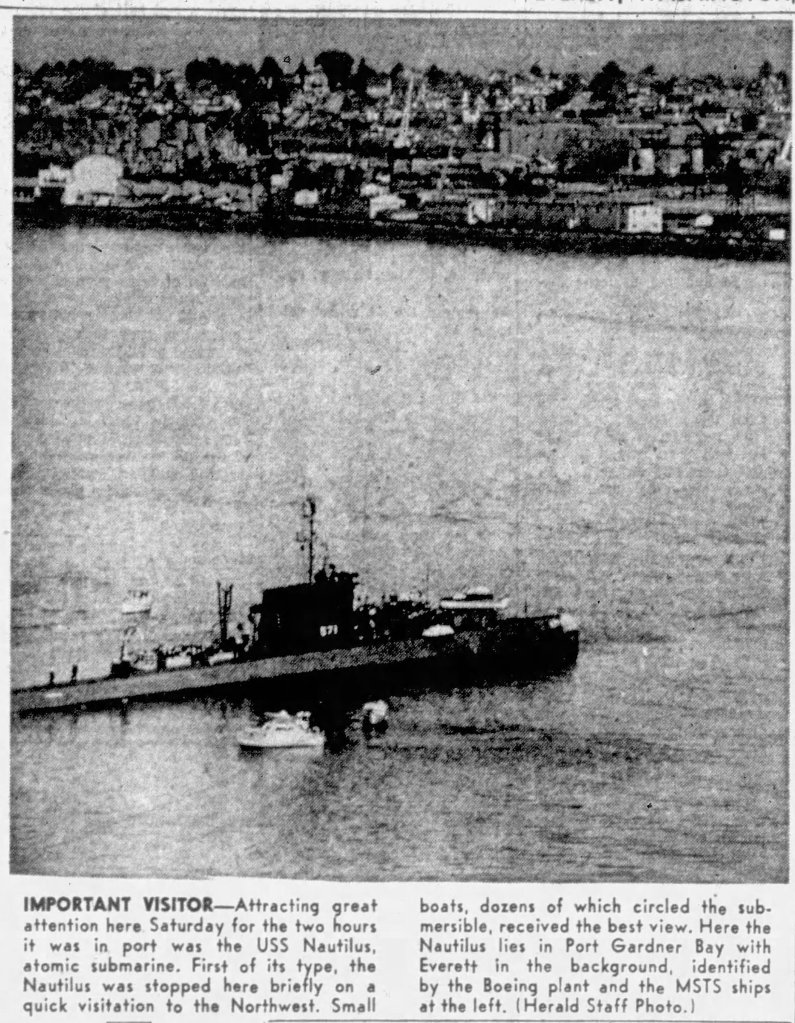
One of those onlookers, Cal Papritz, was just a teenager at the time. His memory of that day remained vivid decades later. In a later account for HistoryLink, Papritz recalled climbing into a small rowboat and paddling furiously toward the dark shape anchored offshore. As he got closer, he noticed sailors on deck, armed and watchful. A warning horn blared. Papritz veered off. The message was clear. Nautilus was here to be seen, but not touched.
Then, just like that, she was gone. The submarine departed Everett as swiftly and silently as she had arrived.
Senator Aboard, History Below
The next stop was Port Townsend, where Senator Henry “Scoop” Jackson of Washington boarded the submarine. A rising political star and an ardent supporter of naval strength, Jackson had taken a keen interest in Nautilus. His presence onboard that day symbolized more than political posturing. It was a full-throated endorsement of America’s investment in nuclear propulsion, a subject on which Jackson would become a national voice.

As Nautilus submerged into Puget Sound with Jackson aboard, she was preparing for one of the most dramatic public arrivals in Cold War naval history.
“Like an Unleashed Whale”
By the time she reached Seattle, Nautilus had gone from being an engineering marvel to a near-mythic creature. She surfaced suddenly and forcefully near Pier 91 in Elliott Bay, rising from the water with such vigor that eyewitnesses described it as “a whale breaching,” a mechanical beast greeting the skyline of the Emerald City.
Crowds along the piers, ferries, and shoreline erupted in cheers. For the average citizen, it was the closest they had ever come to the future of naval warfare. Unlike her World War II diesel-electric predecessors, Nautilus did not need to surface to recharge, did not need to refuel for months at a time, and could outpace nearly anything in the sea. In a single moment, the Navy had shown its cards and the game had changed.
While no official public tours were offered, the spectacle alone stirred patriotic pride and regional curiosity. This was more than a visit. It was a statement.
The Mission Beyond the Visit
The timing of Nautilus’ visit was no accident. Though she was still months away from her historic journey beneath the North Pole in 1958, her presence on the West Coast served a dual purpose. She was bolstering civilian morale and demonstrating to the Pacific Fleet the advantages of nuclear-powered platforms. Exercises conducted during this leg of her voyage helped refine operational doctrine for subs that could remain submerged indefinitely, travel faster than most surface vessels, and challenge the traditional model of undersea combat.

Nautilus had been conducting Pacific exercises throughout late May and early June. Her West Coast tour capped this phase and helped prepare both the boat and her crew for what would come next. She was getting ready to push the boundaries of what submarines could do.
By the end of June 1957, Commander Eugene P. Wilkinson, Nautilus’ first commanding officer, turned over command. His leadership during these formative years was foundational, both to the crew’s confidence and to the vessel’s reputation as a symbol of American innovation and naval dominance.
A Legacy Anchored in the Sound
For the submarine veterans of Kitsap, Bremerton, Bangor, and Keyport, that day serves as a quiet marker of transition. It was the moment when the undersea force we knew transformed into the Silent Service we recognize today.

This was not just another port call. It was the dawn of the nuclear age made manifest in our own waters. In many ways, her surfacing in Elliott Bay mirrored what was happening beneath the surface in the Navy. It marked the rise of a new kind of boat, a new kind of mission, and a new kind of sailor.
Today, Nautilus rests permanently at the Submarine Force Library and Museum in Groton, Connecticut. Her keel is intact, her legacy untarnished. But on June 15, 1957, for two hours in Everett and a sudden splash in Seattle, she belonged to us.
Sources
- HistoryLink Essay #23043 by Cal Papritz
- Naval History and Heritage Command, USS Nautilus (SSN-571) ship history
- Everett Herald archives, recollections from local witnesses
- Senator Henry Jackson Papers, University of Washington Libraries
 Patrol Reports
Leave a comment