The Author recalls: It was November of 1984, and my boat, the USS Michigan, was in Hawaiian waters conducting drills and training with other units, including several “Break Trail” exercises with two fast attack subs: the USS New York City and the USS Hawkbill.
I was in the final week of my ship’s quals, and for reasons I no longer recall, I was assigned to be in Control as a bearing plot recorder during the Break Trails. It sounds important—and I suppose in retrospect it might be—but in reality, it was just writing down a number (the bearing to a contact) every minute as it was called out. That meant I had a lot of time to just observe.
Which, as it turned out, was highly useful for my quals. I spent a full week in Control, watching and listening to how the ship functioned. I saw how all the systems communicated and worked together to become a complete warship. Later, I would tell Captain Conway that that week in Control was more valuable to me than any single checkout I had done. And I meant it.
Anyway, we were up against the Hawkbill when two moments stood out to me. Now, time and distance from any official records may have clouded the memory a bit, but this is what I remember from being in Control during those exercises.
In the first case, we had successfully broken Hawkbill’s trail early in the exercise. Captain Conway—being a bit of a pirate himself—turned the game on its head and decided we would try to track her. And we did.
As the clock wound down, we were close enough that he picked up the WQC and announced, “Tag! You’re it!”
In the second exercise—(it may have been New York City that time, the details blur)—something a bit wilder happened. As the COMEX announcement was made, the Captain took the Conn and ordered a turn to port with a five-degree left rudder.
He then ordered the 5-inch launcher room to fire every 15 seconds, alternating between water slugs and countermeasures, all set to activate at random intervals. As we began the turn, every quarter-minute brought a subtle thump from the launcher. By the time we had completed a full circle, the water behind us was a chaotic soup of noise makers and slugs.
The Captain then ordered rudder amidships, and we tooled off at Patrol Flank, leaving a symphony of distraction in our wake.
Apparently, the fast boat got wise and began to track us—until one of the countermeasures we had launched but that had failed to activate earlier suddenly went off well behind us. Dumb luck, really. But off went the fast boat chasing that ghost as we disappeared into the blue.
The Captain relinquished the Conn and we finished the exercise. Later, I heard through the grapevine that the late-firing countermeasure had thoroughly muddied the water and gave us the space we needed to slip away clean.
I always figured Captain Conway planned it that way. Then again, there is no way he could have known the timer would fail.
Could he?
Anyway, that was the best week of my ship’s qualifications, and it still sticks with me to this day—watching the nerve center of the boat orchestrate everything like an underwater symphony. It taught me a lesson I still apply: when learning something, do not just focus on the parts. Look at the big picture. See how it all works together.
And I was proud to be a part—a very small part—of it all.
Time passed. And then came the day Hawkbill went on her final mission. A proud boat that helped train us and served this nation well for twenty-eight years.
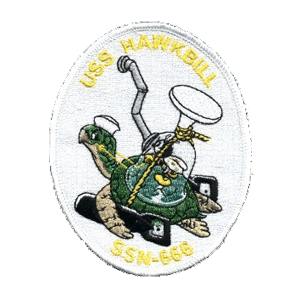
It was a beautiful, warm day in Pearl Harbor on March 18, 1999. Commander Robert Perry knew to savor the sun, because the USS Hawkbill (SSN-666) was heading north into a realm where anything above twenty below zero is considered a heatwave. This was not just another deployment. It was a farewell voyage. After nearly three decades of faithful service, the Hawkbill was bound for decommissioning. But before her final bow, she would take one last trip under the ice to serve science in one of the most unforgiving environments on Earth.
Hawkbill’s mission was SCICEX ’99, the last in a series of five scientific expeditions under the ice, a collaborative effort between the U.S. Navy, the National Science Foundation, and the Office of Naval Research. Nuclear submarines, silent and self-sustaining, proved to be the ideal tools for scientific discovery in the Arctic. They could glide beneath the pack ice for weeks at a time, unaffected by the surface chaos. But as the Navy prepared to retire its older Sturgeon-class boats, the window for this partnership was closing. The Hawkbill, nicknamed the “Devil Boat” thanks to her ominous hull number, would be the final undersea lab.
She left Pearl Harbor with a crew of veterans and a solemn honor: carrying the ashes of Dr. Waldo Lyon, the father of Arctic submarining. Lyon, who had pioneered the Navy’s ability to operate beneath polar ice, had passed away the previous spring. It was only fitting that his final journey should end at the North Pole.
Their path was far from easy. The transit through the Bering Strait was a gauntlet of shallow water and jagged, shifting ice. The average depth of just 160 feet left little margin for error. Ice ridges dangled beneath the surface like frozen daggers. Some ran from the ceiling to the sea floor, forcing the crew to snake the 292-foot submarine through slivers of safe water. Navigation became an orchestration of sonar readings, precision maneuvers, and constant vigilance. At times the Hawkbill had less than 20 feet beneath her keel and only 15 above her sail. The slightest misstep could have torn the submarine apart.
Inside the boat, the control room hummed with tension. The ice sonar operator hunted for gaps in the ceiling. The conning officer made minute corrections. The planesmen fought to maintain the exact angle and depth required for safe passage. There was no room for error, and yet the mood remained calm and focused. It was a ballet performed in total darkness beneath an alien sky.
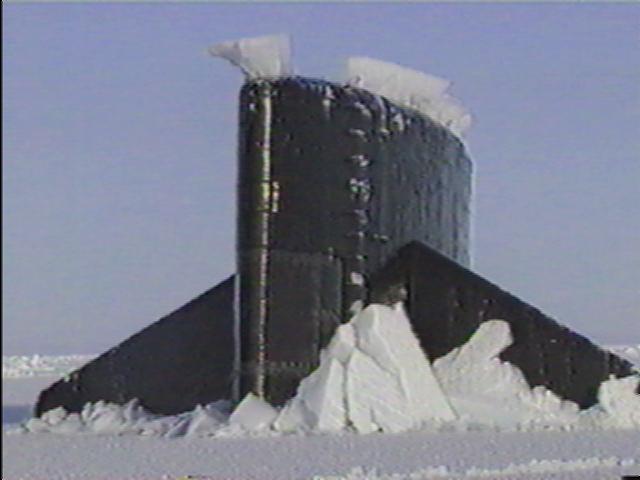
After more than a week of grinding progress, Hawkbill reached her first destination: Ice Camp Lyon, a surface station set up on the ice itself, named in Dr. Lyon’s honor. Here, she surfaced through the pack ice in a controlled, vertical ascent. Breaking through the three-foot-thick frozen crust, the submarine emerged into the polar daylight. Scientists, crew, and journalists disembarked. The temperature was around minus 20, with wind chills near minus 70. Yet the air was electric with excitement.
The ice camp allowed researchers to rotate in and out of the cramped submarine. Among those boarding were Dr. Margo Edwards from the University of Hawaii, the expedition’s chief scientist, and a media team from CNN and National Geographic. Fresh fruit and vegetables came aboard too, a luxury welcomed by the crew.
The scientific work focused on mapping the ocean floor and gathering data about water currents and ice formation. The Hawkbill had been fitted with SCAMP, a specialized sonar system mounted on her hull. It could penetrate two hundred meters into the seabed and map a swath of ocean floor ten miles wide. The results were stunning. Hawkbill charted glacial scours on the Chukchi Cap, uncovered dramatic cliffs on the Northwind Ridge, and discovered massive canyon systems formed during the last Ice Age.
In addition to the sonar work, the crew collected water samples and biological data. Using sensors mounted on the sail, expendable probes, and water bottles lowered through hatches, they gathered information on temperature, salinity, and current structure. Jellyfish floated by the upward-looking video camera. Each reading added to a growing understanding of how the Arctic Ocean functions, how it mixes with the Atlantic and Pacific, and how climate change might be altering that delicate balance.
May 3, 1999 – The nuclear-powered submarine Hawkbill (SSN-666) surfaces at the North Pole in the last joint Navy/National Science Foundation Science Ice Expedition.
– Naval History and Heritage Command
The journey continued eastward, down the Alaskan Shelf, where the submarine followed a sawtooth path to sample the water at different depths and locations. This work, tedious and time-consuming, offered crucial insight into the origins of water masses and the potential for biological activity in the frigid sea.
When the science was done, the Hawkbill made one final visit to Ice Camp Lyon to drop off her civilian guests. Then she turned south and began the long voyage home.
On August 27, 1999, at a ceremony in Pearl Harbor, the USS Hawkbill was officially inactivated. Deputy Secretary of Defense John Hamre was the guest speaker. Crew members from the original World War II Hawkbill attended, bridging two generations of silent service. Commander Perry reflected with pride. The Hawkbill had done something extraordinary. She had surfed the edge of danger beneath the Arctic pack ice not once, but twice, and brought back a treasure trove of scientific knowledge.
Six months later, on March 15, 2000, the Hawkbill was formally decommissioned and entered the Navy’s Ship and Submarine Recycling Program. Her sail now stands on display in Arco, Idaho, a monument to the men who served aboard her and the silent trail she blazed beneath the polar ice.
For the submariners who called her home, the Hawkbill will always be more than steel and systems. She was a ship of discovery, of danger, of pride. She proved that even in her twilight, a submarine could still lead the way into the unknown and return with something greater than victory.
She returned with understanding.
 Patrol Reports
Leave a comment