
When we talk about the legacy of the U.S. Submarine Force during the Second World War, we often gravitate toward the celebrated names—Tang, Wahoo, Barb. But woven just as tightly into the silent steel of America’s wartime submarine story is the USS Snook (SS-279), a Gato-class boat launched in 1942 that would go on to serve valiantly and vanish mysteriously in the closing months of the war. Her story begins with the hard-earned lessons of a young submarine fleet still feeling its way through the murky depths of undersea warfare.
The early 20th-century American submarine force was, to put it politely, experimental. The B-class boats of the first decade—small, short-ranged, and barely livable—were more testbeds than true warships. Powered by temperamental gasoline engines, they posed more danger to their own crews than to any enemy. But each class gave the Navy something to build on. Submarine development evolved rapidly. Design flaws were corrected, endurance was extended, and habitability improved. The Gato-class, into which Snook was born, was the Navy’s first true fleet submarine: fast, long-ranged, heavily armed, and robust enough to fight the long war across the Pacific. These boats had ten torpedo tubes, a 4-inch deck gun, anti-aircraft weapons, and could operate for 75 days at a stretch. They were a far cry from the early boats that could barely stay afloat for more than a few days without mechanical breakdowns.
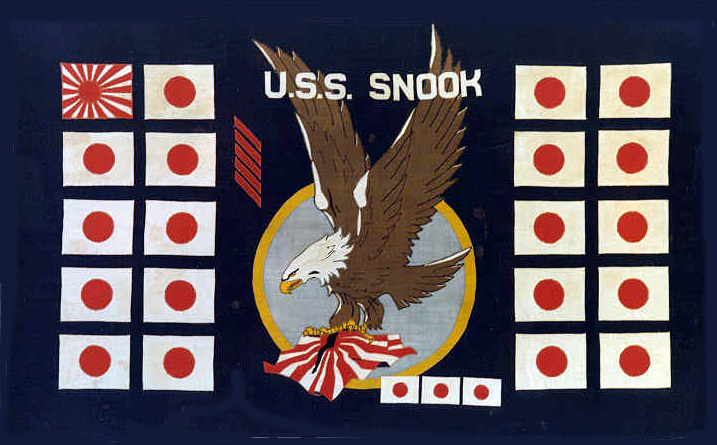
Commissioned on October 24, 1942, and built at Portsmouth Navy Yard, USS Snook began her career like many of her Gato-class sisters: quietly and lethally. From her first war patrol in the East China and Yellow Seas in April 1943, Snook made a name for herself. She planted mines off Shanghai, then sank multiple enemy vessels including Kinko Maru and Daifuku Maru within a single engagement. Over the course of her first five patrols, Snook tore through Japanese shipping routes with ruthless efficiency—sinking transports, gunboats, tankers, and freighters. Among her more deadly strikes was the sinking of Lima Maru during her fifth patrol in January 1944, with over 2,700 lives lost, one of the worst maritime casualties inflicted by a U.S. submarine.
Snook’s seventh patrol was notable not just for its combat achievements, but for its tragic irony. She sank the Arisan Maru—unaware it carried nearly 1,800 American POWs. The truth of that incident would not come to light until long after the war. By the time she completed her eighth patrol off the Kuril Islands in early 1945, her score stood at 17 confirmed enemy vessels sunk and another 10 damaged—a total tonnage of over 180,000 tons, making her one of the most successful U.S. submarines of the war by that metric.
Then came her ninth and final patrol.
On March 25, 1945, Snook, under the command of Commander John F. Walling, departed Guam alongside Burrfish (SS-312) and Bang (SS-385). The group was bound for the Luzon Strait, South China coast, and Hainan Island—waters crawling with Japanese warships, submarines, and aircraft. Snook returned briefly to Guam on March 27 for emergency repairs, then departed again on March 28 to rejoin the coordinated patrol. By April 1, her orders changed: she was instructed to join a new wolfpack under Commander Hiram Cassidy aboard USS Tigrone (SS-419), known as “Hiram’s Hecklers”.
A strange incident occurred on April 7. Cassidy’s Tigrone dodged two torpedoes from an unknown source. At first, he thought Snook had accidentally fired on him, but Snook reported that she had not launched any torpedoes. Cassidy then warned all boats in the area to be on the lookout—likely for a Japanese submarine. The next day, April 8, Snook radioed her position: 18°40’N, 111°39’E. That message was the last ever received from her.
On April 12, she was assigned lifeguard duty in support of British carrier strikes near Sakishima Gunto, about 200 miles east of Formosa. Orders were issued, but Snook never acknowledged them. On April 20, a British commander reported a downed aircraft in Snook’s patrol zone, but attempts to raise her by radio failed. USS Bang was sent to investigate. She rescued three downed aviators—but saw no sign of Snook.
When she had not reported in by May 16, Snook was officially declared overdue and presumed lost. The cause of her loss remains unknown. Several theories exist: that she was sunk by a Japanese submarine (possibly I-56), that she was caught in a minefield she knew existed but may have entered in a rescue attempt, or that she was bombed by a Japanese patrol plane and then depth-charged by enemy surface ships. None of these has been definitively proven. No wreck has ever been located, though a mysterious sonar contact off Iriomote Island in 1995 has raised speculation that her remains may rest in 1,100 feet of water—still unconfirmed.
Eighty-four men went down with her. Eighty-four families never heard their voices again. Their names are etched into memorials from Arkansas to Pearl Harbor. They include her skipper, Commander Walling, and sailors of every rank—from Chief Motor Machinist’s Mates to young Seamen Second Class. Men like Robert Wood and James Wright, the youngest officers aboard, and Paul Keiser, a machinist from Illinois just entering his twenties.
It is easy, perhaps too easy, to let the mystery of Snook define her. But the truth is, she was far more than her disappearance. She was a ship forged in war, a steel hunter that stalked the shipping lanes of the Pacific with deadly precision. Her crew were brave men who faced every danger the enemy—and the deep—could throw at them. They did not shrink from it. They met it head-on.
They were not forgotten. They never will be.
As long as American submariners sail the oceans, as long as there is a United States Navy, Snook will be remembered—not as a ghost, but as a symbol. Of sacrifice. Of silence. Of steel resolve. And of a brotherhood that runs deeper than the ocean that claimed her.
 Patrol Reports
Leave a comment