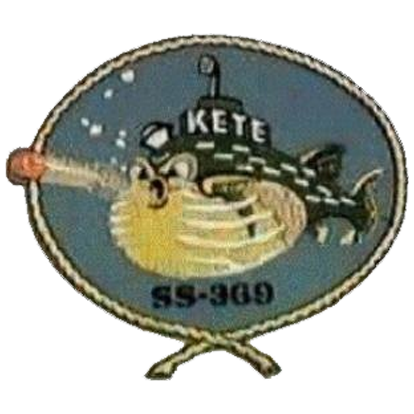
By March of 1945, the Pacific War was reaching its final, ferocious stages. The island-hopping campaign had brought American forces ever closer to the Japanese homeland, and the noose was tightening around the Empire of Japan. The skies above were thick with carrier-based aircraft, and beneath the waves, the silent hunters of the U.S. Navy submarines prowled the sea lanes, disrupting what little remained of Japan’s merchant fleet. Among these hunters was the USS Kete (SS-369), a Balao-class submarine that had already tasted action and was proving to be a formidable adversary beneath the waves.
Commissioned in July 1944, Kete was a relatively new addition to the silent service. She had embarked on her first patrol in November of that year, an uneventful venture into the East China Sea where the harsh reality of submarine warfare—long periods of tense, monotonous waiting punctuated by bursts of action—became all too clear. It wasn’t until her second patrol in early 1945, under the command of Lieutenant Commander Edward Ackerman, that she made her mark. Assigned to patrol the waters of the Nansei Shoto chain, Kete’s mission was twofold: to disrupt Japanese shipping and to provide vital weather reports for the planned invasion of Okinawa.
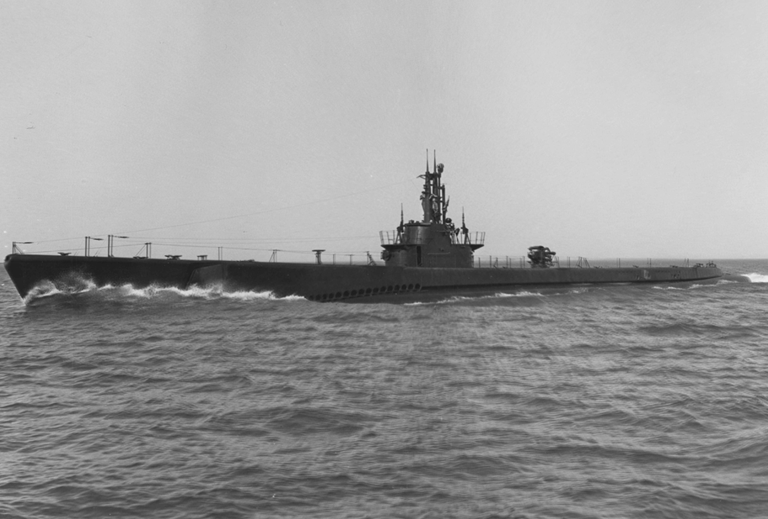
Kete’s second patrol was much more active than her first. On the night of March 9–10, she struck hard, torpedoing and sinking three medium-sized Japanese freighters, an impressive haul that added to the mounting pressure on Japan’s struggling supply lines. Just a few days later, on March 14, she fired four torpedoes at a Japanese cable-laying vessel, but this time, her quarry escaped unscathed. With only three torpedoes left in her arsenal, she was ordered to return to Pearl Harbor for refit, with a scheduled stop at Midway for refueling.
Her last known transmission came on March 20, 1945. Kete had acknowledged her orders the day before, and on that fateful day, she sent in a routine weather report from a position at latitude 29°-38’N, longitude 130°-02’E. After that, silence. The submarine, her crew of 87 men, and her steel hull vanished into the abyss, never to be seen or heard from again.
Theories abound as to what happened to USS Kete. Japanese naval records provide no definitive answers. None of the known anti-submarine attacks recorded between March 20 and March 31 were in Kete’s area of operation, ruling out the possibility of a depth charge or aerial assault. Mines were also a possibility, but Kete had already passed beyond the known minefields of the Nansei Shoto chain by the time she sent her last message. That left one chilling probability: another submarine.
Japanese submarines were still active in the area, despite their dwindling numbers. One in particular, RO-41, was operating in Kete’s vicinity on March 20. Some Western sources speculate that this Japanese Kaichū-type submarine may have been responsible for sinking Kete, but the evidence is thin. RO-41 was itself sunk three days later by U.S. destroyers, and there is no record of it ever reporting an attack on an American submarine. Had Kete fallen victim to a torpedo strike from an unseen enemy, her assailant may have gone to the bottom before ever transmitting news of the kill.
In the years since, various attempts have been made to locate the wreck of USS Kete. A tantalizing lead surfaced in 1995 when a deep-sea dive off Iriomote Island—the far southwest of the Okinawa chain—yielded sonar contacts of a large, unexpected structure. Divers operating a U.S.-made “SCORPIO” ROV detected what appeared to be a submarine lying at a 20-30 degree angle, partially buried in sediment at a depth of approximately 1,148 feet. The discovery was intriguing, but no follow-up expeditions were ever conducted. Some researchers argue that the wreck could belong to USS Snook, another submarine lost in April 1945, but Snook was believed to have been lost off the coast of China, not near Okinawa. If the wreck off Iriomote is indeed a U.S. submarine, there is a strong possibility it could be Kete.
The loss of USS Kete remains one of the enduring mysteries of the U.S. submarine service in World War II. Unlike other boats that went down in known engagements, her fate is speculative, her wreck still waiting to be conclusively identified. What is certain, however, is the bravery of the 87 men aboard her, men who sailed into the deep blue unknown, striking the enemy where it hurt most, never to return. Their names are etched in memorials, their service honored by generations of submariners who followed in their wake. The silence of the deep may have swallowed Kete whole, but the legacy of her crew endures, a reminder of the perilous service undertaken by the silent sentinels of the sea.
Somewhere in the vastness of the Pacific, USS Kete still rests, entombed in the ocean’s cold embrace. Whether claimed by a hidden enemy, an unseen mine, or a cruel twist of mechanical fate, she remains on eternal patrol, another ghost in the long history of those who fought beneath the waves.
 Patrol Reports
Leave a comment