Howard Gilmore had always been a man of the sea. Born in Selma, Alabama, in 1902, he was drawn to the Navy early, enlisting in 1920 and earning an appointment to the U.S. Naval Academy two years later. He wasn’t just another midshipman—he stood out, graduating in 1926 and beginning a career that would lead him to command in the silent service, where men fought unseen beneath the waves. His early service saw him posted to the battleship USS Mississippi, but it was under the surface, in the cold steel belly of a submarine, that he found his calling.
The USS Growler (SS-215) was his command. A Gato-class submarine commissioned in 1942, she was built for stealth, for patience, and for striking hard when the time came. When the war in the Pacific erupted, Gilmore and Growler were thrust into the action, operating out of Pearl Harbor. Her first war patrol took her north, where she proved herself by sinking a Japanese destroyer and damaging two others off Kiska in the Aleutians. By the time 1943 rolled around, Growler had already earned a fierce reputation, hunting Japanese shipping in the waters near Taiwan and Truk, sending enemy vessels to the bottom while evading the relentless counterattacks of depth charges and aerial patrols.
By February 1943, the strategic situation was shifting. The Solomon Islands campaign was well underway, and the Japanese, though battered, were still running critical supply convoys to support their embattled forces. American submarines, the unseen predators of the Pacific, were tasked with strangling that supply line, cutting off reinforcements, food, and ammunition. Growler, on her fourth war patrol, was part of that effort. Gilmore and his crew had already sunk a 6,000-ton enemy vessel in January, and the Growler was prowling near Rabaul and Truk, looking for more prey.
The night of February 6/7, 1943, passed like so many before, the submarine running on the surface to charge her batteries, the crew maintaining their usual watch. As dawn approached on February 7, Growler sighted a small enemy vessel, the 900-ton Japanese gunboat Hayasaki, a provision ship that carried vital supplies but was also well-armed. Gilmore, never one to back down from a fight, ordered the boat into position for a surface attack.
The plan unraveled almost immediately. Whether by sheer luck or a sharp-eyed watchstander aboard Hayasaki, the enemy ship spotted Growler and took action. Instead of waiting for the inevitable torpedo, Hayasaki swung about and bore down on the submarine, determined to ram. It was a desperate move, but one that could prove fatal for a vessel as vulnerable as Growler when caught on the surface.
Gilmore shouted the order—”Left full rudder!”—but there was no time. At 17 knots, Growler slammed into the enemy gunboat amidships, the impact sending a shudder through the steel hull. The bow twisted, crumpling under the force of the collision, rendering the forward torpedo tubes useless. And then came the machine gun fire.
From point-blank range, the Japanese gunners raked Growler’s bridge with a storm of bullets. Ensign William Wadsworth Williams, the junior officer of the deck, was cut down instantly. Fireman Wilbert Fletcher Kelley, a lookout, was also killed. Gilmore took multiple hits, staggering but still on his feet, gripping onto the frame of the periscope shears. Two more men were wounded, chaos reigning as the submarine listed from the collision.
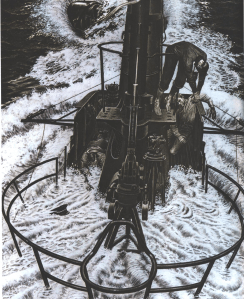
Drawing by Lt. Cmdr. Fred Freeman, courtesy of Theodore Roscoe, from his book “U.S. Submarine Operations of WW II”, published by USNI. – NAVSOURCE
He knew what had to be done. The only chance for Growler‘s survival was to submerge, but Gilmore, bleeding out, realized he wouldn’t make it below in time. If he delayed, the entire submarine could be lost. He did not hesitate. “Take her down!” he shouted.
His executive officer, Lieutenant Commander Arnold Schade, hesitated. Gilmore was still on the bridge. But the order was clear. With a heavy heart, Schade obeyed. He sealed the hatch and gave the command. Growler slipped beneath the waves, leaving her captain behind.
Gilmore was never seen again.
The submarine, battered but afloat, managed to limp back to Brisbane, arriving on February 17, 1943. The men who owed their lives to their captain’s sacrifice knew what he had done for them. His heroism was recognized in the highest way possible—he was posthumously awarded the Medal of Honor. His citation told the story in stark, heroic clarity: he had given his life so that his men might live, making the ultimate sacrifice.
The Navy would not forget Howard Gilmore. His name was given to the submarine tender USS Howard W. Gilmore (AS-16), and his legacy was immortalized in submarine lore. His final order, “Take her down,” remains one of the most legendary phrases in the history of the Silent Service, a testament to the selfless bravery that defines those who take their war beneath the sea.
As for Growler, she would fight on under new command. She continued her war patrols, hunting Japanese convoys and playing her role in the relentless American submarine campaign that strangled Japan’s supply lines. But the sea had one final fate in store for her. On November 8, 1944, during her eleventh patrol, Growler and her wolf pack engaged another enemy convoy. The order to attack was the last transmission ever received from her. She vanished beneath the waves, never to return. Whether she fell victim to an enemy depth charge, a torpedo failure, or a tragic accident, no one will ever know. Her crew remains on eternal patrol.
Howard Gilmore’s story is one of devotion—not to glory, but to his men, to his duty, to the belief that no sacrifice was too great if it meant saving his shipmates. It is the kind of story that resonates across the generations, a reminder that courage is not just found in grand battles, but in the moments of quiet, gut-wrenching decision, where a single command means the difference between life and death. His story lives on, in the annals of submarine history, in the whispered prayers of those who sail beneath the waves, and in the solemn words etched into the legacy of the United States Navy: “Take her down.”
 Patrol Reports
Leave a comment