In the early 20th century, the U.S. Navy was taking its first daring steps into the unknown realm of submarine warfare. These undersea vessels were cramped, untested, and dangerous, but they represented a bold new chapter for the Navy’s evolving Silent Service. Among the pioneers of this era was the USS F-1 (SS-20), originally named Carp. At just 142 feet long and displacing 330 tons, she was small by today’s standards but sturdy and agile, a formidable achievement for her time. Laid down in 1909 at Union Iron Works in San Francisco, she was commissioned on June 19, 1912. Her crew—volunteers to an unknown life beneath the waves—would navigate new technology, constant risk, and a sea of uncertainty.

The F-1 was one of four F-class submarines, a developmental step in submarine design as the Navy worked to refine its undersea capabilities. She spent her early service assigned to the First Submarine Group, Pacific Torpedo Flotilla, operating along the California coast. Her career was marked by both progress and peril. While testing her capabilities, the F-1 set a deep-diving record of 283 feet, a milestone that proved the durability of her design but pushed her small crew into harrowing and uncharted depths. Still, life aboard was harsh. The air was stale, the quarters claustrophobic, and the smell of diesel fuel inescapable. The crew’s job required skill, courage, and no small measure of luck.
The F-1 and her sister submarines also took part in historic operations. In 1914, she was towed—alongside her sister boats—by armored cruisers to Hawaii, where they conducted exercises in the waters around Honolulu. These deployments were critical for testing submarine endurance and establishing a U.S. presence in the Pacific, a region where tensions were slowly simmering. However, accidents loomed over this early period of submarine experimentation. At one point in her career, the F-1 slipped her moorings while docked in Monterey Bay and grounded on a nearby beach. Though most of the crew escaped safely, the incident claimed two lives, a grim reminder of the risks that early submariners faced even during routine operations.
By late 1917, the United States was fully engaged in World War I. The lessons learned from boats like the F-1 were vital as the Navy began refining submarine tactics, training, and technology. On December 17, 1917, during training maneuvers off Point Loma near San Diego, California, the F-1 and her sister ship F-3 were running on the surface in close formation. What began as a routine exercise turned catastrophic in seconds. Whether it was a breakdown in communication, poor visibility, or a lapse in judgment, the two submarines suddenly crossed paths. The F-3 rammed the F-1 on her port side, tearing a massive hole forward of the engine room.
The damage was catastrophic. The F-1 began to flood immediately, her small hull no match for the force of the impact. In a matter of ten seconds—an eternity in such a crisis—the submarine disappeared beneath the waves. Nineteen men were lost, trapped inside as the sea claimed the vessel. Only five crew members survived, saved by the fact that they had been stationed topside at the moment of impact. The survivors were rescued by nearby submarines, their shock and grief etched into their faces as they watched helplessly while their shipmates disappeared into the cold depths.
The F-3, though damaged, remained afloat and managed to limp back to port. In the aftermath of the collision, questions arose. How could two submarines, running together during exercises, collide so disastrously? The exact cause was never fully resolved, but the loss of the F-1 underscored the dangers of early submarine operations. Crews operated in a world with no room for error, where every maneuver, every calculation, could mean the difference between life and death.
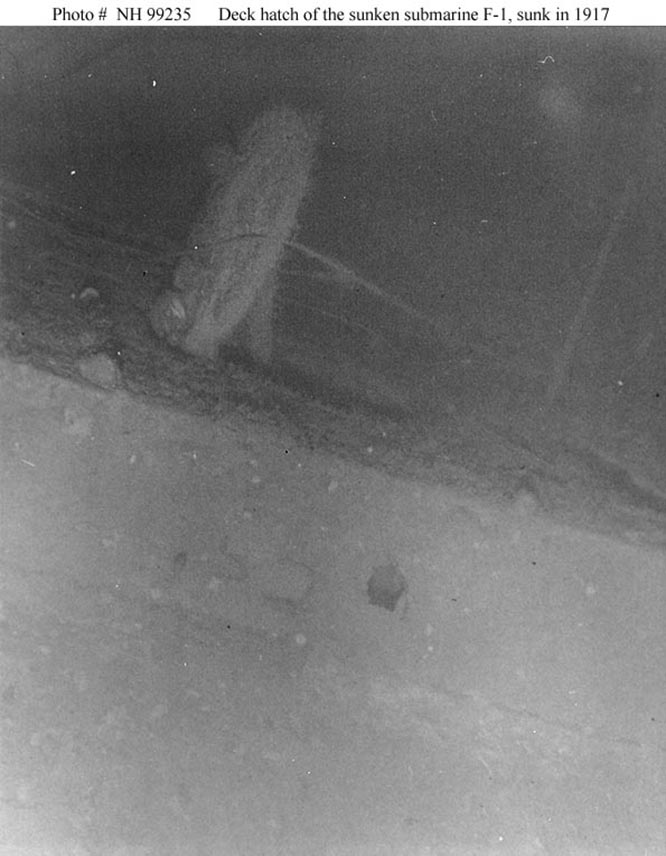
For decades, the USS F-1 remained lost beneath the waves, forgotten except in the memories of her crew’s families and the records of a Navy still learning from her sacrifice. Then, in October 1976, nearly 60 years later, the Navy rediscovered her wreckage while searching for a downed F-4 Phantom jet off La Jolla, California. The Navy located the F-1 resting quietly at 1,439 feet below the surface. Her hull lay on its starboard side, a gaping hole marking the spot where the collision had doomed her. She was left undisturbed, declared a war grave by the Navy. Captain Willard Johnson of Submarine Development Group I said it best: “It will remain the grave of 19 men. There is no reason at this time to bring it up.”
The loss of the USS F-1 is a poignant reminder of the sacrifices made by early submariners—men who volunteered for an uncertain life beneath the sea, testing the limits of both technology and human endurance. They served at a time when the Silent Service was still in its infancy, when each dive into the depths represented a leap into the unknown. Every mission, every maneuver came with the knowledge that a single mistake or unforeseen event could be fatal.
Yet their sacrifices were not in vain. The lessons learned from boats like the F-1 shaped the development of submarines that would one day patrol the world’s oceans as key instruments of naval power. By World War II, submarines had become the vanguard of American naval strategy, wreaking havoc on enemy supply lines and playing a decisive role in the Allied victory. None of this would have been possible without the courage and sacrifice of the crews who came before, men like those aboard the F-1.
For U.S. submarine veterans and historians alike, the F-1 is more than just a forgotten relic of naval history. She represents the price of progress, the dangers of innovation, and the unbreakable bond between submariners—past and present. Her story reminds us of the bravery required to serve in the Silent Service and the risks that come with exploring uncharted waters. The men of the F-1, who gave their lives in an era of trial and error, remain an indelible part of that legacy.
The USS F-1 SS-20 On Eternal Patrol Listing
 Patrol Reports
Leave a comment