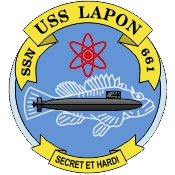
 On a crisp winter day in Newport News, Virginia, the USS Lapon slid into the water, marking the arrival of one of the most advanced submarines of its time. Built as a Sturgeon-class attack submarine, Lapon embodied the technological innovations that redefined undersea warfare in the nuclear age. Its motto, Secret et Hardi—“Silent and Strong”—encapsulated the ethos of the men who would take it into the depths. Sponsored by Mrs. Charles D. Griffin, the Lapon became an integral player in America’s underwater chess game with the Soviet Union.
Commissioned in December 1967, Lapon quickly proved its mettle. Early readiness evaluations demonstrated the submarine’s operational capabilities, paving the way for its entry into classified missions. By 1968, Lapon was already making waves—literally and figuratively—earning a Meritorious Unit Commendation for its early missions.

The Lapon’s breakthrough moment came in 1969 under Commander Chester “Whitey” Mack. Tasked with the high-stakes mission of trailing a Soviet Yankee-class ballistic missile submarine, the crew of the Lapon executed one of the most impressive tracking feats in Cold War history. For 47 days, they shadowed the Soviet sub through its entire deterrent patrol. The operation, requiring unparalleled stealth and precision, culminated in Lapon earning a Presidential Unit Citation, a rare honor for submarines. Commander Mack, hailed as a tactical genius, received the Distinguished Service Medal, cementing his place in submarine lore.
The 1973 Yom Kippur War found Lapon stationed in the Mediterranean, poised to monitor Soviet naval activity. As tensions flared, the submarine played a pivotal role in intelligence-gathering operations. The crew’s resilience was tested as they extended their deployment to 44 days, surviving on dwindling supplies and enduring repeated viewings of Dirty Harry—the sole tolerable movie among their limited onboard collection. The mission set a record for trailing Soviet submarines and earned the crew yet another Navy Unit Commendation.
Lapon wasn’t just a workhorse; it was a pioneer. Over the years, the submarine’s missions included everything from Arctic expeditions to anti-submarine warfare exercises. Its technical capabilities, powered by the S5W2 nuclear reactor, enabled it to dive deeper and remain submerged longer than its predecessors. Lapon’s achievements were reflected in its extensive list of accolades, including multiple Meritorious Unit Commendations, Navy Battle “E” awards, and the prestigious Arctic Expedition Ribbon during Ice Exercise 1988.
One of Lapon’s defining features was its exceptional crew culture. Submarine service demands extraordinary teamwork, and Lapon’s sailors consistently rose to the occasion. The camaraderie, forged in the confined quarters of a 292-foot vessel, was bolstered by shared victories and mutual respect.

Decommissioned in 1992, the USS Lapon’s journey did not end with its scrapping. In a fitting tribute to its storied career, the submarine’s sail was preserved and now stands as a war memorial at American Legion Post 639 in Springfield, Missouri. Dedicated in 2005, the memorial serves as a reminder of the submarine’s contributions and the sacrifices of its crew.
The Lapon’s history is a microcosm of the Cold War’s undersea battles—silent, high-stakes conflicts fought by men whose courage and expertise often went unheralded. For submarine veterans and history enthusiasts alike, the USS Lapon symbolizes the enduring spirit of the Silent Service, proving that strength lies not in volume, but in resolve.
 Patrol Reports
Leave a comment